Key Highlights
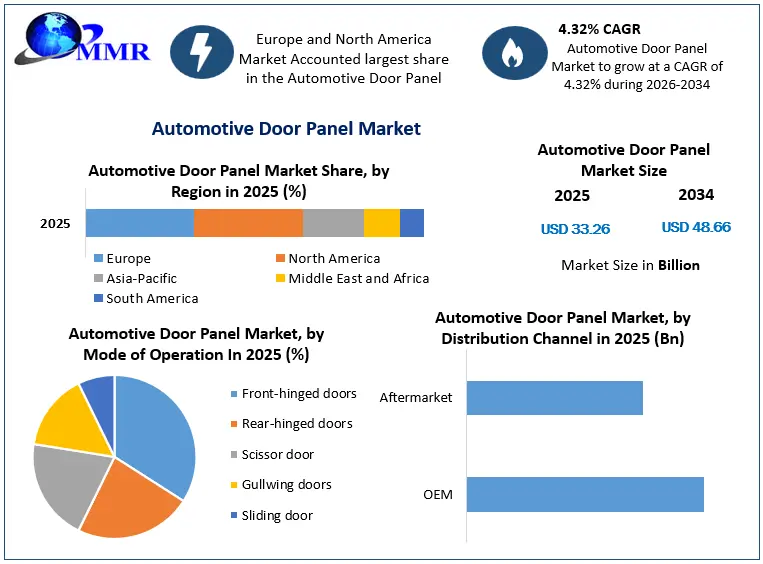
Automotive Door Panel Market valued at USD 33.26 Bn in 2025, expected to reach USD 48.66 Bn by 2034, at a CAGR of around 4.32%.
Door panels evolve from simple trims to complex modules integrating electronics, switches, speakers, airbags, storage and lighting.
Rising demand for premium, soft‑touch interiors and improved NVH drives material and design innovation in door panels.
Lightweight materials—plastics, composites and advanced substrates—are increasingly used to reduce vehicle weight and improve fuel economy or EV range.
Growth is supported by increasing vehicle production and strong demand from Asia Pacific and other major automotive hubs.
Why This Matters Now
OEMs and Tier‑1 suppliers face a strategic squeeze: consumers demand premium, tech‑rich interiors while EV and emissions targets demand weight reduction and cost discipline. A USD 48.66 Bn door panel market growing at 4.32% CAGR is where these tensions collide, because every vehicle, ICE or EV, carries multiple door panels.
If OEMs treat door panels as commodity trim, they risk falling behind in perceived quality, HMI integration and acoustic comfort. For investors and regulators, the way door panels evolve—material choices, embedded electronics, recyclability—signals how fast the industry is retooling for electrification, safety and sustainability.
Market Overview
Automotive door panels are structural and decorative elements mounted inside the door that house switches, armrests, storage, speakers and often side airbags. They serve both functional and aesthetic roles, influencing ergonomics, safety, NVH performance and perceived interior quality.
The Automotive Door Panel Market, as measured by Maximize Market Research, was valued at USD 33.26 Bn in 2025 and is projected to reach USD 48.66 Bn by 2034, reflecting a CAGR of around 4.32% during the forecast period. Growth tracks overall vehicle production and the trend toward higher‑value interiors, particularly in SUVs, crossovers and premium segments.
Door panel design is shaped by multiple forces: electrification, which shifts door electronics and wiring demands; safety regulations, which dictate side‑impact performance; and customer expectations for soft‑touch surfaces, ambient lighting and seamless integration with digital interfaces. These requirements collectively push up the content value per panel.
Key Trends Driving Growth
Premiumization and Interior Experience
Consumers increasingly use interior quality, fit and finish as key purchase criteria, especially as EV powertrain differences become less visible. Door panels are front‑line touchpoints: they carry armrests, grab handles, trim inserts, fabrics, and accent lighting that define the cabin’s perceived value.
OEMs are responding by upgrading materials from hard plastics to soft‑touch surfaces, leather, high‑grade vinyl and decorative elements. This premiumization increases the value and complexity of door panels, lifting revenue per vehicle and opening differentiation opportunities for suppliers that can deliver both upscale aesthetics and durability.
Lightweight Materials and Efficiency
Regulations on emissions and CO₂ targets, along with EV range requirements, force OEMs to search for every kilogram of weight reduction. Door panels contribute by moving from heavy, multi‑piece assemblies to lightweight plastics, composites and optimized structures that maintain strength while cutting mass.
Lightweight door panels also support improved crash performance and NVH when combined with advanced fillers and foams. Tier‑1 suppliers capable of engineering lighter yet stiffer panels gain an advantage as OEMs redesign doors for EVs and advanced safety structures.
Electronics and ADAS Integration
Door panels increasingly host electronics: window and mirror switches, seat memory controls, ambient lighting, speakers, and in some cases, capacitive touch surfaces and ADAS‑related alerts. As vehicles add more functions to the door—such as blind‑spot warning indicators or door‑open alerts—the panel becomes a critical HMI and wiring hub.
This integration complicates design and manufacturing, as panels must manage wiring harnesses, connectors and mounting structures while still meeting crash and NVH targets. Suppliers that master electronics integration and modular design can reduce assembly complexity and warranty risk for OEMs.
Request a Free Sample Copy or View Report Summary: https://www.maximizemarketresearch.com/request-sample/29967/
Segment Insights
Dominant Segment – Not Explicitly Stated
The Maximize Market Research report segments the market by material, type, vehicle type and region, but the information at hand does not specify which segment is dominant by revenue or volume. In line with the source rule, no additional claims are made on the leading segment.Fastest-Growing Segment – Not Explicitly Stated
Similarly, while EVs and premium vehicles are likely to shift content in door panels, the report extract does not identify the fastest‑growing segment, so no inference is added.From an industry perspective, passenger vehicles—especially SUVs and crossovers—generate high door panel volumes, while premium and luxury segments drive higher content per door via materials and electronics. Commercial vehicles emphasize durability and functional storage, creating a different design and cost profile.
Regional Growth Story
The Automotive Door Panel Market spans key automotive manufacturing regions: Asia Pacific, Europe, North America and others. Asia Pacific, led by China and India, is a major contributor due to large vehicle production volumes and rising demand for feature‑rich vehicles. Growing middle‑class incomes and a preference for SUVs further lift interior content in these markets.
Europe and North America also provide strong demand, with established OEMs pushing premium interiors, advanced safety features and high levels of electronic integration. Regulatory focus on safety, recyclability and material emissions (VOC) in these regions influences door panel design and material selection.
Emerging markets in Latin America and the Middle East & Africa show slower but steady growth, depending on macroeconomics and vehicle import/production patterns. In these regions, cost sensitivity means door panel upgrades often focus on durability and basic comfort rather than high‑end materials or complex electronics.
Competitive Landscape
The door panel market features global Tier‑1 suppliers and regional specialists. Leading players typically offer complete interior systems—dashboards, door panels, consoles—and leverage integration to win platform programs. Their competitiveness hinges on design, materials engineering, manufacturing footprint and cost management.
As OEMs globalize platforms, they prefer suppliers capable of delivering consistent quality across plants and regions. This dynamic favors larger Tier‑1s with multi‑regional production and strong engineering resources, while smaller players may focus on niche segments or regional OEMs.
The shift toward lightweight materials, electronics integration and sustainability raises the bar for entry. Suppliers must manage complex supply chains—from plastics and textiles to adhesives and electronic components—while ensuring fit, finish, and noise performance in increasingly quiet EV cabins.
Recent Developments
Interior Upgrades in Volume Segments
OEMs are extending premium interior features—soft‑touch panels, stitching, decorative inserts—into mid‑segment vehicles, lifting average door panel value. This trend is particularly visible in Asia Pacific and Europe, where competition is intense and interior experience is a key differentiator.Adoption of Lightweight and Recyclable Materials
Door panel programs increasingly reference lightweight substrates and recyclable materials to support OEM sustainability goals and comply with regulations on material recovery. This includes greater use of plastics, composites, and in some cases natural fibers or recycled content.Integration of Ambient Lighting and Sound Systems
OEMs and Tier‑1s are adding ambient lighting strips and improved speakers into door panels to create more immersive in‑car experiences. This pushes suppliers to refine acoustic tuning, wiring integration and assembly processes at scale.
Strategic Implications
For OEMs, the door panel is now a strategic HMI and brand canvas as much as a structural component. Cross‑functional decisions—design, electronics, safety, manufacturing—converge here, making supplier selection and platform strategy critical. Aligning door panel design with EV architectures and ADAS strategies will influence customer perception and assembly complexity.
Tier‑1 suppliers must decide where to compete: high‑content premium panels, cost‑optimized mass‑market panels, or modular systems with integrated electronics. Investments in materials R&D, tooling flexibility and electronics integration will determine who can respond quickly to platform refreshes and EV‑specific requirements.
For investors and regulators, door panel evolution offers a window into broader industry shifts: rising cabin digitalization, stricter safety and sustainability standards, and the move to lighter structures across ICE and EV fleets. Companies that innovate on materials, design and recycling can turn regulatory pressure into competitive advantage.
Future Outlook
With the Automotive Door Panel Market projected to grow from USD 33.26 Bn in 2025 to USD 48.66 Bn by 2034 at a 4.32% CAGR, interior systems will remain a key battleground for differentiation and value capture. As powertrains converge around electrification and ADAS spreads across segments, the cabin—and with it, the door panel—becomes a primary field for brand expression and customer experience.
Future leaders will be OEMs and suppliers that treat the door panel as a high‑value, multi‑functional module—combining lightweight structures, premium surfaces and smart electronics—while laggards will be those that continue to manage it as a low‑complexity trim piece and miss the shift in value and expectations.
Related Reports
Global Pneumatic Marine Fender Market https://www.maximizemarketresearch.com/market-report/global-pneumatic-marine-fender-market/75368/
Global High-performance Tires Market https://www.maximizemarketresearch.com/market-report/global-high-performance-tires-market/120926/
Wave Sensors and Modules Market https://www.maximizemarketresearch.com/market-report/mmwave-sensors-and-modules-market/126654/
Analyst Perspective
“The Automotive Door Panel Market is a quiet but crucial battleground where interior experience, lightweighting and electronics all meet,” “With the market set to rise from USD 33.26 Bn to USD 48.66 Bn by 2034, the winners will be Tier‑1s and OEMs that turn door panels into smart, lightweight, premium modules rather than treating them as commodity trim.”-Tejaswini Kakade
About Maximize Market Research
Maximize Market Research Pvt. Ltd. (MMR) is a global market research and consulting company that provides reliable, data-focused, and practical business insights. The firm serves a wide range of industries, including healthcare, pharmaceuticals, technology, automotive, electronics, chemicals, personal care, and consumer goods. Through market forecasts, competitive analysis, strategic consulting, and industry impact assessments, MMR helps organizations understand changing market conditions, identify growth opportunities, and make informed business decisions for long-term success.
2nd Floor, Navale IT Park Phase 3
Pune Banglore Highway, Narhe
Pune, Maharashtra 411041, India
+91 9607365656
sales@maximizemarketresearch.com
