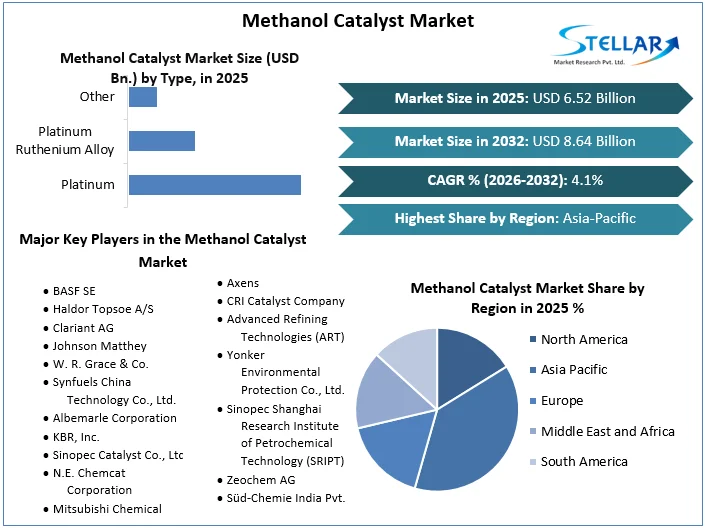
The Methanol Catalyst Market was valued at USD 6.52 Bn in 2025 and is projected to reach USD 8.64 Bn by 2032, growing at a CAGR of 4.1 % during the forecast period. Rising demand for methanol across the chemical, energy, and transportation sectors, coupled with ongoing advancements in catalyst technology, is expected to support long-term market expansion.
The global chemical industry is undergoing a major transformation as manufacturers focus on improving production efficiency, reducing carbon emissions, and adopting cleaner industrial processes. Methanol has emerged as one of the most versatile chemical feedstocks, playing a critical role in producing formaldehyde, acetic acid, olefins, fuels, and numerous downstream chemicals. At the center of this production process are methanol catalysts, which enable efficient chemical reactions while enhancing productivity and minimizing energy consumption. As industries increasingly invest in sustainable manufacturing and alternative fuels, the Methanol Catalyst Market is witnessing steady growth worldwide.
Download Free PDF Brochure: https://www.stellarmr.com/report/req_sample/Methanol-Catalyst-Market-/1457
Understanding Methanol Catalysts
Methanol catalysts are specialized materials used to accelerate the chemical reactions involved in methanol synthesis. They improve reaction efficiency by enabling the conversion of synthesis gas, a mixture of carbon monoxide, carbon dioxide, and hydrogen, into methanol under controlled temperature and pressure conditions.
Copper-based catalysts remain the most widely used due to their high activity, excellent selectivity, and cost-effectiveness. Zinc oxide and alumina are commonly incorporated into catalyst formulations to improve thermal stability, catalyst durability, and overall process efficiency.
Modern catalyst technologies help chemical manufacturers maximize methanol yield while reducing energy consumption, operating costs, and greenhouse gas emissions. Their performance directly influences plant productivity, making catalyst innovation an important competitive factor within the chemical industry.
Expanding Demand for Methanol Across Industries
One of the primary drivers of the Methanol Catalyst Market is the increasing global demand for methanol. Methanol serves as an essential feedstock for producing formaldehyde, acetic acid, methyl tert-butyl ether (MTBE), dimethyl ether (DME), and olefins used in plastics, textiles, construction materials, paints, and adhesives.
The growing use of methanol as an alternative transportation fuel has further strengthened market demand. Several countries are exploring methanol-blended fuels and marine fuel applications as part of broader efforts to reduce dependence on conventional fossil fuels and lower carbon emissions.
The expansion of industrial manufacturing, rapid urbanization, and increasing infrastructure development continue to drive consumption of methanol-derived products across multiple sectors.
Green Methanol Creating New Market Opportunities
Sustainability has become a defining trend within the methanol industry. Green methanol, produced using renewable hydrogen and captured carbon dioxide or biomass feedstocks, is attracting significant investment as industries pursue decarbonization strategies.
Advanced catalyst technologies are essential for improving the efficiency of green methanol production processes. Manufacturers are developing catalysts capable of operating under lower temperatures while delivering higher conversion rates and improved carbon utilization.
The growing adoption of carbon capture, utilization, and storage (CCUS) technologies is also increasing demand for high-performance catalysts that efficiently convert captured carbon dioxide into valuable chemical products.
As governments strengthen climate policies and promote low-carbon industrial development, green methanol production is expected to become a major growth opportunity for catalyst manufacturers.
Technology Innovation Enhancing Catalyst Performance
Continuous research and development are driving significant improvements in catalyst design and manufacturing. Companies are investing in advanced catalyst formulations that offer longer operational lifespans, higher resistance to deactivation, and improved process stability.
Nanotechnology is playing an increasingly important role by enhancing catalyst surface area and improving reaction efficiency. Advanced catalyst structures provide greater active sites for chemical reactions, resulting in higher methanol yields and lower energy requirements.
Digital technologies are also transforming catalyst management. Artificial intelligence and advanced process analytics enable manufacturers to monitor catalyst performance in real time, predict maintenance requirements, and optimize production conditions.
These innovations help chemical plants maximize operational efficiency while reducing downtime and maintenance costs.
Sustainability and Regulatory Influence
Environmental regulations continue to influence catalyst development and methanol production strategies. Governments worldwide are implementing stricter emission standards that encourage industries to adopt cleaner manufacturing technologies and reduce carbon intensity.
Methanol producers are increasingly investing in energy-efficient production facilities equipped with advanced catalyst systems that minimize emissions and optimize resource utilization.
Catalyst manufacturers are also focusing on sustainable production practices by reducing hazardous materials, improving recyclability, and extending catalyst service life. These initiatives support broader environmental, social, and governance (ESG) objectives while improving operational profitability.
The transition toward renewable feedstocks and circular carbon utilization is expected to further increase demand for innovative catalyst technologies.
Regional Market Insights
Asia Pacific currently dominates the Methanol Catalyst Market due to its extensive chemical manufacturing industry, expanding industrial infrastructure, and rising methanol production capacity. China remains the world’s largest producer and consumer of methanol, supported by strong demand from construction, automotive, and manufacturing sectors.
India is also witnessing increasing investments in chemical manufacturing and clean energy initiatives, creating additional opportunities for catalyst suppliers. Japan and South Korea continue investing in advanced catalyst technologies and sustainable chemical production.
The Middle East & Africa is expected to experience the fastest market growth during the forecast period. Abundant natural gas resources, expanding petrochemical investments, and increasing interest in green methanol projects are driving regional demand.
North America and Europe continue investing in carbon-neutral industrial processes, hydrogen production, and renewable methanol technologies, supporting steady market expansion.
Competitive Landscape
The Methanol Catalyst Market is highly competitive, with global manufacturers focusing on technological innovation, strategic collaborations, and sustainable product development. Companies continue investing in research and development to improve catalyst efficiency, durability, and environmental performance.
Leading market participants include Johnson Matthey, BASF SE, Clariant AG, Topsoe, Axens, Casale SA, Sinopec Catalyst, Albemarle Corporation, and other specialized catalyst manufacturers. Strategic partnerships with chemical producers, investments in advanced catalyst research, and expansion of global manufacturing capabilities remain key competitive strategies.
Growing demand for green methanol and carbon capture technologies is encouraging manufacturers to accelerate innovation and strengthen their positions within the evolving chemical industry.
Download Free PDF Brochure: https://www.stellarmr.com/report/req_sample/Methanol-Catalyst-Market-/1457
Future Outlook
The future of the Methanol Catalyst Market appears highly promising as industries increasingly prioritize energy efficiency, low-carbon manufacturing, and sustainable chemical production. Continued growth in methanol consumption across fuel, petrochemical, and industrial applications will remain a major driver of catalyst demand.
Emerging technologies such as green hydrogen production, carbon capture utilization, artificial intelligence, and advanced catalyst engineering will further improve process efficiency and reduce environmental impact. At the same time, supportive government policies promoting clean fuels and industrial decarbonization will create new investment opportunities worldwide.
As the global economy transitions toward more sustainable manufacturing practices, methanol catalysts will continue to play a vital role in enabling efficient chemical production. Their contribution to improving productivity, reducing emissions, and supporting renewable fuel development positions the market for stable and long-term growth throughout the forecast period.
Media Contact
Stellar Market Research
Website: http://stellarmr.com/
Email: sales@stellarmr.com
