Key Highlights
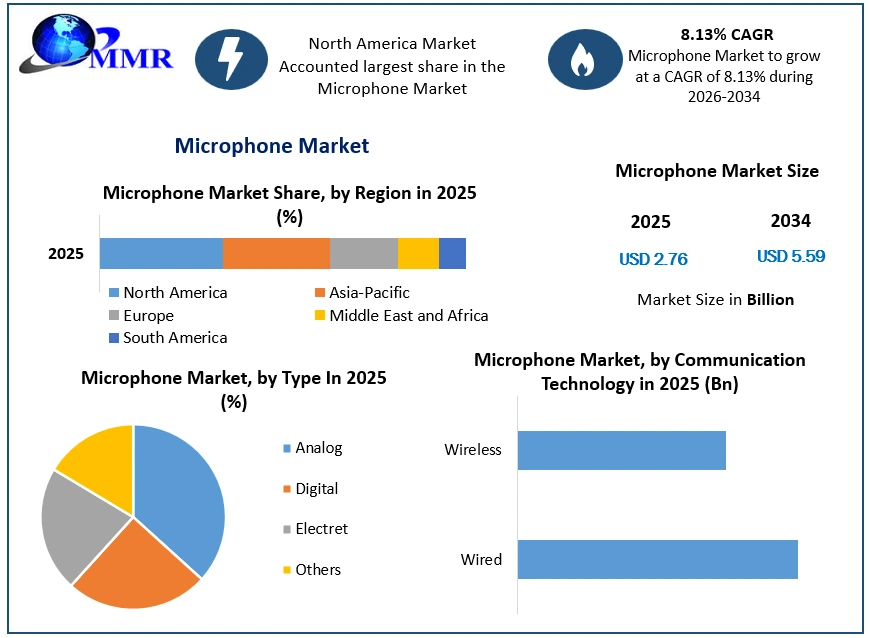
The Microphone Market size was valued at USD 2.76 Billion in 2025, confirming that audio capture components are already a multi‑billion‑dollar business closely tied to semiconductors and electronics manufacturing.
Total microphone revenue is expected to grow at a CAGR of 8.13% from 2026 to 2034, reaching nearly USD 5.59 Billion, signaling strong, demand‑driven expansion as voice interfaces and smart devices proliferate.
The near‑doubling of market value over less than a decade positions microphones from peripheral parts to strategic enablers of AI, edge computing, and user experience across devices.
Why This Matters Now
Voice is becoming the default interface for phones, speakers, cars, wearables, and collaboration tools. Every spoken command, meeting, and in‑car conversation starts with the microphone, not the cloud model. An 8.13% CAGR from 2026 to 2034 tells semiconductor and electronics leaders that audio capture demand is not episodic; it is embedded in the next decade of device design.
Smartphones, true wireless earbuds, smart speakers, conferencing systems, and vehicles are all adding more microphones per product—arrays for beamforming, noise cancellation, and far‑field pickup. That change pushes the microphone from commodity into a system‑level design concern: placement, packaging, and integration with audio ICs and AI processors directly affect product quality, and therefore pricing power and brand perception.
Market Overview
At USD 2.76 Billion in 2025, microphones market already sit at the intersection of consumer electronics, automotive, enterprise collaboration, and emerging IoT audio nodes. The forecast to nearly USD 5.59 Billion by 2034 at 8.13% CAGR indicates that this cross‑sector role will intensify, not fade.
For semiconductor manufacturers and fabless audio IC vendors, the growth path means sustained demand for microphone‑friendly analog front ends, ADCs, DSP blocks, and interface controllers. For OEMs and EMS providers, it means more complex BOMs that blend multiple microphone types and placements per device, with tighter tolerances on acoustics and assembly. The market is no longer about “one mic per product”; it is about arrays, redundancy, and specialization.
Key Trends Driving Growth
The 8.13% CAGR signals several parallel trends. First, AI voice assistants and on‑device speech models are migrating from cloud‑only to hybrid or edge implementations. That shifts emphasis to local audio quality and latency: if the microphone front‑end does not deliver clean signals, expensive models underperform, undermining the value of AI investment.
Second, smart device ecosystems—from phones and wearables to TVs and home hubs—are integrating microphones as always‑on sensors. This moves the component into the core of edge computing strategies, where low‑power, high‑fidelity capture drives wake‑word detection, contextual awareness, and multimodal UX (audio plus visual). The growth rate points to a future where “how well you listen” becomes as important as “how well you compute.”
Third, enterprise and education demand higher‑quality audio for hybrid work and remote learning. Conferencing equipment, webcams, laptops, and room systems all need improved microphones and better array design. This drives richer audio BOMs and more stringent manufacturing processes, benefiting microphone vendors and their semiconductor partners.
Request a Free Sample Copy or View Report Summary: https://www.maximizemarketresearch.com/request-sample/95025/
Segment Insights
Dominant Segment – Consumer and Mobile Devices
Given the overall market size and growth profile, microphones deployed in smartphones, laptops, wearables, and consumer audio devices form the dominant demand pool. These products ship in massive volumes, and most now contain multiple microphones per unit, making design wins in this segment critical for scale and cost optimization.Fastest‑Growing Segment – Smart, Connected and AI‑Enabled Devices
The 8.13% CAGR from 2026 to 2034 points to especially rapid expansion in smart speakers, true wireless earbuds, automotive in‑cabin systems, and IoT nodes that rely on voice and sound as primary inputs. In these devices, microphones enable hands‑free control, context detection, and noise management, directly tying growth to AI and edge computing trajectories.Professional and creator audio—podcasting, streaming, live sound, and studio gear—adds a premium, performance‑oriented segment where microphone differentiation supports higher ASPs and brand positioning.
Industrial and safety applications, including acoustic monitoring and voice control in equipment and environments, represent emerging segments that link microphones to predictive maintenance and human‑machine interaction.
Regional Growth Story
The global path from USD 2.76 Billion in 2025 to nearly USD 5.59 Billion by 2034 implies strong demand across major electronics and semiconductor hubs. The United States, China, South Korea, Taiwan, Japan, Germany, and India all anchor device manufacturing, design, or consumption, making regional dynamics critical.
In Asia, smartphone production, consumer electronics assembly, and growing automotive electronics content drive microphone inclusion in large volumes of hardware. This supports dense local supply chains for both components and EMS integration. In the United States and Europe, design leadership in pro audio, collaboration systems, and automotive UX pushes innovation in microphone performance and integration, influencing global standards and specifications.
Government incentives for semiconductor sovereignty and electronics manufacturing—across the US, EU, India, and East Asia—indirectly support microphone ecosystems by encouraging domestic design and assembly of high‑value devices. As fabs and OSATs invest in capacity and packaging, audio front‑end ICs and MEMS microphones benefit from improved access to advanced processes and integration options.
Competitive Landscape
A market set to reach nearly USD 5.59 Billion by 2034 at 8.13% CAGR is not just about more units; it is about sharper competition along technology and supply‑chain lines. Microphone vendors that master MEMS processes, advanced packaging, and tight integration with audio and AI chips gain leverage with OEMs and system designers.
For semiconductor players, microphone coupling to audio ICs, DSPs, and SoCs becomes a differentiator in winning sockets in smartphones, wearables, automotive ECUs, and collaboration equipment. Vendors that offer reference designs, tuned signal chains, and software tools for beamforming and noise suppression will be better positioned than those selling bare components into fragmented ecosystems.
On the supply‑chain side, resilience and quality control matter. As EMS providers juggle complex assemblies with multiple microphones per device, component reliability and test coverage become competitive factors. Companies that provide stable, high‑yield microphone lines and robust testing frameworks can claim better support for OEM ramp‑ups and lower risk of field failures, directly influencing pricing power and long‑term design relationships.
Recent Developments
The projected move from USD 2.76 Billion in 2025 to nearly USD 5.59 Billion by 2034 is driving OEMs to embed more microphones per device, particularly in smartphones, earbuds, and smart speakers that rely on arrays and adaptive audio features.
Semiconductor and audio IC vendors increasingly co‑design microphone front‑end solutions with OEMs, aligning hardware, firmware, and AI algorithms to improve speech pickup and noise performance.
Automotive and enterprise collaboration segments are expanding their audio roadmaps, incorporating advanced microphone configurations into dashboards, conference rooms, and headsets as hybrid work and connected vehicles mature.
Strategic Implications
For semiconductor executives and technology strategists, the microphone market’s 8.13% CAGR is a direct signal to prioritize audio front‑end design. Ignoring microphones as “simple components” risks under‑utilizing expensive AI and compute assets when the input signal is compromised. Strategic roadmaps need to treat microphones and audio chains as co‑equal with displays, radios, and sensors.
Electronics OEMs and EMS leaders should invest in acoustic design, layout optimization, and manufacturing quality for microphone implementations. Better placement, shielding, and mechanical integration can unlock performance gains without major BOM cost increases. Meanwhile, investors can view microphone vendors and tightly integrated audio semiconductor players as leveraged plays on voice interfaces, smart devices, and edge AI adoption.
Future Outlook
As the Microphone Market rises from USD 2.76 Billion in 2025 to nearly USD 5.59 Billion by 2034 at 8.13% CAGR, the industry will treat “listening” as a core computing capability rather than a peripheral feature. Future technology leaders will build full audio capture stacks—microphones, packaging, front‑end ICs, and AI models—into their competitive edge, while laggards that treat microphones as interchangeable parts will find their devices mute in the most important interface shift of the next decade: from touch and click to voice and sound.
Related Reports
Medical Sensors Market https://www.maximizemarketresearch.com/market-report/medical-sensors-market/2785/
Global Tank Level Monitoring System Market https://www.maximizemarketresearch.com/market-report/global-tank-level-monitoring-system-market/96647/
Electric Vehicle Motor Market https://www.maximizemarketresearch.com/market-report/global-electric-vehicle-motor-market/63034/
Analyst Perspective
“The microphone is becoming the gateway component for AI, edge computing, and smart‑device interaction,” “With the market expanding from USD 2.76 Billion in 2025 to nearly USD 5.59 Billion by 2034 at an 8.13% CAGR, the winners in semiconductors and electronics will be those who engineer complete audio capture chains and treat microphones as strategic silicon, not commodity hardware.”-Rucha Deshpande.
About Maximize Market Research
Maximize Market Research Pvt. Ltd. (MMR) is a global market research and consulting company that provides reliable, data-focused, and practical business insights. The firm serves a wide range of industries, including healthcare, pharmaceuticals, technology, automotive, electronics, chemicals, personal care, and consumer goods. Through market forecasts, competitive analysis, strategic consulting, and industry impact assessments, MMR helps organizations understand changing market conditions, identify growth opportunities, and make informed business decisions for long-term success.
2nd Floor, Navale IT Park Phase 3
Pune Banglore Highway, Narhe
Pune, Maharashtra 411041, India
+91 9607365656
sales@maximizemarketresearch.com
