Key Highlights
Dominant Segment: Authentication systems capture the largest market share, serving as the foundational layer for identity verification and access governance.
Fastest-Growing Segment: Cloud-based Access Control as a Service (ACaaS) and multi-technology readers are outpacing traditional hardware, as enterprises prioritize remote management and low-latency API integration.
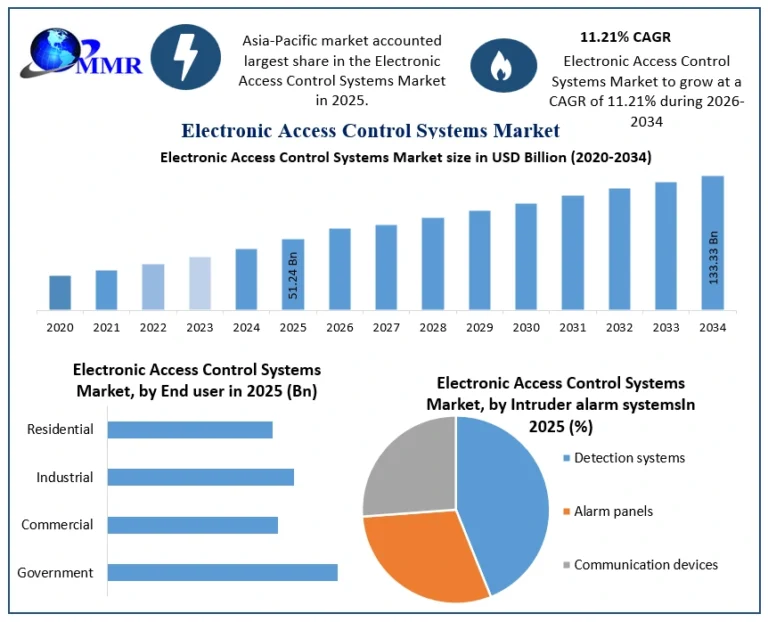
Regional Leadership: The Asia-Pacific region currently dominates the global market, fueled by massive domestic industrialization, smart city initiatives, and rapid IoT adoption.
Technology Shift: Transition from legacy physical credentials (magnetic/proximity cards) to smartphone-based NFC/BLE mobile credentials is now the industry standard for new commercial high-rise construction.
Why This Matters Now
The rapid adoption of AI-enabled biometric sensors and IoT-based monitoring has created a critical dependency on low-power, high-performance semiconductors. Traditional physical locks are being replaced by “intelligent nodes” that require secure, encrypted communication, continuous cloud connectivity, and real-time behavioral analytics. For electronics manufacturers, this necessitates a pivot toward modular chiplet architectures that can support both hardware-heavy security requirements—such as locking mechanisms—and software-heavy data processing—such as biometric matching—in a single, edge-ready device.
Market Overview
The global electronic access control systems market is valued at USD 51.24 Billion in 2025, with projections charting a robust trajectory toward USD 133.33 Billion by 2034. Growing at a steady CAGR of 11.21%, the industry is underpinned by the urgent need for scalable, high-security credential management in smart city infrastructure and corporate enterprise environments. As infrastructure modernization accelerates, the demand for systems that integrate seamlessly into broader building management software is becoming a primary purchasing driver.
Key Trends Driving Growth
Semiconductor Sovereignty & Security: The mandate for “trusted hardware” in government and defense-adjacent projects is driving demand for chips designed with hardware-root-of-trust (RoT) capabilities, insulating access control systems from remote firmware attacks.
AI at the Edge: Modern access systems now perform facial recognition and gait analysis directly at the edge, requiring dedicated Neural Processing Units (NPUs) within the access controller to minimize latency and ensure data privacy by keeping biometric templates on-device.
5G-Enabled Remote Monitoring: 5G connectivity is enabling “zero-touch” access management, allowing facility operators to push real-time updates and security patches to thousands of endpoints simultaneously without relying on local network bandwidth.
Get Free Sample Report
Segment Insights
Hardware (Dominant Segment): Continues to hold the largest market share, driven by the replacement of mechanical door hardware with sophisticated, connected card readers and biometric scanners.
Software (Fastest-Growing Segment): Emerging as the primary value driver, as cloud-based identity management software becomes the “brain” of physical security.
Networked Systems: Account for the majority of the product segment, reflecting the enterprise-wide requirement for synchronized access logs and audit trails across dispersed physical locations.
Regional Growth Story
Asia-Pacific: Currently leads the market in revenue share, fueled by large-scale government investments in urban security and high demand for advanced surveillance integration.
North America: Remains an innovation hub with a focus on compliance-driven upgrades in healthcare, data centers, and critical infrastructure.
Europe: Focused heavily on data protection and sustainability, with a strong regulatory push toward energy-efficient, long-lifecycle hardware that adheres to strict privacy mandates.
Competitive Landscape
The market is shifting from fragmented, local hardware providers to a consolidated ecosystem led by players with integrated hardware-software stacks. Leadership is no longer determined by the physical strength of a lock, but by the resilience of the identity management API and the speed of the biometric processing chip. Acquisitions are increasingly targeting companies with proprietary AI/ML algorithms and edge-computing talent, signaling a strategic shift toward full-stack security ownership where software-defined security models dictate pricing power.
Recent Developments
Foundry Alignment: Major access control firms are securing exclusive capacity with mid-tier foundries to ensure steady supplies of application-specific integrated circuits (ASICs) optimized for low-power operation and advanced encryption.
Advanced Packaging: Movement toward System-in-Package (SiP) designs is allowing manufacturers to shrink controllers to the size of a door handle, facilitating “smart-everything” building designs.
Sustainability Initiatives: Launch of circular-economy programs to reclaim and recycle high-value components from obsolete card readers, driven by both corporate ESG mandates and resource scarcity in the semiconductor supply chain.
Strategic Implications
For semiconductor executives and OEMs, the electronic access control market is no longer a peripheral consumer of commodity parts. It is a Tier-1 destination for high-reliability, security-hardened silicon. Companies failing to integrate AI-ready, low-latency processing into their access control offerings will see their hardware relegated to low-margin commoditized segments, while those embedding advanced logic and cloud-native software will command the majority of the market’s value share.
Future Outlook
The next decade will be defined by the “invisible access” era, where biometrics and intent-based recognition, powered by decentralized, blockchain-verified identities, make physical credentials obsolete; the winners will be the firms that successfully integrate silicon-level security with AI-orchestrated building intelligence, separating the agile technology leaders from those clinging to fragmented, hardware-only models.
Analyst Perspective
“The transition to intelligent, edge-based access control is the most significant structural change this industry has seen in twenty years. We are moving beyond simple ‘door openers’ to comprehensive security AI nodes that are now central to the enterprise digital strategy, and the ability to secure the silicon-to-cloud link is the new competitive benchmark.”
— Rucha Deshpande
About Maximize Market Research
Maximize Market Research Pvt. Ltd. (MMR) is a global market research and consulting company that provides reliable, data-focused, and practical business insights. The firm serves a wide range of industries, including healthcare, pharmaceuticals, technology, automotive, electronics, chemicals, personal care, and consumer goods. Through market forecasts, competitive analysis, strategic consulting, and industry impact assessments, MMR helps organizations understand changing market conditions, identify growth opportunities, and make informed business decisions for long-term success.
2nd Floor, Navale IT Park Phase 3
Pune Banglore Highway, Narhe
Pune, Maharashtra 411041, India
+91 9607365656
sales@maximizemarketresearch.com
Report URL: https://www.maximizemarketresearch.com/market-report/global-electronic-access-control-systems-market/23261/
