Key Highlights
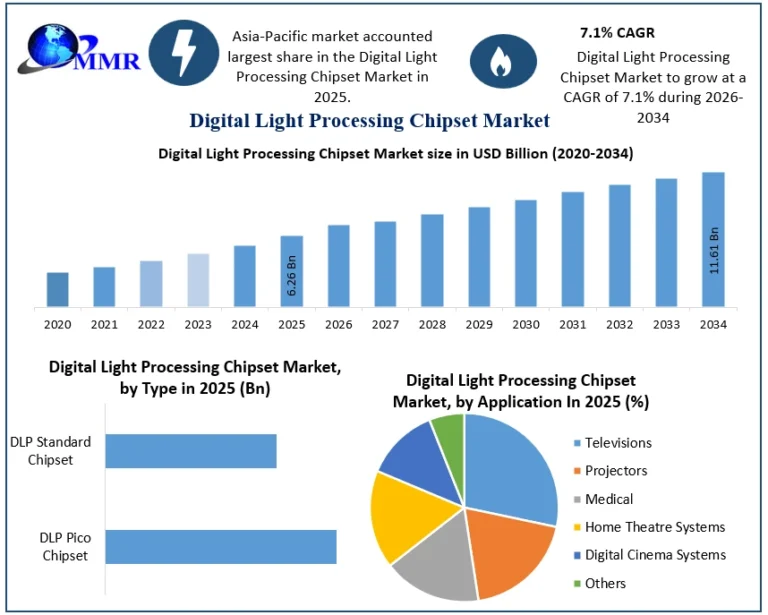
Dominant Segment: 1-chip DLP architectures lead the market share, favored for their balance of performance, cost-efficiency, and compact form factor across consumer and educational applications.
Fastest-Growing Application: 3D printing and additive manufacturing are emerging as the fastest-growing segments, leveraging DLP’s speed and precision for dental, jewelry, and prototyping applications.
Regional Leadership: Asia-Pacific remains the dominant market, fueled by strong electronics manufacturing bases in China, Japan, and India, and a rapidly digitizing education sector.
Technology Shift: The industry is moving toward laser-based light sources and miniaturized DMD (Digital Micromirror Device) arrays that integrate AI-driven image optimization for real-time edge processing.
Why This Matters Now
The transition of DLP technology into mission-critical environments—such as medical imaging and industrial inspection—has necessitated a paradigm shift in semiconductor design. Modern DLP chipsets must now offer high optical efficiency, long operational lifespans, and, increasingly, embedded processing for AI-assisted image correction. For semiconductor manufacturers, the strategic value lies in developing highly durable DMD arrays that can operate under intense laser light sources without degradation, a requirement that differentiates next-generation industrial-grade chipsets from standard consumer variants.
Market Overview
The global DLP chipset market is currently valued at USD 5.46 Billion (2023) and is on a steady growth trajectory toward USD 8.82 Billion by 2030, expanding at a CAGR of 7.1%. This growth reflects a sustained transition away from traditional projection-only use cases. While entertainment and cinema remain volume drivers, the market is finding sustained value in the “industrialization of light,” where DLP chipsets serve as the primary engine for high-speed light curing in 3D printing and precision visualization in automotive digital cockpits.
Key Trends Driving Growth
Industrial Precision: DLP technology’s ability to cure resins at high speeds with micron-level accuracy is turning projection chipsets into critical production tools for the manufacturing sector.
Automotive Transformation: The push for augmented reality (AR) in vehicles is driving demand for compact, high-brightness DLP modules capable of powering sophisticated head-up displays (HUDs) that project real-time navigation and safety data onto windshields.
Laser Migration: The industry is aggressively replacing traditional lamps with laser light sources to improve color saturation, boost brightness exceeding 10,000 lumens, and eliminate the need for frequent, labor-intensive maintenance.
Segment Insights
1-Chip DLP (Dominant Segment): Holds the largest market share due to its versatility and cost-effectiveness in projectors for education, corporate boardrooms, and home theaters.
3-Chip DLP: Serves high-end, large-venue, and digital cinema markets, where superior color reproduction and brightness are non-negotiable requirements.
3D Printing (Fastest-Growing Segment): Emerging as a specialized high-growth niche, where the ability to control millions of microscopic mirrors enables unparalleled speed in additive manufacturing workflows.
Regional Growth Story
Asia-Pacific: Retains its status as the global growth engine, benefiting from massive investments in smart classrooms, infrastructure development, and a concentration of global OEMs specializing in projector and display manufacturing.
North America: Leads in R&D and premium applications, with strong integration of DLP technology in medical research, defense simulation, and advanced prototyping.
Europe: Focused on high-end industrial and medical applications, where the emphasis remains on long-term reliability and adherence to specialized quality standards for healthcare imaging.
Competitive Landscape
The market is characterized by a central dominance of chipset developers—led by Texas Instruments—who set the foundational standard for DMD architecture, contrasted by a competitive application-layer ecosystem. OEMs such as Barco, Christie Digital, Optoma, and BenQ compete heavily on integration expertise, optics design, and software-defined visual performance. Recent competitive trends suggest that differentiation is shifting toward those who can effectively couple DLP hardware with proprietary AI algorithms for image enhancement and real-time environment adaptation.
Recent Developments
Miniaturization: New chipset architectures are enabling the deployment of DLP technology in portable, handheld smart devices and wearable display prototypes.
AI-Integration: The introduction of smart features that perform automatic keystoning, focus adjustment, and color calibration directly on the chipset.
Laser Optimization: Advancement in cooling and heat-sink technologies designed specifically to handle the thermal demands of high-output laser projection.
Strategic Implications
For semiconductor executives and OEMs, the DLP market represents a stable, high-margin opportunity when positioned as an industrial production tool rather than a commodity display component. Strategic investments should prioritize the development of DMD arrays capable of extreme duty cycles, as industrial and medical clients demand near-zero downtime. Companies that can provide a seamless software API for these chipsets—allowing users to program the mirrors for specialized, non-display tasks—will capture significant premium pricing power.
Future Outlook
As the market moves toward 2030, the true test of leadership will be the successful integration of DLP chipsets into the burgeoning “Smart Industrial” ecosystem, where high-speed light modulation will be essential for automated quality control and next-generation lithography; the winners will be those who treat the DMD as a programmable compute resource rather than just a passive display mirror, creating a decisive edge in precision manufacturing and AR-ready automotive systems.
Analyst Perspective
“We are witnessing a shift where DLP is moving from the movie theater to the factory floor and the automobile cabin. The future of this market belongs to those who can master the balance between high-intensity light management and the computational intelligence needed to control it at micro-second intervals.”— Rucha Deshpande
About Maximize Market Research
Maximize Market Research Pvt. Ltd. (MMR) is a global market research and consulting company that provides reliable, data-focused, and practical business insights. The firm serves a wide range of industries, including healthcare, pharmaceuticals, technology, automotive, electronics, chemicals, personal care, and consumer goods. Through market forecasts, competitive analysis, strategic consulting, and industry impact assessments, MMR helps organizations understand changing market conditions, identify growth opportunities, and make informed business decisions for long-term success.
2nd Floor, Navale IT Park Phase 3
Pune Banglore Highway, Narhe
Pune, Maharashtra 411041, India
+91 9607365656
sales@maximizemarketresearch.com
Report URL: https://www.maximizemarketresearch.com/market-report/global-digital-light-processing-chipset-market/73497/
