Material Detection System Market: AI-Powered Inspection Technologies Are Transforming Industrial Safety and Quality Control
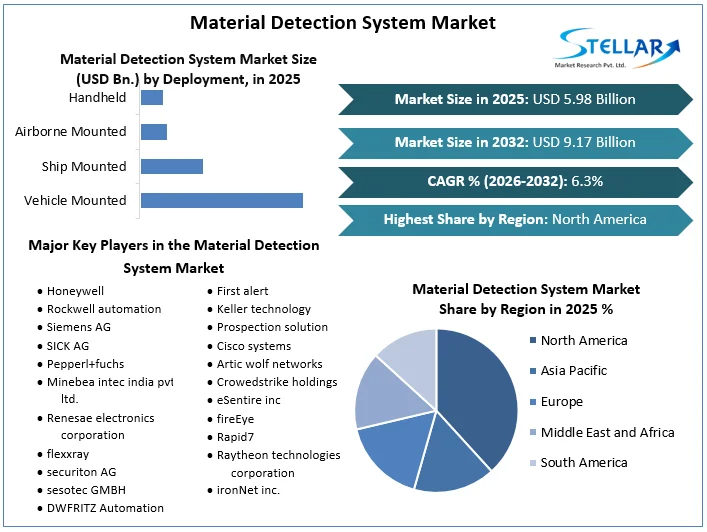
As industries increasingly prioritize safety, quality assurance, and operational efficiency, advanced inspection technologies have become essential across manufacturing, food processing, pharmaceuticals, mining, and logistics. The Material Detection System Market is experiencing steady growth as organizations invest in intelligent detection solutions capable of identifying contaminants, defects, and hazardous materials with greater speed and accuracy. According to Stellar Market Research, the global Material Detection System Market was valued at USD 5.98 billion in 2025 and is projected to reach USD 9.17 billion by 2032, expanding at a CAGR of 6.3% during the forecast period.
Understanding the Material Detection System Market
Material detection systems are advanced inspection technologies used to identify metals, plastics, wood, contaminants, structural defects, and hazardous materials across various industrial environments. These systems utilize technologies such as ultrasonic sensors, inductive sensors, magnetic detection, capacitive sensing, radar, laser, sonar, and photoelectric sensors to deliver precise and reliable detection.
Industries rely on these systems to improve product quality, ensure workplace safety, comply with regulatory standards, and reduce operational risks. Their growing integration with automation platforms has made them indispensable in modern industrial facilities.
𝐃𝐨𝐰𝐧𝐥𝐨𝐚𝐝 𝐅𝐫𝐞𝐞 𝐏𝐃𝐅 𝐁𝐫𝐨𝐜𝐡𝐮𝐫𝐞: https://www.stellarmr.com/report/req_sample/Material-Detection-System-Market/1510
Industrial Automation Is Accelerating Market Growth
One of the primary drivers of the Material Detection System Market is the rapid adoption of industrial automation. Manufacturers increasingly depend on automated inspection systems to detect production defects, foreign materials, and equipment abnormalities before products reach customers.
Smart factories require continuous monitoring systems capable of operating in real time while integrating seamlessly with production lines. Material detection systems help reduce waste, improve productivity, and minimize costly recalls, making them a valuable investment for manufacturers seeking operational excellence.
Food Safety and Pharmaceutical Compliance Create Strong Demand
Food processing and pharmaceutical manufacturing represent two of the fastest-growing application areas for material detection technologies. Strict quality regulations require manufacturers to detect metal fragments, glass, plastics, and other contaminants before products enter the market.
Modern detection systems improve consumer safety while helping manufacturers comply with international food safety standards and pharmaceutical quality requirements. Their ability to inspect products without interrupting production significantly improves operational efficiency.
Artificial Intelligence Is Enhancing Detection Accuracy
Technological innovation continues to reshape inspection systems through artificial intelligence and machine learning.
Key advancements include:
AI-powered defect recognition
Machine learning-based quality inspection
IoT-enabled remote monitoring
High-resolution imaging systems
Radar and laser detection technologies
Automated sorting systems
Cloud-connected inspection platforms
Predictive maintenance analytics
These technologies improve detection accuracy, reduce false alarms, and enable predictive maintenance by continuously analyzing equipment performance and production data.
Mining, Automotive, and Electronics Expand Market Opportunities
Beyond food and pharmaceuticals, material detection systems are widely used across mining, automotive manufacturing, electronics production, and packaging industries.
Mining companies use advanced sensors to identify valuable minerals and improve worker safety. Automotive manufacturers employ inspection systems to verify component quality and ensure production consistency, while electronics manufacturers rely on precision detection technologies to identify microscopic defects during assembly.
The increasing complexity of manufactured products continues to create demand for more sophisticated inspection solutions.
North America Leads While Asia-Pacific Emerges as a High-Growth Region
North America remains the leading regional market due to strong investments in industrial automation, workplace safety, and advanced manufacturing technologies. Well-established food processing, pharmaceutical, and automotive industries continue driving demand for intelligent detection systems.
Asia-Pacific is expected to experience the fastest growth as rapid industrialization, expanding manufacturing capacity, and increasing quality standards encourage greater adoption of automated inspection technologies. Countries including China, India, Japan, and South Korea continue investing in smart manufacturing infrastructure to strengthen global competitiveness.
Sustainability and Smart Manufacturing Support Market Expansion
Manufacturers are increasingly using material detection systems to reduce waste and improve resource efficiency. Accurate inspection minimizes defective products, lowers raw material consumption, and supports sustainability objectives by improving production yield.
The integration of Industry 4.0 technologies—including digital twins, cloud analytics, and Industrial Internet of Things (IIoT) platforms—is enabling continuous monitoring and data-driven process optimization across manufacturing facilities.
Challenges Facing the Industry
Despite positive long-term growth prospects, several challenges remain.
High Initial Investment
Advanced material detection systems often require significant capital investment, making adoption more challenging for small and medium-sized enterprises.
Integration Complexity
Many manufacturers operate legacy production equipment that may require additional engineering work to integrate with modern inspection technologies, increasing deployment costs and implementation time.
Regulatory and Performance Requirements
Manufacturers must continuously improve detection accuracy while complying with evolving safety regulations across industries such as food processing, pharmaceuticals, and mining. Meeting these standards requires ongoing investment in research, calibration, and system upgrades.
𝐃𝐨𝐰𝐧𝐥𝐨𝐚𝐝 𝐅𝐫𝐞𝐞 𝐏𝐃𝐅 𝐁𝐫𝐨𝐜𝐡𝐮𝐫𝐞: https://www.stellarmr.com/report/req_sample/Material-Detection-System-Market/1510
Competitive Landscape
The Material Detection System Market is highly competitive, with global technology companies focusing on innovation, automation, and digital inspection capabilities.
Leading companies are investing in:
Artificial intelligence-enabled inspection systems
IoT-connected detection platforms
High-speed automated quality control
Radar and laser sensing technologies
Remote monitoring capabilities
Strategic partnerships and acquisitions
Expansion into emerging industrial markets
Continuous investment in research and development enables manufacturers to deliver more intelligent, reliable, and scalable inspection solutions that meet evolving industrial requirements.
Future Outlook
The outlook for the Material Detection System Market remains strong as industries continue modernizing production facilities through automation and digital transformation. Growing demand for product quality, worker safety, regulatory compliance, and predictive maintenance will continue supporting market expansion through 2032.
Emerging technologies such as artificial intelligence, machine vision, cloud computing, robotics, and edge analytics are expected to further improve inspection accuracy while enabling autonomous quality control. Companies that prioritize technological innovation, system interoperability, and intelligent automation will be well positioned to capitalize on future opportunities.
Conclusion
The Material Detection System Market is becoming an essential component of modern industrial operations, supporting higher quality standards, improved safety, and greater production efficiency. Increasing adoption across manufacturing, food processing, pharmaceuticals, mining, and electronics demonstrates the growing importance of advanced detection technologies in today’s competitive industrial landscape.
As automation, AI, and Industry 4.0 continue reshaping global manufacturing, demand for intelligent material detection systems is expected to rise steadily. Organizations that invest in advanced inspection technologies will be better equipped to enhance operational performance, reduce waste, and maintain regulatory compliance in an increasingly quality-focused marketplace.
