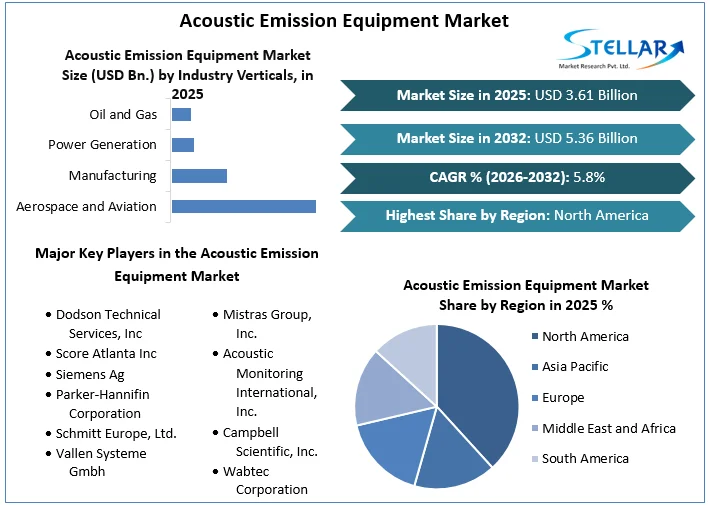
Acoustic Emission Equipment Market: Predictive Maintenance and Industrial Safety Drive Global Growth
As industries place greater emphasis on asset reliability, workplace safety, and predictive maintenance, acoustic emission (AE) technology has emerged as a critical tool for non-destructive testing (NDT). By detecting stress waves generated within materials before visible damage occurs, acoustic emission equipment enables organizations to identify structural defects early, minimize downtime, and extend the lifespan of critical infrastructure. According to Stellar Market Research, the Acoustic Emission Equipment Market is experiencing steady growth, driven by increasing investments in industrial inspection, energy infrastructure, aerospace, and manufacturing.
What Is Acoustic Emission Equipment?
Acoustic emission equipment is a non-destructive testing (NDT) system used to monitor and evaluate the structural integrity of materials and equipment by detecting high-frequency elastic waves released during crack formation, corrosion, leakage, deformation, or mechanical stress.
These systems typically consist of sensors, signal processors, amplifiers, data acquisition units, and analysis software that continuously monitor structures in real time. Acoustic emission technology is widely used across industries including oil and gas, aerospace, power generation, manufacturing, automotive, civil infrastructure, and pressure vessel inspection, where early defect detection is essential for operational safety and regulatory compliance.
𝐃𝐨𝐰𝐧𝐥𝐨𝐚𝐝 𝐅𝐫𝐞𝐞 𝐏𝐃𝐅 𝐁𝐫𝐨𝐜𝐡𝐮𝐫𝐞: https://www.stellarmr.com/report/req_sample/Acoustic-Emission-Equipment-Market/1513
Growing Demand for Predictive Maintenance Fuels Market Growth
One of the primary drivers of the Acoustic Emission Equipment Market is the increasing adoption of predictive maintenance strategies. Rather than relying on scheduled maintenance or waiting for equipment failure, industries are implementing continuous condition monitoring to detect abnormalities before they become critical.
Acoustic emission systems enable maintenance teams to identify fatigue cracks, corrosion, pressure leaks, and material degradation without interrupting operations. This reduces maintenance costs, improves equipment reliability, and minimizes unexpected downtime, making AE technology an increasingly valuable investment for industrial facilities.
Infrastructure Modernization Expands Inspection Requirements
Aging infrastructure across many countries has created growing demand for advanced structural health monitoring solutions. Bridges, pipelines, storage tanks, wind turbines, pressure vessels, and nuclear facilities require continuous inspection to ensure long-term safety and regulatory compliance.
Acoustic emission equipment allows engineers to evaluate structural conditions while assets remain in service, reducing inspection costs and avoiding unnecessary operational shutdowns. Governments and infrastructure operators are increasingly investing in these technologies as part of long-term asset management programs.
Digital Technologies Enhance Acoustic Monitoring
Technological innovation continues to improve the performance and capabilities of acoustic emission systems.
Major advancements include:
AI-powered defect classification
Wireless acoustic emission sensors
IoT-enabled structural monitoring
Cloud-based inspection platforms
Real-time remote diagnostics
Advanced signal processing algorithms
Predictive maintenance analytics
Digital twin integration
These technologies improve defect detection accuracy while enabling continuous monitoring across geographically distributed industrial assets.
Oil & Gas, Aerospace, and Power Generation Remain Key End Users
The oil and gas industry remains one of the largest users of acoustic emission equipment for monitoring pipelines, storage tanks, offshore platforms, and pressure vessels. Early detection of leaks and structural weaknesses helps prevent costly failures while supporting environmental protection initiatives.
In aerospace, manufacturers use AE systems to inspect aircraft structures, composite materials, and engine components throughout production and maintenance cycles.
Power generation facilities—including nuclear, thermal, hydroelectric, and renewable energy plants—also rely on acoustic emission technology to monitor turbines, boilers, pressure systems, and critical infrastructure, ensuring safe and reliable operation.
Asia-Pacific Emerges as a Fast-Growing Regional Market
North America continues to lead the Acoustic Emission Equipment Market due to its advanced industrial base, established non-destructive testing industry, and strong investments in infrastructure safety and predictive maintenance technologies.
Asia-Pacific is expected to experience the fastest growth, driven by rapid industrialization, expanding manufacturing capacity, increasing energy infrastructure investments, and stricter safety regulations. Countries such as China, India, Japan, and South Korea are accelerating adoption of advanced inspection technologies to improve industrial productivity and infrastructure reliability.
Sustainability Supports Wider Adoption
Sustainability initiatives are encouraging industries to maximize the useful life of existing infrastructure rather than replacing assets prematurely. Acoustic emission monitoring supports this objective by identifying defects early, allowing maintenance teams to perform targeted repairs that reduce material waste and capital expenditure.
Continuous structural monitoring also helps prevent environmental incidents such as pipeline leaks and equipment failures, supporting corporate ESG objectives and regulatory compliance.
Challenges Facing the Market
Despite strong long-term growth prospects, several challenges remain.
High Equipment and Installation Costs
Advanced acoustic emission systems require specialized sensors, monitoring software, and skilled personnel, resulting in relatively high initial investment costs.
Limited Technical Expertise
Successful implementation depends on experienced engineers capable of interpreting complex acoustic signals and distinguishing genuine defects from environmental noise.
Integration with Legacy Infrastructure
Many industrial facilities operate aging equipment that may require customized monitoring solutions and additional engineering work before modern acoustic emission technologies can be fully integrated.
𝐃𝐨𝐰𝐧𝐥𝐨𝐚𝐝 𝐅𝐫𝐞𝐞 𝐏𝐃𝐅 𝐁𝐫𝐨𝐜𝐡𝐮𝐫𝐞: https://www.stellarmr.com/report/req_sample/Acoustic-Emission-Equipment-Market/1513
Competitive Landscape
The Acoustic Emission Equipment Market remains highly competitive, with manufacturers focusing on technological innovation, digital monitoring capabilities, and global expansion.
Leading companies are investing in:
AI-driven inspection software
Wireless sensing technologies
Cloud-connected monitoring platforms
Portable acoustic emission instruments
Automated defect analysis
Strategic partnerships with industrial operators
Research and development for advanced NDT solutions
Continuous product innovation enables suppliers to address increasingly complex industrial inspection requirements while improving ease of deployment and data accuracy.
Future Outlook
The future of the Acoustic Emission Equipment Market remains highly promising as industries continue embracing predictive maintenance, digital asset management, and Industry 4.0 technologies. Growing investments in renewable energy infrastructure, transportation networks, smart manufacturing, and industrial automation will continue creating demand for advanced structural monitoring systems.
The integration of artificial intelligence, machine learning, digital twins, and Industrial Internet of Things (IIoT) platforms is expected to further enhance acoustic emission technology, enabling more accurate diagnostics and fully automated asset health monitoring. Companies that prioritize intelligent analytics, remote monitoring, and scalable inspection solutions will be well positioned to capitalize on emerging market opportunities.
Conclusion
The Acoustic Emission Equipment Market is becoming an indispensable part of modern industrial maintenance and infrastructure management. Its ability to detect hidden structural defects before catastrophic failures occur makes it one of the most valuable technologies in non-destructive testing.
As industries continue investing in predictive maintenance, digital transformation, and sustainable asset management, demand for acoustic emission equipment is expected to grow steadily. Manufacturers that focus on innovation, intelligent monitoring, and advanced analytical capabilities will strengthen their competitive position while supporting safer, more efficient industrial operations worldwide.
