Sludge Management and Dewatering Market: Sustainable Wastewater Solutions Drive Global Infrastructure Investment
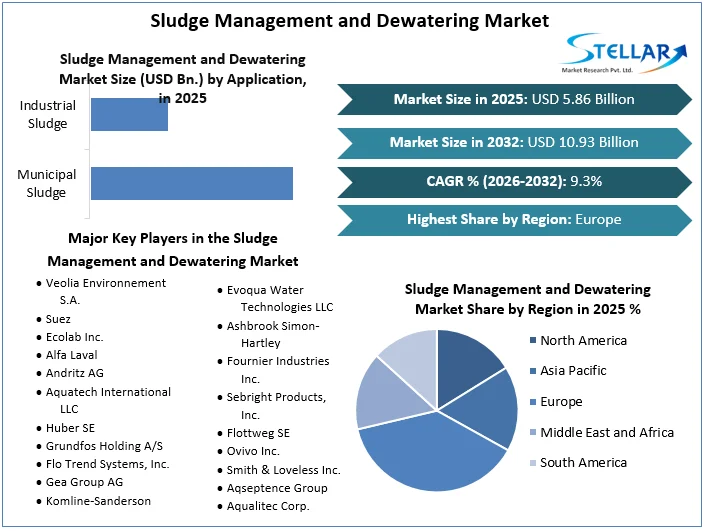
As governments and industries strengthen their focus on environmental protection and resource efficiency, wastewater treatment has become a strategic priority worldwide. Growing urbanization, industrial expansion, and stricter environmental regulations are increasing the need for advanced sludge handling technologies. According to Stellar Market Research, the global Sludge Management and Dewatering Market was valued at USD 5.86 billion in 2025 and is projected to reach USD 10.93 billion by 2032, growing at a CAGR of 9.3% during the forecast period.
Understanding the Sludge Management and Dewatering Market
Sludge management and dewatering involve the treatment, volume reduction, stabilization, and disposal or reuse of sludge generated during municipal and industrial wastewater treatment. Dewatering technologies remove excess water from sludge, significantly reducing its volume and making transportation, disposal, or resource recovery more economical.
Common technologies include centrifuges, belt filter presses, screw presses, filter presses, thermal drying systems, and biological treatment methods. These solutions are widely deployed across municipal wastewater plants, chemical processing facilities, food and beverage manufacturing, mining operations, pharmaceuticals, and energy utilities.
𝐃𝐨𝐰𝐧𝐥𝐨𝐚𝐝 𝐅𝐫𝐞𝐞 𝐏𝐃𝐅 𝐁𝐫𝐨𝐜𝐡𝐮𝐫𝐞: https://www.stellarmr.com/report/req_sample/Sludge-Management-and-Dewatering-Market/1526
Rising Wastewater Generation Accelerates Market Growth
Rapid urbanization and industrialization have substantially increased wastewater generation across both developed and emerging economies. As cities expand and manufacturing activities grow, wastewater treatment facilities must process larger volumes of sludge while complying with increasingly stringent environmental standards.
Modern dewatering systems help reduce sludge volume, lower transportation costs, improve operational efficiency, and minimize environmental impact. Their ability to optimize sludge handling makes them an essential investment for municipalities and industrial operators seeking cost-effective wastewater management solutions.
Resource Recovery Creates New Business Opportunities
The wastewater industry is shifting from simple waste disposal toward resource recovery and circular economy practices. Instead of viewing sludge solely as waste, utilities increasingly recover valuable materials and energy from treated sludge.
Emerging opportunities include:
Biogas production through anaerobic digestion
Phosphorus recovery for fertilizer manufacturing
Organic matter recycling
Sludge-to-energy technologies
Biosolid reuse in agriculture where regulations permit
Heat recovery systems
Sustainable wastewater treatment processes
These initiatives help reduce disposal costs while creating additional revenue streams and supporting global sustainability objectives.
Advanced Dewatering Technologies Improve Operational Efficiency
Technological innovation continues to improve sludge treatment performance across municipal and industrial facilities.
Key technology trends include:
High-efficiency centrifuges
Advanced belt filter presses
Screw press systems
Automated sludge monitoring
Energy-efficient dewatering equipment
Smart process control systems
AI-enabled predictive maintenance
Digital monitoring and remote diagnostics
These technologies reduce energy consumption, improve cake dryness, minimize operating costs, and enhance plant reliability while supporting increasingly automated wastewater treatment operations.
Municipal Infrastructure Remains the Largest End User
Municipal wastewater treatment plants represent the largest application segment due to continuous increases in urban wastewater volumes and government investments in sanitation infrastructure.
Industrial sectors—including food and beverage, pharmaceuticals, chemicals, mining, and energy—are also expanding adoption as environmental regulations become more stringent. Efficient sludge treatment enables these industries to reduce disposal expenses while meeting sustainability and compliance requirements.
Europe Leads While Asia-Pacific Offers Strong Growth Potential
Europe currently dominates the Sludge Management and Dewatering Market due to strict environmental legislation, mature wastewater infrastructure, and strong investments in sustainable sludge treatment technologies. Countries across the region continue implementing advanced resource recovery programs and circular economy initiatives.
Asia-Pacific is expected to witness significant growth over the forecast period as rapid industrialization, population growth, and expanding urban infrastructure increase wastewater treatment requirements. Countries including China and India are investing heavily in modern treatment facilities to improve public sanitation and environmental protection.
Sustainability and Environmental Compliance Shape Industry Trends
Governments worldwide continue strengthening wastewater discharge regulations, encouraging utilities and industries to adopt more efficient sludge management systems.
At the same time, organizations are prioritizing lower carbon emissions, reduced landfill dependency, and greater resource recovery. These sustainability initiatives are driving investment in energy-efficient dewatering equipment, sludge-to-energy projects, and advanced treatment technologies that support long-term environmental goals.
𝐃𝐨𝐰𝐧𝐥𝐨𝐚𝐝 𝐅𝐫𝐞𝐞 𝐏𝐃𝐅 𝐁𝐫𝐨𝐜𝐡𝐮𝐫𝐞: https://www.stellarmr.com/report/req_sample/Sludge-Management-and-Dewatering-Market/1526
Challenges Facing the Market
Despite favorable growth prospects, several challenges remain.
High Capital Investment
Modern sludge treatment systems require significant upfront investment in equipment, installation, and automation, creating financial barriers for smaller municipalities and industrial facilities.
Regulatory Complexity
Wastewater treatment operators must comply with evolving environmental regulations governing sludge disposal, emissions, and biosolid utilization. Meeting these standards often requires continuous investment in technology upgrades and operational improvements.
Public Acceptance and Disposal Constraints
Locating sludge treatment facilities near populated areas can face community opposition, while identifying environmentally responsible disposal or reuse pathways remains an ongoing operational challenge.
Competitive Landscape
The Sludge Management and Dewatering Market is highly competitive, with global engineering companies and specialized wastewater technology providers investing in innovation and sustainable treatment solutions.
Major competitive strategies include:
Development of energy-efficient dewatering equipment
Digital automation and remote monitoring
Expansion of resource recovery technologies
Strategic partnerships with municipal utilities
Capacity expansion in emerging markets
Research into sludge valorization and circular economy solutions
Mergers and acquisitions to broaden product portfolios
Leading participants continue focusing on improving operational efficiency while reducing lifecycle costs for customers.
Future Outlook
The outlook for the Sludge Management and Dewatering Market remains highly positive as wastewater infrastructure investment accelerates globally. Rising urban populations, industrial growth, and increasingly stringent environmental regulations will continue driving demand for efficient sludge treatment systems.
Future growth will be supported by AI-enabled process optimization, automated monitoring, advanced dewatering technologies, and expanded resource recovery initiatives. Organizations that invest in sustainable wastewater management and digital plant operations will be well positioned to capitalize on long-term market opportunities while contributing to global environmental sustainability.
Conclusion
The Sludge Management and Dewatering Market is becoming an essential component of modern wastewater management as governments and industries seek more sustainable methods for handling increasing sludge volumes. Advanced dewatering technologies are improving operational efficiency, lowering disposal costs, and enabling valuable resource recovery from wastewater treatment processes.
With continued investment in environmental infrastructure, smart treatment technologies, and circular economy practices, the market is expected to maintain strong growth through 2032. Companies that prioritize innovation, regulatory compliance, and sustainable sludge management solutions will be well positioned to succeed in this evolving global industry.
