Real-Time Spectrum Analysis Market: 5G Expansion and Advanced Wireless Technologies Accelerate Industry Growth
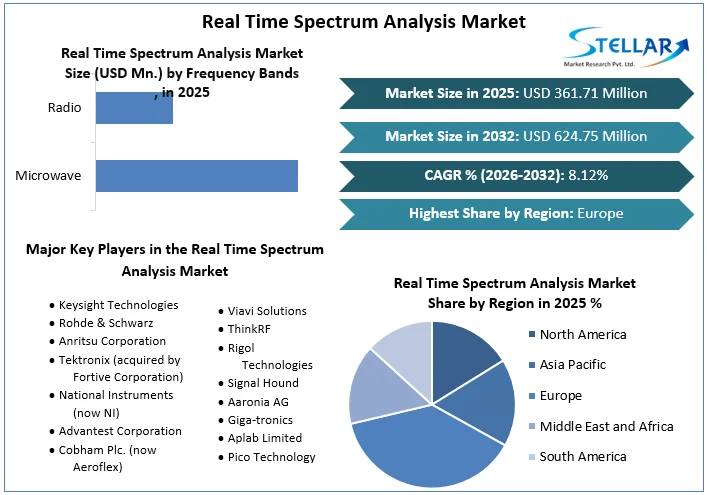
The rapid deployment of 5G networks, increasing spectrum congestion, and growing demand for secure wireless communication are transforming the global test and measurement industry. Organizations across telecommunications, aerospace, defense, automotive, and electronics are investing in advanced signal monitoring solutions to improve network performance and ensure regulatory compliance. According to Stellar Market Research, the Real-Time Spectrum Analysis Market was valued at USD 334.55 million in 2024 and is projected to reach USD 624.76 million by 2032, registering a CAGR of 8.12% during the forecast period.
Understanding the Real-Time Spectrum Analysis Market
Real-time spectrum analysis (RTSA) is a technology used to continuously monitor and analyze radio frequency (RF) signals across a wide frequency range. Unlike conventional spectrum analyzers, RTSA systems capture transient, intermittent, and rapidly changing signals in real time, making them essential for modern wireless communication environments.
These analyzers are widely used in telecommunications, aerospace and defense, automotive, healthcare, semiconductor manufacturing, and research laboratories for signal monitoring, interference detection, wireless communication testing, and electromagnetic spectrum management. As wireless technologies become increasingly complex, RTSA solutions are playing a critical role in maintaining reliable and efficient communication networks.
𝐃𝐨𝐰𝐧𝐥𝐨𝐚𝐝 𝐅𝐫𝐞𝐞 𝐏𝐃𝐅 𝐁𝐫𝐨𝐜𝐡𝐮𝐫𝐞: https://www.stellarmr.com/report/req_sample/Real-Time-Spectrum-Analysis-Market/1528
5G Deployment Is Driving Market Expansion
The global rollout of 5G infrastructure is one of the strongest growth drivers for the Real-Time Spectrum Analysis Market. Fifth-generation wireless networks operate across broader frequency ranges and utilize complex signal architectures that require advanced testing and monitoring capabilities.
Telecommunication companies rely on real-time spectrum analyzers to optimize network performance, detect interference, verify signal quality, and improve spectrum utilization. As governments and private operators continue expanding 5G coverage, demand for high-performance spectrum analysis equipment is expected to increase significantly.
Growing Spectrum Congestion Increases Demand
The rapid growth of connected devices, IoT networks, satellite communications, and wireless services has intensified pressure on available radio spectrum.
Real-time spectrum analyzers help organizations:
Detect signal interference
Monitor spectrum utilization
Optimize wireless network performance
Troubleshoot communication issues
Validate RF device performance
Improve electromagnetic compatibility (EMC) testing
Support regulatory compliance
Enhance electronic surveillance capabilities
These capabilities make RTSA systems indispensable for industries operating in increasingly crowded radio frequency environments.
Artificial Intelligence and Automation Enhance Signal Analysis
Technology innovation is significantly improving spectrum analysis capabilities.
Key developments include:
AI-assisted signal classification
Machine learning-based interference detection
Cloud-connected testing platforms
Automated RF diagnostics
Software-defined spectrum analyzers
Remote monitoring capabilities
High-bandwidth signal capture
Integration with Industry 4.0 testing environments
These innovations enable engineers to identify complex signal behavior faster while reducing manual analysis and improving operational efficiency.
Aerospace and Defense Remain Strategic End Users
Defense organizations rely extensively on real-time spectrum analysis for electronic warfare, radar system testing, surveillance, secure communications, and threat detection. The ability to capture short-duration RF events makes RTSA particularly valuable for military applications where conventional analyzers may miss critical signals.
The aerospace sector also uses these systems during aircraft communication testing, satellite development, navigation system validation, and electromagnetic compatibility assessments. Continued investment in advanced defense technologies is expected to sustain long-term market demand.
North America Leads While Asia-Pacific Shows Strong Growth Potential
North America remains the largest market due to its advanced telecommunications infrastructure, strong defense spending, mature semiconductor industry, and leadership in wireless technology innovation. The presence of major instrument manufacturers further strengthens regional growth.
Asia-Pacific is expected to witness the fastest growth during the forecast period, supported by rapid 5G deployment, expanding electronics manufacturing, increasing semiconductor production, and significant investments in wireless communication infrastructure across China, India, Japan, and South Korea.
Challenges Facing the Industry
Despite favorable growth prospects, the market faces several challenges.
High Equipment Costs
High-performance real-time spectrum analyzers incorporate advanced hardware and software capabilities, making them expensive for small organizations and research institutions with limited budgets.
Technical Complexity
Operating and interpreting RF spectrum data requires specialized engineering expertise. The shortage of skilled professionals may slow adoption in certain industries.
Rapid Technological Evolution
Continuous advances in wireless communication standards require manufacturers to regularly update hardware and software platforms to remain compatible with emerging technologies such as 6G, advanced satellite communications, and next-generation IoT networks.
𝐃𝐨𝐰𝐧𝐥𝐨𝐚𝐝 𝐅𝐫𝐞𝐞 𝐏𝐃𝐅 𝐁𝐫𝐨𝐜𝐡𝐮𝐫𝐞: https://www.stellarmr.com/report/req_sample/Real-Time-Spectrum-Analysis-Market/1528
Competitive Landscape
The Real-Time Spectrum Analysis Market is characterized by strong competition among established test and measurement companies focused on technological innovation and product differentiation.
Leading companies are investing in:
AI-enabled spectrum analysis
Portable and handheld analyzers
High-frequency measurement capabilities
Cloud-based RF testing platforms
Integrated wireless communication testing solutions
Strategic partnerships with telecom operators
Expansion into emerging 5G and aerospace applications
Major participants include Keysight Technologies, Rohde & Schwarz, Anritsu Corporation, Tektronix, NI, Advantest, Viavi Solutions, ThinkRF, Rigol Technologies, Signal Hound, Aaronia AG, Giga-tronics, Aplab Limited, and Pico Technology.
Future Outlook
The future of the Real-Time Spectrum Analysis Market remains highly promising as wireless communication technologies continue evolving. Growing adoption of 5G, Industrial IoT, autonomous vehicles, satellite communications, and future 6G networks will require increasingly sophisticated RF monitoring and testing solutions.
Artificial intelligence, cloud-based analytics, software-defined instrumentation, and automated testing platforms are expected to reshape the industry over the coming years. Companies that invest in high-speed data processing, intelligent signal analysis, and scalable spectrum management technologies will be well positioned to capitalize on expanding market opportunities.
Conclusion
The Real-Time Spectrum Analysis Market has become a critical component of modern wireless communication infrastructure, supporting reliable connectivity, spectrum optimization, and advanced signal analysis across multiple industries. As global demand for faster, more secure, and more efficient wireless networks continues to grow, real-time spectrum analyzers will remain indispensable tools for engineers, researchers, and communication service providers.
Driven by 5G expansion, increasing spectrum congestion, and continuous technological innovation, the market is expected to experience sustained growth through 2032. Organizations that embrace AI-powered analysis, automated testing, and next-generation RF technologies will be best positioned to succeed in this rapidly evolving landscape.
