Key Highlights
Dominant Segment: Wireless contact sensors (reed switch technology) lead the technology landscape, favored for their balance of reliability, ease of installation, and cost-effectiveness in high-volume security deployments.
Fastest-Growing Segment: The integration of sensors into HVAC-automated smart home systems is the primary driver for high-volume demand, enabling energy-saving ventilation controls.
Regional Leadership: The Asia-Pacific region dominates the market, fueled by rapid urbanization, large-scale infrastructure projects, and the aggressive adoption of smart home security technology in China, India, and Japan.
Technology Shift: A migration toward low-power wide-area network (LPWAN) connectivity and mesh networking is enabling seamless, long-range integration of sensors into complex, multi-story building management architectures.
Why This Matters Now
The convergence of personal security concerns and stringent energy-efficiency mandates has turned window sensing into a foundational requirement for modern construction. Beyond intrusion alerts, these sensors now serve as the primary logic gate for HVAC optimization—automatically halting climate control when a perimeter breach occurs. For electronics manufacturers, this necessitates a shift toward intelligent, energy-harvesting, or ultra-long-battery-life sensor nodes that can provide real-time status telemetry without the constraints of legacy hardwired installations.
Market Overview
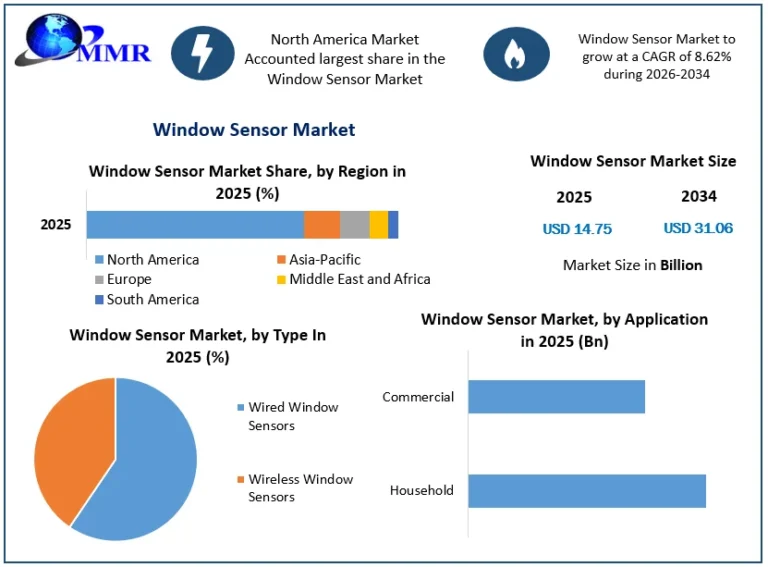
Valued at USD 14.75 billion in 2025, the global window sensor market is projected to reach USD 31.06 billion by 2034, growing at a CAGR of 8.62%. The industry is underpinned by a transition from standalone security hardware to fully integrated smart environments. As end-users prioritize both domestic safety and operational energy cost reductions, the demand for highly reliable, low-latency, and wirelessly connected sensing nodes is dictating the trajectory of global procurement.
Key Trends Driving Growth
Smart Building IoT: Window sensors are increasingly deployed as part of broader building automation systems, enabling demand-controlled climate management and energy usage analytics.
Security Integration: Rising urbanization and residential density are driving demand for automated perimeter security systems that provide immediate remote verification via mobile-first platforms.
Sensor Miniaturization: The transition to advanced MEMS (Micro-Electro-Mechanical Systems) technology is drastically reducing the footprint of sensing elements, allowing for discreet, aesthetic-friendly integration into modern architectural designs.
Segment Insights
Contact Sensors (Dominant Segment): Remain the backbone of the market for perimeter security due to their high reliability, minimal maintenance, and mature, cost-optimized manufacturing profiles.
Integrated Multi-Function Sensors (Fastest-Growing Technology): These devices—combining open/close detection with shock, glass-break, and temperature sensing—are seeing increased adoption in premium segments requiring comprehensive protection.
Residential Security (Dominant End-User): Represents the largest share of the market, driven by the mass-market adoption of smart-home DIY security platforms that rely on modular, easy-to-install sensing arrays.
Regional Growth Story
Asia-Pacific: Currently leads the market in growth, sustained by the region’s massive residential construction volume and aggressive adoption of IoT-native security infrastructure in smart city initiatives.
North America: Leads in terms of high-value innovation and platform integration, with a strong consumer appetite for premium smart-home security systems that feature advanced cloud-based monitoring services.
Europe: Focused on sustainability-driven building standards, with a market pull for interoperable sensors that support energy-saving initiatives and green building certifications.
Competitive Landscape
The competitive landscape is defined by established security hardware firms and agile smart-home technology developers. Success is no longer determined by the sensitivity of the magnet switch but by the robustness of the software API and the interoperability of the sensor within broader ecosystems (e.g., Matter, Zigbee, Z-Wave). Companies like Honeywell, ADT, and various smart-home innovators are setting the pace by providing digitally addressable sensing solutions that simplify configuration for both installers and end-users.
Recent Developments
Ecosystem Interoperability: Introduction of sensors compatible with universal smart-home protocols, drastically reducing the friction of integrating perimeter security into multi-vendor IoT networks.
Low-Power Innovation: Breakthroughs in sensing circuitry have significantly reduced power draw, enabling multi-year battery life for wireless window nodes in high-density installations.
AI-Enhanced Security: Integration of on-device signal processing that distinguishes between legitimate physical breach attempts and environmental false positives, such as high-wind vibrations.
Strategic Implications
For semiconductor and electronics leaders, the window sensor market is an essential gatekeeper of the “Connected Home” layer. Suppliers that can provide low-power, standard-compliant, and high-reliability sensing modules will capture the bulk of the market value. Investing in AI-enabled, self-testing sensors that alert the user to battery depletion or connectivity loss will be the key differentiator for securing design-ins with high-volume residential security OEMs.
Future Outlook
The next phase of the window sensor market will be defined by the shift to “Predictive Perimeter Intelligence,” where sensors utilize edge-based processing to anticipate security risks and manage building thermodynamics with near-zero human intervention, effectively bridging the gap between passive sensing and proactive home autonomy.
Analyst Perspective “The window sensor market has hit a critical inflection point where the demand for seamless IoT connectivity outweighs the simplicity of the legacy magnetic reed switch. The future belongs to sensors that function as intelligent, autonomous data nodes. Those who master the synergy between low-power hardware and open-standard communication protocols will dictate the future of smart building infrastructure.” — Rucha Deshpande
About Maximize Market Research Maximize Market Research Pvt. Ltd. (MMR) is a global market research and consulting company that provides reliable, data-focused, and practical business insights. The firm serves a wide range of industries, including healthcare, pharmaceuticals, technology, automotive, electronics, chemicals, personal care, and consumer goods. Through market forecasts, competitive analysis, strategic consulting, and industry impact assessments, MMR helps organizations understand changing market conditions, identify growth opportunities, and make informed business decisions for long-term success.
2nd Floor, Navale IT Park Phase 3
Pune Banglore Highway, Narhe
Pune, Maharashtra 411041, India
+91 9607365656
sales@maximizemarketresearch.com
Report URL: https://www.maximizemarketresearch.com/market-report/window-sensor-market/127665/
