Key Highlights
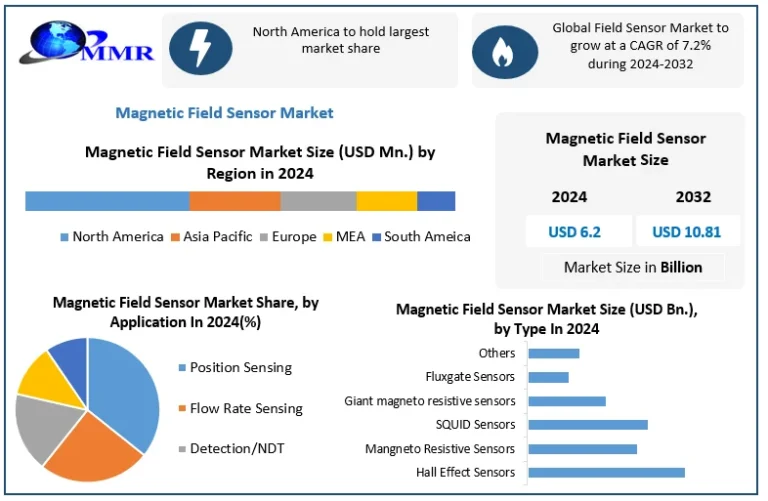
Dominant Segment: Hall-effect sensors continue to lead the technology landscape, favored for their robustness, cost-effectiveness, and broad applicability in high-volume automotive and industrial applications.
Fastest-Growing Segment: TMR (Tunnel Magnetoresistance) technology is witnessing the most rapid growth, as manufacturers pivot toward higher precision, lower power consumption, and improved stray-field immunity in safety-critical systems.
Regional Leadership: The Asia-Pacific region dominates the global market share, fueled by massive demand for consumer electronics and the region’s concentration of EV and electronics manufacturing hubs.
Technology Shift: A migration toward integrated system-on-chip (SoC) solutions and digital interfaces (I2C/SPI) is enabling the seamless integration of magnetic sensing into resource-constrained IoT devices and robotics.
Why This Matters Now
The convergence of the EV revolution and the industrial IoT mandate has turned magnetic field sensing into a foundational requirement for modern mechanical engineering. Beyond simple speed or position triggers, these sensors are now essential for complex tasks like battery management, torque sensing, and regenerative braking. For electronics manufacturers, this necessitates a move toward intelligent, self-calibrating sensor nodes that can provide real-time telemetry, enabling predictive maintenance and AI-driven motion control without increasing the power budget of the end system.
Market Overview
Valued at USD 6.2 billion in 2024, the global magnetic field sensor market is projected to reach USD 10.81 billion by 2032, growing at a CAGR of 7.2%. The industry is underpinned by a transition from standalone hardware to integrated sensing ecosystems. As end-users prioritize precision, safety, and operational efficiency, the demand for sensors that deliver high reliability and low latency is becoming the primary driver of procurement cycles in automotive and industrial sectors.
Key Trends Driving Growth
Vehicle Electrification: The shift toward EVs is dramatically increasing the volume of magnetic sensors required for motor control, inverter efficiency, and high-voltage current monitoring.
Industrial Automation: Robotics and automated assembly lines require high-precision position and angular sensing to maintain operational accuracy and ensure safety.
Sensor Miniaturization: The transition to MEMS (Micro-Electro-Mechanical Systems) and advanced semiconductor packaging is reducing the sensor footprint, allowing for deeper integration into compact consumer wearables and medical diagnostic implants.
Segment Insights
Hall Effect Sensors (Dominant Segment): Remains the backbone of the market due to its unmatched balance of performance-to-price, serving as the default choice for automotive speed and position sensing.
TMR Sensors (Fastest-Growing Technology): Gaining critical mass in applications requiring extreme sensitivity and low noise, particularly in medical magnetocardiography and high-end industrial robotics.
Automotive (Dominant End-User): Remains the largest revenue-generating sector, driven by ADAS, infotainment, and the growing requirement for safety-qualified (AEC-Q100) electronic components.
Regional Growth Story
Asia-Pacific: Holds the largest market share, sustained by China, Japan, and South Korea’s massive industrial manufacturing bases and their leadership in the global EV supply chain.
North America: Leads in terms of high-value innovation and R&D-driven demand, particularly in aerospace, defense, and high-end industrial automation sectors.
Europe: Focused on stringent environmental and safety-led building/automotive standards, driving demand for high-performance, energy-efficient sensor arrays.
Competitive Landscape
The competitive landscape is defined by established semiconductor leaders and specialized sensing technology firms. Success is increasingly tied to the maturity of the software API, ease of integration into larger IoT platforms, and the ability to provide safety-critical certification. Companies like Allegro MicroSystems, Honeywell, and Infineon are setting the pace by providing digitally addressable sensing solutions that reduce time-to-market for OEMs. Mergers and partnerships are increasingly focused on acquiring sensor-fusion software expertise to help process raw magnetic data at the edge.
Recent Developments
AI-Enhanced Sensing: Integration of machine learning at the edge, allowing sensors to filter out stray magnetic fields and environmental noise automatically.
Low-Power Innovation: Breakthroughs in sensing material chemistry have significantly reduced power consumption, extending battery life for wireless and portable monitoring devices.
Safety Standards: Increasing adoption of ASIL (Automotive Safety Integrity Level) compliant sensors to meet the strict requirements of autonomous driving systems.
Strategic Implications
For semiconductor and electronics leaders, the magnetic field sensor market is becoming a key component of the “Industrial Intelligence” layer. Suppliers that can provide integrated, low-power, and data-ready sensing modules will capture the bulk of the value share. Investing in sensors that offer high stray-field immunity and self-diagnostics will be the key differentiator for securing design-ins with high-volume industrial and automotive OEMs.
Future Outlook
The next phase of the magnetic field sensor market will be defined by “Contextual Sensing,” where sensors use edge-based AI to recognize specific mechanical behaviors—such as motor wear-and-tear or component fatigue—and trigger preventative maintenance alerts, effectively bridging the gap between raw hardware and actionable machine intelligence.
Analyst Perspective
“The magnetic sensor market has moved past the era of ‘simple detection.’ We are now entering an age where the intelligence is embedded at the sensor level. Manufacturers who focus on TMR-based precision and robust digital integration will dominate the future of both EV powertrain management and the next generation of industrial robotics.”
— Rucha Deshpande
About Maximize Market Research
Maximize Market Research Pvt. Ltd. (MMR) is a global market research and consulting company that provides reliable, data-focused, and practical business insights. The firm serves a wide range of industries, including healthcare, pharmaceuticals, technology, automotive, electronics, chemicals, personal care, and consumer goods. Through market forecasts, competitive analysis, strategic consulting, and industry impact assessments, MMR helps organizations understand changing market conditions, identify growth opportunities, and make informed business decisions for long-term success.
2nd Floor, Navale IT Park Phase 3
Pune Banglore Highway, Narhe
Pune, Maharashtra 411041, India
+91 9607365656
sales@maximizemarketresearch.com
Report URL: https://www.maximizemarketresearch.com/market-report/global-magnetic-field-sensor-market/66549/
