Key Highlights
Dominant Segment: Hydraulic drilling jars lead the market, favored for their superior precision in delivering controlled, repeatable impact loads, which is essential for complex directional and horizontal drilling.
Fastest-Growing Segment: “Smart” or electronic drilling jars equipped with embedded sensors for real-time performance monitoring are experiencing the highest growth, as operators demand greater predictability in harsh downhole conditions.
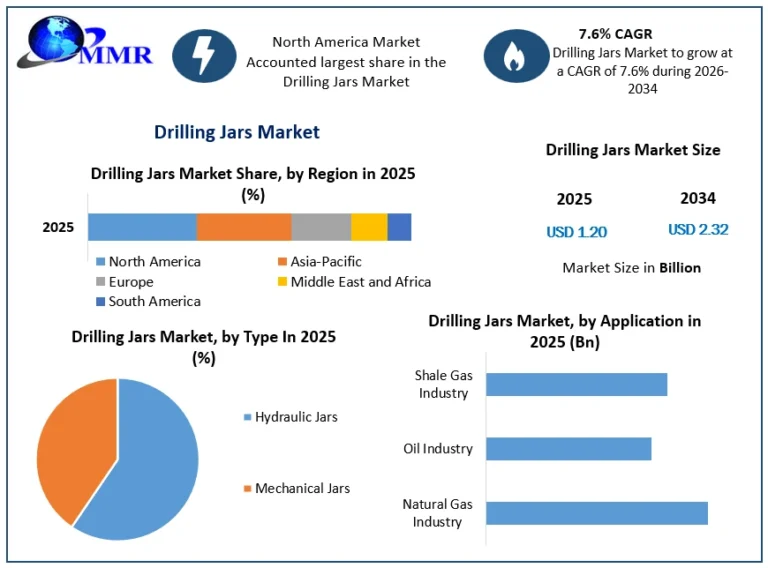
Regional Leadership: North America dominates the global market, anchored by extensive, mature oilfield infrastructure and continuous R&D investment in shale gas and tight oil extraction.
Technology Shift: A migration toward integrated digitalization, where jars act as data nodes, providing force, temperature, and activation timing telemetry to surface systems to prevent mechanical sticking before it happens.
Why This Matters Now
The convergence of volatile energy prices and the need for operational lean-ness has turned stuck-pipe incidents into one of the most expensive risks in drilling. Every hour a rig is idled due to stuck equipment represents significant financial loss. Consequently, drilling jars are no longer treated as “utility items” but as mission-critical equipment. For operators, this necessitates a move toward intelligent jars that offer higher reliability and diagnostic capabilities to navigate the unpredictable pressures of modern unconventional reservoirs.
Market Overview
The global drilling jars market is on a robust growth trajectory, with market valuations projected to reach between USD 1.7 billion and USD 2.5 billion by 2034. The industry is underpinned by a transition from basic mechanical designs to complex hydro-mechanical and electronic hybrid systems. As exploration pushes into ultra-deepwater and remote frontier regions, the demand for high-tensile, heat-resistant, and precision-engineered jar strings is dictating the trajectory of global drilling procurement.
Key Trends Driving Growth
Unconventional Resource Exploration: The shift toward shale gas and tight oil reserves in North America and emerging regions requires specialized, high-strength jars capable of managing the high-pressure, high-temperature (HPHT) environments found in these formations.
Offshore/Deepwater Expansion: Growing global investment in deepwater oilfield exploration creates a high demand for jars that provide consistent performance at extreme depths, where fishing operations are prohibitively expensive.
Real-Time Monitoring Integration: The integration of sensors into drilling jars allows operators to monitor “jar health” in real-time, reducing the risk of premature tool failure and enabling proactive maintenance cycles.
Segment Insights
Hydraulic Jars (Dominant Segment): Remain the industry standard due to their adaptability; they allow the operator to adjust the jarring force from the surface, providing critical flexibility in diverse geological formations.
Mechanical Jars (Reliability Segment): Continue to hold significant share, particularly in simpler drilling applications, due to their lower cost and robust, uncomplicated mechanical architecture.
Smart Electronic Jars (Fastest-Growing Technology): Emerging as the premium choice for high-stakes projects where every second of drilling time is optimized by digital feedback loops.
Regional Growth Story
North America: Leads the market, driven by the United States’ leadership in shale gas technology and a mature, tech-forward oilfield services sector.
Asia-Pacific: Represents the fastest-growing market, fueled by rapid industrialization and aggressive hydrocarbon exploration initiatives in China and India.
Middle East & Africa: Remains a stable stronghold for high-capacity jar deployment, supported by large-scale, long-term offshore and conventional field development projects.
Competitive Landscape
The competitive landscape is defined by a mix of major oilfield service titans and specialized downhole tool manufacturers. Success is increasingly tied to “smart” capabilities and global support footprints. Companies like Schlumberger, Halliburton, Baker Hughes, and Weatherford are setting the pace by integrating jar diagnostics into their broader drilling automation platforms. Meanwhile, specialized niche players are focusing on high-durability materials and customized engineering for specific geologies.
Recent Developments
Digital Hydraulic Jars: Introduction of jars that include digital interfaces for surface communication, allowing for immediate confirmation of jar activation and impact force.
Material Innovation: New alloy applications that provide higher tensile and torsional strength, enabling jars to withstand the extreme torque required by ultra-extended reach drilling (ERD).
Automation Partnerships: Collaborations between downhole tool manufacturers and software firms to create “auto-jarring” workflows that detect sticking events and automatically fire the jar at optimal force settings.
Strategic Implications
For semiconductor and hardware leaders in the energy sector, the drilling jar is becoming a key node in the “Connected BHA” (Bottom Hole Assembly). Suppliers that can provide integrated, low-power sensing modules that survive the extreme vibration and shock of jarring will capture a premium market share. Investing in reliable, high-speed data transmission from the BHA to the surface will be the key differentiator for securing design-ins with high-volume drilling OEMs.
Future Outlook
The next phase of the drilling jars market will be defined by “Autonomous Recovery,” where the jar system intelligently adapts its hydraulic delay and impact force in real-time without operator intervention, effectively bridging the gap between passive mechanical protection and fully autonomous, self-recovering drilling systems.
Analyst Perspective “The drilling jars market has moved past the era of ‘simple impact tools.’ We are now entering an age where the performance of the entire drilling operation is limited by the intelligence and reliability of the bottom-hole assembly. Manufacturers who master the integration of sensor-driven diagnostics with robust hydraulic performance will dictate the future of drilling efficiency in the world’s most difficult reservoirs.” — Rucha Deshpande
About Maximize Market Research Maximize Market Research Pvt. Ltd. (MMR) is a global market research and consulting company that provides reliable, data-focused, and practical business insights. The firm serves a wide range of industries, including healthcare, pharmaceuticals, technology, automotive, electronics, chemicals, personal care, and consumer goods. Through market forecasts, competitive analysis, strategic consulting, and industry impact assessments, MMR helps organizations understand changing market conditions, identify growth opportunities, and make informed business decisions for long-term success.
2nd Floor, Navale IT Park Phase 3
Pune Banglore Highway, Narhe
Pune, Maharashtra 411041, India
+91 9607365656
sales@maximizemarketresearch.com
Report URL: https://www.maximizemarketresearch.com/market-report/drilling-jars-market/77622/
