Key Highlights
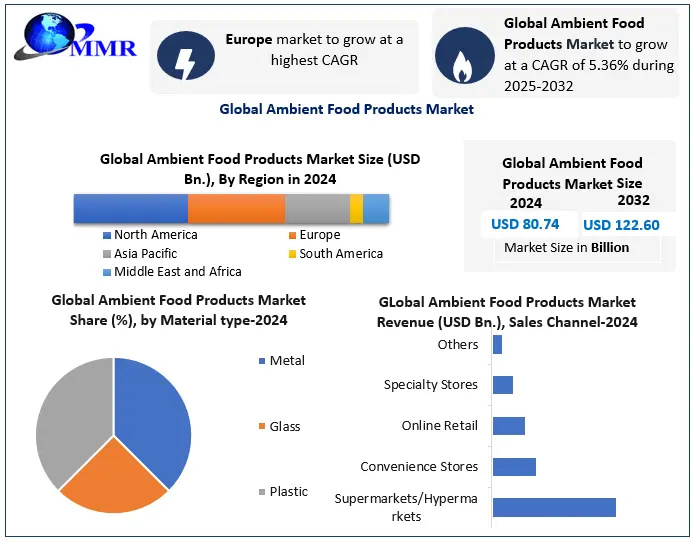
The global ambient food products market achieved a baseline economic valuation of USD 80.74 billion in 2024, confirming its scale within international packaging manufacturing.
Commercial deployment exhibits a steady compound annual growth rate (CAGR) of 5.36%, with net revenue projected to reach USD 122.60 billion by 2032.
Flexible plastics command the dominant segment position, outperforming legacy packaging types due to continuous structural material innovations.
Advanced pouches emerge as the fastest-growing sub-segment, accelerated by widespread adoption of modified atmospheric packaging, vacuum seals, and retort systems.
High steel prices act as a central market driver, forcing converters and FMCG brand owners to swap rigid metal formats for lightweight plastic substrates.
Why This Matters Now
The global packaging sector faces immediate disruption as consumer packaged goods portfolios transition away from carbon-intensive, cold-chain dependent distribution models. Brand owners cannot absorb the soaring operational costs and real-time energy vulnerabilities associated with continuous refrigeration. The integration of high-barrier ambient packaging directly solves this logistics vulnerability by allowing perishable items to remain shelf-stable under room-temperature conditions.
For converters and resin manufacturers, this transition demands a rapid reallocation of capital toward advanced flexible packaging technologies. High metal costs have transformed traditional rigid steel cans from low-cost baselines into premium balance-sheet burdens. Organizations that secure production capacity for multi-layer retort pouches and barrier materials will gain pricing power, while legacy converters reliant on un-plasticized metal stamping risk structural margin deterioration.
Market Overview
Ambient food processing Market relies on pasteurization and sterilization techniques to eliminate microbial pathogens, requiring subsequent packaging formats to maintain absolute environmental isolation. High-barrier packaging substrates serve as the primary defensive shield separating ambient food formulations from atmospheric degradation.
The global ambient food products market established a market size of USD 80.74 billion in 2024. Pushed by aggressive demand for shelf-life optimization and logistics flexibility, the sector advances at a 5.36% CAGR, building an industry footprint worth USD 122.60 billion by the end of the 2025–2032 forecast matrix.
Key Trends Driving Growth
The mainstream migration toward long-distance food distribution channels remains the core catalyst for advanced flexible packaging procurement. To ship culinary sauces, cooking oils, ready meals, and dairy items across global supply lines without quality degradation, manufacturers utilize robust barrier systems. These materials offer resistance against ambient degradation agents, including oxygen, water vapor, carbon dioxide, and external fragrances.
Concurrently, severe cost pressures within the primary metals supply chain have altered conversion dynamics. High steel prices have forced global FMCG brands to actively minimize their dependence on traditional canning formats. This dynamic accelerates the adoption of flexible pouches, which utilize lightweight engineering to reduce freight tonnage and minimize downstream extended producer responsibility penalties.
Segment Insights
Dominant Segment: Plastic substrates represent the dominant material type, capturing the largest industry share due to its superior puncture resistance and performance in packing large items and perishable foods.
Fastest-Growing Segment: Pouches constitute the fastest-growing sub-segment within flexible packaging, driven by accelerated commercial deployment of sophisticated modified atmospheric packaging, vacuum processing, and retort technologies.
Material Diversification: The underlying manufacturing matrix spreads across Polyethylene Terephthalate (PET), Polyethylene (PE), Polypropylene (PP), Polystyrene (PS), alongside glass, steel, and aluminum layers.
Application Spectrum: End-use manufacturing activity is diversified across ready meals, sauces and dressings, meat and seafood, dairy, bakery products, confectionery, fruits, vegetables, and beverages.
Regional Growth Story
Regional distribution shows distinct shifts between high-volume consumer demand and rapid infrastructural adoption. North America held a commanding 35% market share in 2024 and is positioned to dictate aggregate demand volumes through 2032. The region’s trajectory is shaped by strict government regulations targeting food waste reductions, alongside intensive consumer demand for advanced convenience food packaging.
Meanwhile, the Asia-Pacific region is expanding at the fastest growth rate throughout the assessment timeframe. This momentum is propelled by massive demographic demand for ambient-stable fruits, vegetables, dairy arrays, and meats across India and China. In China particularly, a rapid rise in ambient yogurt consumption—valued by consumers for its nutritional benefits and freedom from cold-chain refrigeration—is creating major opportunities for localized flexible packaging lines.
Competitive Landscape
The global ambient packaging landscape is defined by aggressive technological competition between tier-one converters, machinery integrators, and integrated material providers. Industry operations are led by dominant participants, including Amcor Limited, Tetra Pak, Mondi Group, DuPont, Bemis, RPC Group, Alexir Partnership, Marsden Packaging Limited, Alto Packaging, SIG Combibloc Obeikan, Rexam, Ampac LLC, KM Packaging, FFP Packaging Solutions Ltd., and Excelsior Technologies.
Technology leadership is determined by a supplier’s capacity to deliver ultra-thin, high-barrier laminates that do not compromise food safety or line automation speeds. Major players are investing heavily in mono-material flexible developments to counter regulatory pressures while maintaining the oxygen transmission rates previously achieved by multi-material structures. The consolidation of corporate capacity via targeted partnerships allows these market leaders to offer complete, end-to-end processing and filling systems, locking brand owners into proprietary packaging ecosystems.
Recent Developments
Advanced converting systems have successfully integrated retort pouch technology into high-speed automated filling lines, lowering per-unit production costs for ready-meal brands.
Material suppliers have rolled out next-generation barrier films featuring improved resistance to oxygen and water vapor transmission under high ambient humidity.
Vacuum pouch designs have been optimized to pack dry ingredients, dried fruits, and nuts with minimal material usage.
Strategic partnerships between flexible packaging converters and major Asian dairy brands have expanded to support the deployment of shelf-stable yogurt lines.
Strategic Implications
For packaging procurement executives and corporate sustainability officers, the expansion of the ambient market requires an immediate audit of material choices. Continuing to utilize heavyweight, rigid steel formats under high metal pricing trends directly erodes gross margins. Converters must realign production lines toward flexible plastic architectures to remain cost-competitive.
Furthermore, engineering teams must leverage barrier innovations to meet the rigorous food safety requirements of international retail networks. Moving toward flexible plastics requires investment in automated modified atmospheric packaging and retort sterilization systems to prevent shelf-life degradation. The optimal corporate strategy involves executing long-term supplier agreements with high-barrier film manufacturers to insulate production operations from spot-market material disruptions.
Future Outlook
The next iteration of the ambient food packaging sector will see advanced barrier technologies integrated directly into standard flexible plastic lines, rendering old-fashioned, high-weight rigid designs obsolete in high-volume retail categories. As international logistics lines face increased strain, the demand for light-weighted formats will intensify to reduce transport carbon footprint allocations.
The industry will favor flexible converters that deliver extreme barrier performance with mono-material profiles suitable for current recycling infrastructure. Ultimately, market dominance will belong to agile packaging developers who successfully scale high-speed retort pouch manufacturing, while legacy operations bound to traditional rigid steel conversion methods will experience systematic loss of market share.
Analyst Perspective
“The structural transition toward flexible plastic packaging within the ambient food market highlights a permanent change in how FMCG brands approach supply chain durability. By utilizing advanced barrier films and retort pouch technologies, manufacturers are successfully bypassing the high energy costs of cold chains while protecting products from environmental degradation. As high metal prices continue to challenge rigid formats, the ability to supply lightweight, thin-profile flexible solutions will remain the primary differentiator for global converters.” — Dr. Ashwini Jadhav, Lead Analyst, Maximize Market Research
About Maximize Market Research
Maximize Market Research Pvt. Ltd. (MMR) is a global market research and consulting company that provides reliable, data-focused, and practical business insights. The firm serves a wide range of industries, including healthcare, pharmaceuticals, technology, automotive, electronics, chemicals, personal care, and consumer goods. Through market forecasts, competitive analysis, strategic consulting, and industry impact assessments, MMR helps organizations understand changing market conditions, identify growth opportunities, and make informed business decisions for long-term success.
2nd Floor, Navale IT Park Phase 3
Pune Banglore Highway, Narhe
Pune, Maharashtra 411041, India
+91 9607365656
sales@maximizemarketresearch.com
