Key Highlights
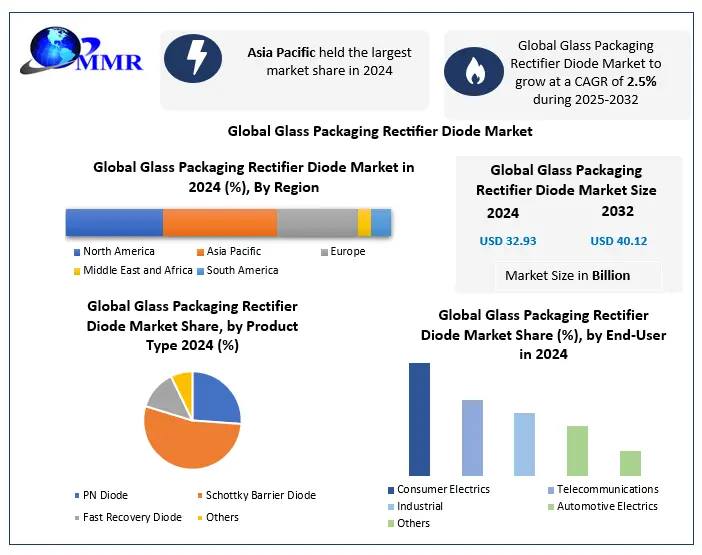
The global glass packaging rectifier diode market established a solid base valuation of USD 32.93 billion in 2024, demonstrating its vast footprint within modern power hardware.
Total market revenue is projected to expand at a steady compound annual growth rate (CAGR) of 2.5%, moving total market value to USD 40.12 billion by 2032.
The Schottky barrier diode configuration stands as the dominant product segment, expanding rapidly due to widespread utilization in radio frequency mixers and fast switching circuits.
Consumer electronics commands the largest industry vertical allocation, driven by massive production volumes for high-frequency rectification in compact adapters.
Asia-Pacific retains its position as the dominant regional market, utilizing extensive fabrication capacity and electronics exports to control international component supply chains.
Leading players like ON Semiconductor, Vishay, and NXP are shifting engineering resources toward AEC-Q101 qualified, lead-free packages to support automotive platforms.
Why This Matters Now
The rapid deployment of 5G cellular infrastructure and the mass production of electric vehicles (EVs) have pushed traditional plastic-encapsulated power components to their physical limits. High-frequency power management systems generate severe thermal stress and operate in intense electrical environments that degrade standard packages, causing premature system failures. Glass packaging rectifier diodes solve this core operational vulnerability by providing permanent hermetic seals that isolate sensitive silicon junctions from moisture, dust, and high temperatures.
For foundries, fabless designers, and electronics OEMs, the shift toward glass-passivated architecture is a structural necessity to protect system integrity. As product dimensions shrink, power circuits must tolerate higher energy densities and surge levels without increasing physical space. Device manufacturers who secure reliable access to high-voltage, glass-packaged diodes will ensure long-term hardware reliability, while slow-moving component buyers will face higher product failure rates and warranty liabilities.
Market Overview
A Glass packaging rectifier diode Market is a specialized discrete semiconductor component encased in a protective glass shell, engineered to maintain low leakage current and high surge tolerance under extreme operations. These properties make the devices essential for high-frequency rectification within switched-mode power supplies (SMPS), telecom power amplifiers, and industrial inverters. The global glass packaging rectifier diode market reached a valuation of USD 32.93 billion in 2024. Moving forward at a 2.5% CAGR, the total sector revenue will reach USD 40.12 billion by 2032, driven by intensive integration across advanced consumer, telecom, and automotive electronics.
This hardware transition reflects a broader shift toward advanced packaging technologies capable of enduring harsh operational fields. The glass passivation layer functions by eliminating structural impurities on the silicon surface, which lowers reverse leakage current to less than 1 microampere. Consequently, electronics manufacturing services (EMS) providers rely heavily on these robust components to maximize power conversion ratios across compact consumer devices and complex industrial power grids.
Key Trends Driving Growth
The accelerated rollout of 5G telecom base stations stands as a major driver for high-frequency optoelectronic and power infrastructure. Base station radio frequency amplifiers require extreme thermal stability and high surge tolerance to process rapid data signals without signal degradation. Glass-passivated diodes meet these strict parameters, preventing current leakage even when operating continuously at temperatures up to 175 degrees Celsius.
Concurrently, the consumer electronics market is undergoing a major wave of miniaturization. Compact consumer hardware, including true wireless stereo (TWS) earbuds, smartwatches, and ultra-thin laptops, requires power circuits that fit into highly restricted internal spaces. Glass-packaged variants provide a minimal physical footprint while ensuring high moisture resistance, enabling reliable deployment in wearable technology exposed to sweat and humidity. Furthermore, the expansion of EV onboard electronics requires durable components for DC-DC converters, where high surge handling is critical.
Segment Insights
Dominant Segment: Schottky barrier diodes represent the largest product type, leading the market due to their unique metal-semiconductor junction design that excels in voltage clamping, reverse current prevention, and switched-mode power architectures.
Fastest-Growing Segment: High-frequency fast recovery diodes are expanding rapidly, driven by the immediate hardware needs of telecom infrastructure and fast-charging power adapters.
Dominant Industry Vertical: The consumer electronics sector commands the largest application share, utilizing high component volumes across smartphones, digital cameras, laptops, and televisions to manage internal voltage levels.
Fastest-Growing Industry Vertical: Automotive electronics is accelerating at a rapid pace, as tier-one vehicle suppliers ramp up procurement of qualified discrete diodes for onboard vehicle converters and battery management systems.
Regional Growth Story
The geography of the global glass packaging rectifier diode market matches the world’s primary semiconductor fabrication clusters and component export centers. The Asia-Pacific region held the largest market share in 2024 and will maintain its dominant position through the forecast window. Massive manufacturing operations across China, Japan, Taiwan, South Korea, India, and Vietnam drive this regional concentration. The presence of numerous small and medium-sized manufacturers, combined with strong government-backed 5G infrastructure initiatives, provides Asia-Pacific with significant local supply chain advantages.
Meanwhile, North America—led by advanced engineering hubs in the United States, Canada, and Mexico—focuses primarily on high-reliability applications for aerospace, defense, and premium electric vehicle platforms. In Europe, the market is sustained by rigorous automotive manufacturing standards and clean energy transition initiatives in Germany, the United Kingdom, France, Italy, and the Netherlands. Emerging opportunities are also scaling across South America, anchored by Brazil and Argentina, alongside steady telecom expansions throughout the Middle East and Africa.
Competitive Landscape
The global competitive market is defined by a distinct separation between western tier-one innovators focused on high-margin automotive designs and fast-moving Asian firms optimizing high-volume production costs. Top market participants include ON Semiconductor, Vishay, Diodes Incorporated, Bourns, Microchip, Microsemi, NXP, Panasonic, Renesas Electronics, Toshiba, Yangjie Technology, Littelfuse, Kexin, ANOVA, and ROHM. Product leadership is determined by achieving high voltage tolerance and surge limits while meeting international environmental mandates.
ON Semiconductor leverages a vertically integrated manufacturing model to deliver AEC-Q101 qualified diodes with surge current ratings up to 30 amperes, defending its position against rising wide bandgap alternatives. In contrast, Asian competitors like Littelfuse and Taiwan Semiconductor focus on price-sensitive consumer electronics lines to capture high-volume manufacturing market share. This bifurcation forces leading producers to continuously form deep development partnerships with major device OEMs and foundry operators to protect their core margins.
Recent Developments
Vishay (US) – March 2024: Launched the VS-xxTxx series of ultra-miniature glass-passivated rectifiers for 5G RF power amplifiers, achieving less than 1 microampere reverse leakage current alongside a 200 degrees Celsius surge tolerance.
NXP (Netherlands) – September 2024: Introduced AEC-Q101 qualified glass diodes for EV onboard chargers, delivering 40% lower power loss versus traditional silicon options to capture market share among Chinese automakers.
Yangjie Technology (China) – November 2024: Unveiled cost-optimized glass diodes for solar inverters, securing a 20% share of Asia’s renewable energy component market under China’s 14th Five-Year Plan.
Toshiba (Japan) – January 2025: Scaled high-volume production of lead-free glass diodes compliant with EU RoHS 3.0 regulations, responding directly to a 30% surge in demand from premium smartphone suppliers.
Renesas Electronics (Japan) – May 2025: Formed a strategic partnership with TSMC to co-develop gallium nitride (GaN) compatible glass packaging for high-frequency rectifiers inside emerging 6G telecom base stations.
Strategic Implications
For procurement executives and hardware OEMs, the steady 2.5% CAGR expansion of the glass packaging rectifier diode market indicates a tightening supply chain for high-reliability components. Relying on basic plastic-molded diodes for high-frequency architectures creates significant long-term product risks. Supply chain managers must secure dedicated foundry capacity and align with vendors that are proactively adapting to lead-free environmental standards.
Furthermore, engineering teams must evaluate packaging compatibility as wide bandgap materials like GaN and SiC gain traction. The collaboration between Renesas and TSMC to develop GaN-compatible glass packaging demonstrates that packaging technology must evolve alongside silicon architecture. OEMs should integrate advanced glass-passivated components like Vishay’s ultra-miniature series or NXP’s low-loss automotive diodes directly into initial system layouts to reduce future redesign costs and satisfy changing international environmental laws.
Future Outlook
The global electronics market is transitioning toward complex, high-frequency computing platforms that require exceptional power efficiency at the edge. As international environmental bodies enforce strict regulations like EU RoHS 3.0, the market for standard lead-based discrete components will contract rapidly. Future value will flow toward manufacturers who can deliver miniaturized, hermetically sealed, lead-free glass diodes that integrate seamlessly with wide bandgap semiconductors.
Semiconductor companies that successfully optimize their advanced packaging technologies to support GaN and SiC power grids will lock in multi-year contracts with tier-one automotive and 5G infrastructure providers. Conversely, component suppliers stuck manufacturing legacy, high-loss silicon parts will face intense pricing pressure and eventual exclusion from premium electronics supply chains.
Analyst Perspective
“The continuous transition toward high-frequency electronics and compact power circuits has made robust hermetic protection an operational necessity for modern hardware design. With the global glass packaging rectifier diode market moving toward a USD 40.12 billion valuation by 2032, component reliability in harsh fields remains a critical differentiator for electronics OEMs. Manufacturers that invest heavily in miniaturized, lead-free glass passivation will capture stable long-term revenue as automotive and 5G telecom platforms scale globally.” — Alpana Patil, Lead Analyst, Maximize Market Research
About Maximize Market Research
Maximize Market Research Pvt. Ltd. (MMR) is a global market research and consulting company that provides reliable, data-focused, and practical business insights. The firm serves a wide range of industries, including healthcare, pharmaceuticals, technology, automotive, electronics, chemicals, personal care, and consumer goods. Through market forecasts, competitive analysis, strategic consulting, and industry impact assessments, MMR helps organizations understand changing market conditions, identify growth opportunities, and make informed business decisions for long-term success.
2nd Floor, Navale IT Park Phase 3
Pune Banglore Highway, Narhe
Pune, Maharashtra 411041, India
+91 9607365656
sales@maximizemarketresearch.com
