Key Highlights
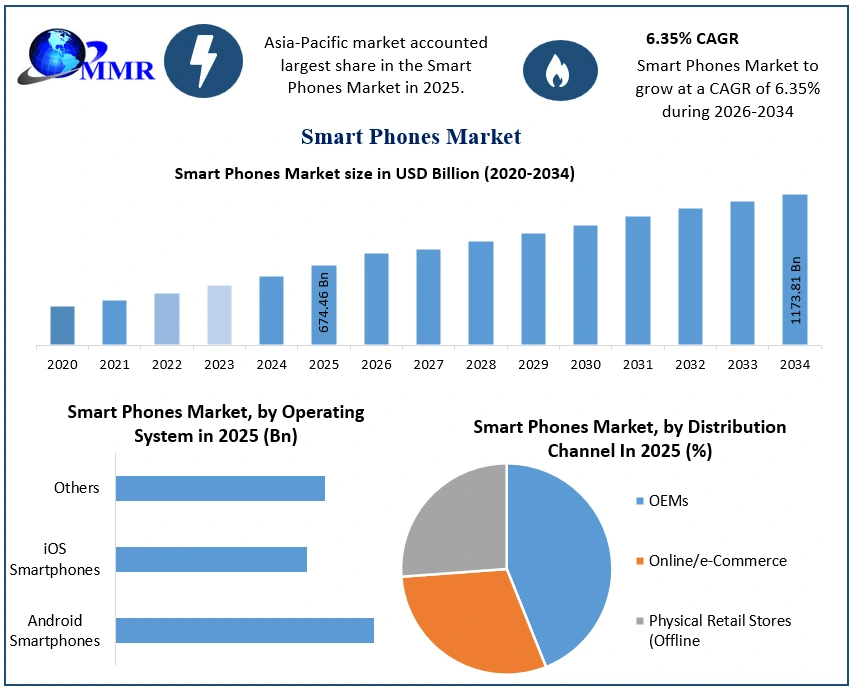
Global market valuation scaling from USD 674.46 billion in 2025 to USD 1173.81 billion by 2034.
Total market revenue compounding at a documented 6.35% CAGR throughout the 2026 to 2034 timeframe.
The Android operating system captured the dominant market share in 2025 across all major original equipment manufacturers.
On-device artificial intelligence features and advanced foldable form factors represent the primary catalysts for premium hardware shifts.
The Asia-Pacific region secured the leading global market share position in 2025, driven by intense regional telecom modernization.
Why This Matters Now Mobile computing environments are experiencing a fundamental shift as the introduction of on-device generative AI capabilities and local machine learning models turns standard handheld devices into powerful edge computing nodes. Chief information officers, enterprise technology buyers, and telecom operators face sudden strategic displacement if they continue to view mobile devices as simple communication endpoints rather than critical pieces of integrated enterprise software platforms. The massive transition toward hybrid cloud computing setups and virtualized applications means that hardware limits directly dictate the execution speed of corporate automation tools. Upgrading to next-generation intelligent device lines is a key baseline requirement for supporting distributed security tools, improving remote worker output, and maximizing corporate digital transformation returns.
Furthermore, the simultaneous rollout of high-capacity 5G infrastructure requires advanced internal phone components to process dense data streams without creating performance bottlenecks or draining battery life. Technology executives and application developers are prioritizing high-performance, AI-optimized chipsets to deploy cloud-linked productivity applications safely at the device edge. For chief technology officers and institutional investors, dedicating capital to advanced mobile ecosystem architectures provides a direct structural mechanism for optimizing long-term platform economics. The ongoing expansion of digital sovereignty rules further pushes developers to anchor identity verification and data isolation protocols within tamper-proof hardware compartments. Ultimately, updating these vital end-user entryways provides the necessary foundation to run advanced business applications while mitigating remote data security risks.
Market Overview Smart Phones Market size Rapidly expanding global internet penetration and the continuous modernization of regional telecom architectures are prompting international corporate entities and consumers to accelerate hardware replacement cycles. The global smartphone market reached a clear valuation of USD 674.46 billion in 2025 and is projected to scale to an estimated USD 1173.81 billion by 2034, advancing at a steady 6.35% compound annual growth rate from 2026 to 2034. This broad capital expansion reflects a major industrial transition toward AI-driven computational computing, where devices process complex language and visual tasks locally to minimize data transfer costs.
What changed across the modern technology landscape is the definitive replacement of basic data-tethered devices that functioned merely as static access panels for remote mainframes. Why now? The rapid rollout of localized high-speed networks, paired with an explosion in consumer demand for media streaming and digital commerce solutions, requires massive processing upgrades at the individual point of interaction. This modernization shift directly benefits hyper-scale cloud providers, semiconductor developers, and platform ecosystems by creating highly interactive user endpoints that feed real-time analytics pipelines. What happens next is a complete transition toward ambient user experiences, where foldable form factors and specialized neural processing chips execute complex digital tasks without manual application shifting.
Key Trends Driving Growth Escalating requirements for continuous remote application connectivity and the rapid growth of mobile commerce frameworks are driving corporate infrastructure buyers to deploy highly integrated device fleets over legacy communication setups. To capture expanding market share, global hardware manufacturers are embedding advanced AI processing capabilities and biometric tracking arrays directly into active component designs. This tactical transition allows enterprise software deployments to function seamlessly at the user edge, executing automated compliance checks, location-based asset routing, and predictive text synthesis without relying on continuous remote server pings.
Simultaneously, the widespread market saturation within highly developed economies has forced original equipment manufacturers to heavily emphasize alternative premium device characteristics to stimulate upgrade cycles. Component suppliers are responding by introducing flexible, folding display layers and health-monitoring sensor suites that cater to changing consumer well-being and productivity expectations. By giving premium buyers clear operational improvements that justify premium pricing tiers, these design iterations lower the overall replacement lifespan of corporate hardware fleets while protecting data properties through hardware-level security measures. Additionally, the increasing emphasis on sustainable procurement initiatives drives manufacturers to use recycled internal metals, building competitive advantages among environmentally regulated enterprise accounts.
Segment Insights
Dominant Operating System Segment: The Android OS segment held the major market share in 2025. Developed by Google LLC, this open system configuration continues to capture the highest volume allocation across the industry because almost every global original equipment manufacturer utilizes the platform to run handsets outside of Apple’s proprietary line.
Core Technological Catalyst: AI-powered feature sets and next-generation processing units represent the fastest-expanding drivers within the high-end tier, serving as the core differentiation mechanism needed to stimulate premium handheld device upgrades.
Form Factor Growth Focus: Foldable smart phones and innovative modular architectures establish promising new structural opportunities, providing larger workspace visual fields without breaking standard pocket-sized mobility constraints.
Regional Growth Story The Asia-Pacific region held the largest global smartphone market share in 2025, positioning itself as the primary geographic engine of technical development and high-volume consumer demand. This top regional standing is supported by the concentration of massive domestic technology companies and manufacturing ecosystems across China, India, South Korea, and Japan. Widespread digital infrastructure investments and intense government-backed telecom modernization initiatives across these developing centers create massive, high-density user populations that rapidly adopt both budget-friendly mid-range units and premium AI-enabled flagship designs.
Concurrently, mature western marketplaces including North America and Europe maintain strong structural baseline revenues, supported by high consumer device replacement frequencies and extensive 5G network coverage. The presence of major corporate buying hubs in the United States, the United Kingdom, and Germany ensures a continuous demand for advanced enterprise-grade smartphones capable of supporting virtualized applications and strict corporate security tools. These highly developed regions rely on attractive carrier financing options and device trade-in frameworks to lower the entry barriers for premium hardware tiers, helping operators monetize their massive network virtualization investments.
Competitive Landscape The competitive architecture of the global smartphone market features prominent technology specialists and engineering giants, including Apple Inc., Samsung Electronics, ZTE Corp., Huawei Technologies Co., Ltd., Sony Corp., Vivo Communication Technology Co. Ltd., Xiaomi Corporation, and Guangdong OPPO Mobile Telecommunications Corp., Ltd. The strategic actions of these industry participants signal a clear transition away from selling basic hardware components toward securing expansive, closed platform ecosystems. Market dominance and pricing power are no longer won through camera resolution specifications alone, but through a manufacturer’s capacity to build deeply integrated hardware-software layers that tie users to automated lifestyle and workspace platforms.
Leading market participants are leveraging their massive supply chain controls to bundle premium hardware devices with cloud subscriptions and personalized protection plans, creating high technical barriers for incoming market challengers. This approach changes enterprise procurement parameters, shifting business buyers away from simple device cost evaluations toward long-term operating platform compatibility optimizations. As global software requirements continue to centralize around AI capabilities, manufacturers that control their own silicon chip architectures possess a clear competitive edge, allowing them to optimize software execution speeds while maintaining superior device margin structures over specialized hardware assemblers.
Recent Developments
Global hardware manufacturers have increased the deployment of advanced on-device neural processing units to automate complex computational photography and real-time voice translation workflows for premium users.
Primary software developers have expanded native integration between mobile operating systems and extended reality engineering frameworks to secure immediate application compatibility with emerging virtualized workspaces.
Core component providers have introduced advanced silicon chipsets featuring improved power and thermal efficiencies to handle continuous generative AI workloads without causing device battery degradation.
Strategic Implications For enterprise executives, chief information officers, and institutional investment groups, the exponential scaling of the intelligent mobile sector dictates an immediate modernizing of end-user system access points. Relying on legacy, unmanaged handheld hardware introduces severe data vulnerability risks, undermining broader digital transformation strategies and eroding overall corporate workflow productivity. Corporate leaders must view next-generation smartphone deployment as a mandatory requirement for executing scalable multi-site enterprise software modernization strategies.
Allocating substantial capital toward integrated, AI-ready mobile platforms allows modern enterprises to build highly responsive, self-correcting field workflows that reduce technical debt while stabilizing remote operational expenses. Furthermore, investors evaluating the digital infrastructure space must thoroughly analyze the software integration and ecosystem locking capabilities of target corporations, as future financial returns depend entirely on executing high-volume digital commerce transactions smoothly across highly distributed mobile environments.
Future Outlook The global trajectory of the mobile platform market will be defined by the absolute integration of physical edge devices with highly automated, cloud-hosted enterprise orchestration networks. As multi-site corporate business models require continuous workforce collaboration and real-time field data processing, smartphone operations will shift toward intelligent, context-aware platforms that execute workflow adjustments autonomously.
The divide between future corporate market participants will be absolute: digital leaders will exploit highly automated, AI-linked smartphone platforms to achieve unmatched transaction velocity and superior resource efficiency, while digital laggards will struggle with escalating operational expenses, technical data blindness, and catastrophic security breaches associated with legacy authentication architectures.
Analyst Perspective “The rapid expansion of edge computing demand and the sudden emergence of sophisticated on-device generative AI are forcing a structural rewrite of traditional mobile platforms,” states Yash Ghosalkar, Research Analyst at Maximize Market Research. “Market value is migrating rapidly away from basic hardware assembly toward intelligent, hyper-connected endpoint ecosystems that process transaction, security, and collaboration data instantly at the user edge.”
About Maximize Market Research
Maximize Market Research Pvt. Ltd. (MMR) is a global market research and consulting company that provides reliable, data-focused, and practical business insights. The firm serves a wide range of industries, including healthcare, pharmaceuticals, technology, automotive, electronics, chemicals, personal care, and consumer goods. Through market forecasts, competitive analysis, strategic consulting, and industry impact assessments, MMR helps organizations understand changing market conditions, identify growth opportunities, and make informed business decisions for long-term success.
2nd Floor, Navale IT Park Phase 3
Pune Banglore Highway, Narhe
Pune, Maharashtra 411041, India
+91 9607365656
sales@maximizemarketresearch.com
