Key Highlights
The physical custom and enthusiast tier acts as a primary revenue generator, supported by gasket-mounted builds.
Professional coding workflows and high-speed data entry fields remain the dominant end-user deployment hubs.
The hot-swappable printed circuit board layout serves as the fastest-expanding product configuration.
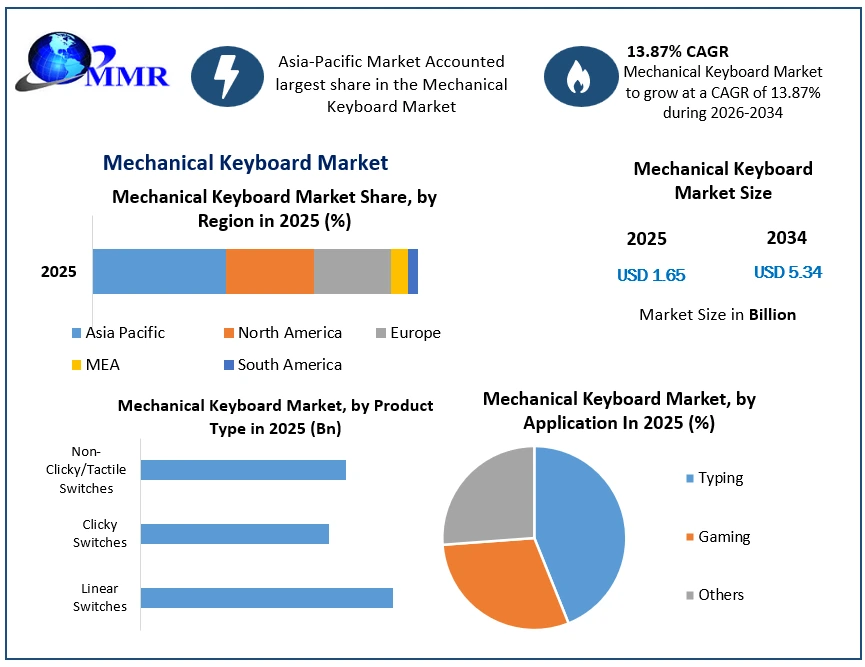
North America secured the dominant market share position, driven by mature corporate office updates.
The Asia-Pacific region recorded the fastest growth rate due to localized electronics manufacturing hubs.
Why This Matters Now Corporate workflow environments are experiencing severe structural transformation as deep digital transformation initiatives and remote operation strategies force a complete rewrite of peripheral lifecycle management. Chief information officers, enterprise technology buyers, and software providers face immediate employee output issues if they continue to distribute cheap, flexible membrane keyboards that cause frequent typing errors, accelerate muscle fatigue, and require rapid replacement. Upgrading to advanced, high-durability mechanical keyboard arrays is no longer a simple office accessory choice, but a core baseline architectural dependency needed to maximize typing output, secure hardware durability, and satisfy modern worker comfort demands.
Furthermore, the widespread corporate pivot toward advanced enterprise software modernization and extensive hybrid cloud data processing requires continuous, accurate data input tools that can withstand long, high-intensity operating cycles. Enterprise technology leaders are prioritizing custom, programmably layered input devices to give data operators and software engineers superior tactical speed over legacy office layouts. For technology strategists and institutional investors, allocating capital to high-performance workspace peripherals provides an immediate operational edge by lowering long-term replacement expenses while boosting daily task completion efficiency. The ongoing rollout of cloud-hosted SaaS frameworks makes the implementation of sturdy, high-performance edge hardware a primary focus for maintaining stable platform economics.
Market Overview Mechanical Keyboard Market size Expanding consumer preferences for precise tactile response, paired with aggressive corporate digital transformation initiatives, are prompting global business entities to redirect equipment procurement budgets toward advanced mechanical keyboard layouts. The international marketplace experiences solid ongoing development as companies realize that high-grade key-switch mechanisms actively reduce systemic data entry error rates. This sustained capital expenditure demonstrates an industry-wide transition toward robust hardware components, where durable individual copper contacts replace standard rubber domes to ensure prolonged reliability.
What changed across contemporary workspace topologies is the definitive replacement of low-cost, short-lived membrane boards that degraded rapidly under continuous usage cycles. Why now? The rapid evolution of multi-device remote work configurations, combined with massive investments in secure corporate data center operations, requires highly efficient and precise end-user inputs to feed data analytics applications smoothly. This modernization shift directly benefits large-scale software engineering teams, high-volume financial data centers, and advanced administrative hubs by lowering peripheral failure rates. What happens next is a complete market transition toward specialized custom and ergonomic configurations, where built-in multi-system switching and sound-dampened layers become standard enterprise specifications.
Key Trends Driving Growth Escalating workspace procurement expenses and the universal prioritization of workplace comfort systems are driving corporate infrastructure buyers to implement durable mechanical typing tools over traditional membrane designs. To capture expanding market share, peripheral system manufacturers are embedding advanced structural attributes directly into baseline office hardware lines. This architectural modification allows enterprise technology buyers to source hot-swappable models that allow rapid, toolless switch replacements, extending device usage lifespans without requiring full unit replacement.
Simultaneously, the widespread corporate adoption of multi-device pairing frameworks has altered the baseline requirements for peripheral connectivity, forcing original equipment manufacturers to deliver tri-mode wireless setups (Wired, 2.4GHz, and Bluetooth). Tech-savvy professionals are responding to these changes by utilizing portable layouts that transition smoothly between laptops, tablets, and main workstations without requiring multiple distinct input sets. By providing stable hardware structures that decrease typos before they slow down critical programming sprints, these intelligent peripheral models optimize daily workflow velocity while protecting physical investments. Additionally, ongoing engineering improvements addressing component acoustics—such as utilizing integrated foam dampeners and pre-lubricated linear switches—allow companies to deploy mechanical devices across shared workspaces without increasing noise levels.
Segment Insights
Dominant Segment: Professional coding and office workflows secured the largest application market share. This leading position expands because modern enterprise organizations require high-durability input arrays that minimize data entry errors and reduce repetitive strain injuries during extended programming shifts.
Fastest-Growing Segment: Hot-swappable printed circuit boards (PCBs) represent the fastest-expanding configuration within the hardware matrix. This rapid expansion occurs because corporate IT groups can instantly replace damaged switches or modify tactile resistance without executing specialized technical soldering routines.
Regional Growth Story North America maintained the dominant global market position, capturing the largest aggregate revenue share and positioning itself to lead technical procurement standards throughout the forecast timeframe. This top geographic standing is supported by the rapid integration of high-end workspace architectures across enterprise IT environments in the United States and Canada. This mature corporate landscape generates continuous, high-volume demands for premium typing peripherals as major technology enterprises look to optimize long-term office hardware lifecycles.
Concurrently, the Asia-Pacific region has emerged as the fastest-growing geographical market, projected to achieve the highest compound annual growth rate over the coming years. Developing manufacturing hubs and rapid urbanization across major regional giants like China, India, Japan, and South Korea drive this intense growth curve. The continuous presence of large electronics assembly centers in China, paired with growing corporate cloud software deployments throughout India, creates a perfect environment for the rapid adoption of highly durable mechanical keyboards across regional commercial zones.
Competitive Landscape The competitive architecture of the global mechanical keyboard market features prominent technology specialists and engineering brands, including Cherry GmbH, Corsair Gaming Inc., Logitech International S.A., Razer Inc., SteelSeries, DuckyChannel International Co., Ltd., Keychron, and HyperX. The strategic movements of these primary industry participants indicate a major transition away from simple consumer accessory design toward the deployment of highly integrated enterprise hardware suites. Competitive strength is no longer won through basic gaming configurations alone, but through a manufacturer’s capacity to deliver standardized, multi-system hardware profiles that blend with enterprise device management software.
Leading industry participants are leveraging their massive supply chain controls to bundle high-end mechanical peripherals with corporate workspace agreements, building high commercial barriers for incoming market followers. This operational integration shifts corporate procurement parameters away from simple upfront hardware unit cost metrics toward long-term total cost of ownership reductions and hardware lifecycle reliability. As international enterprise software requirements continue to consolidate, providers offering standardized global peripheral lines paired with robust warranty frameworks are winning key corporate accounts from budget-tier component providers.
Recent Developments
Global component manufacturers have increased the deployment of integrated sound-dampened layers within commercial mechanical keyboards to automate noise reduction inside modern shared office spaces.
Primary software developers have expanded native integration between keyboard layout programming tools and centralized cloud profiles to secure seamless configuration synchronization for hybrid corporate workers.
Core product providers have introduced enhanced tri-mode wireless connectivity chipsets within their core peripheral portfolios to maximize battery lifespans and maintain secure data transmissions across enterprise local networks.
Strategic Implications For chief technology officers, corporate strategists, and institutional investors, the exponential scaling of the high-end peripheral market dictates an immediate modernization of physical office equipment pipelines. Relying on legacy, easily worn membrane typing panels introduces severe input friction, undermining broader digital transformation investments and eroding baseline worker productivity. Corporate leaders must view mechanical keyboard deployment as a core strategic asset requirement for executing scalable multi-site enterprise software modernization goals.
Allocating substantial capital toward integrated, long-lasting hardware options allows modern enterprises to build highly efficient, comfortable workspace environments that reduce technical debt while stabilizing long-term hardware support expenses. Furthermore, investors evaluating the digital infrastructure sector must thoroughly analyze the product lifecycle advantages of target corporations, as future financial returns depend entirely on executing high-volume digital workflows smoothly across highly distributed operational ecosystems.
Future Outlook The global trajectory of the workplace input hardware market will be defined by the absolute integration of durable, customizable physical nodes with highly scalable, cloud-hosted enterprise device management systems. As multi-site corporate business models require continuous workforce data processing and real-time task optimization, peripheral hardware deployment will shift toward highly reliable mechanical architectures that handle continuous workloads seamlessly.
The divide between future corporate market participants will be absolute: digital leaders will exploit highly automated, durable mechanical keyboard setups to achieve unmatched transaction velocity and superior resource efficiency, while digital laggards will struggle with escalating replacement costs, employee physical fatigue, and prohibitive IT support overhead associated with short-lived legacy hardware configurations.
Analyst Perspective “The convergence of heavy digital transformation requirements and long-term hardware durability demands is forcing a wholesale reconfiguration of corporate workplace procurement models,” states Yash Ghosalkar, Research Analyst at Maximize Market Research. “Enterprise value is migrating rapidly away from traditional low-cost membrane devices toward automated, long-lasting mechanical hardware ecosystems that process critical data inputs reliably at the corporate edge.”
About Maximize Market Research
Maximize Market Research Pvt. Ltd. (MMR) is a global market research and consulting company that provides reliable, data-focused, and practical business insights. The firm serves a wide range of industries, including healthcare, pharmaceuticals, technology, automotive, electronics, chemicals, personal care, and consumer goods. Through market forecasts, competitive analysis, strategic consulting, and industry impact assessments, MMR helps organizations understand changing market conditions, identify growth opportunities, and make informed business decisions for long-term success.
2nd Floor, Navale IT Park Phase 3
Pune Banglore Highway, Narhe
Pune, Maharashtra 411041, India
+91 9607365656
sales@maximizemarketresearch.com
