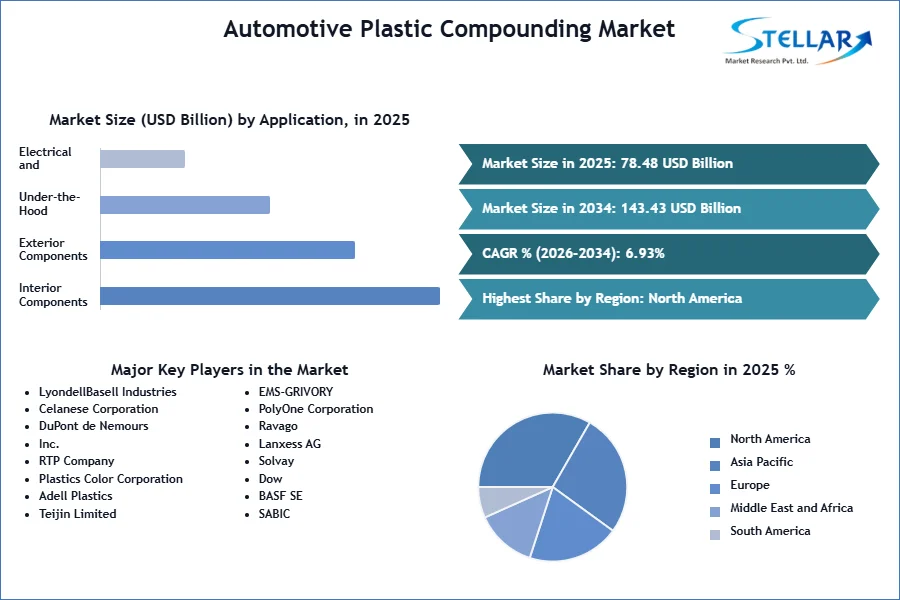
The Automotive Plastic Compounding Market has become a critical segment of the automotive materials industry by providing engineered plastic compounds that enhance vehicle performance, safety, durability, and sustainability. Plastic compounds are created by blending base polymers with additives, fillers, reinforcements, and performance-enhancing materials to achieve specific mechanical, thermal, and chemical properties required for automotive applications.
With automakers focusing on reducing vehicle weight to improve fuel efficiency and extend electric vehicle driving range, plastic compounds are increasingly replacing traditional materials such as steel and aluminum in both interior and exterior vehicle components. Continuous innovations in polymer technology and recyclable materials are further accelerating market growth.
Vehicle Lightweighting Drives Market Growth
One of the primary drivers of the Automotive Plastic Compounding Market is the automotive industry’s emphasis on lightweight vehicle design. Reducing vehicle weight improves fuel economy, lowers emissions, and enhances overall performance.
Automotive plastic compounds are widely used in:
Interior trim components
Instrument panels
Door panels
Bumpers
Under-the-hood components
Exterior body parts
Battery enclosures
Electrical connectors
These materials offer an excellent balance of strength, durability, and reduced weight.
𝐃𝐨𝐰𝐧𝐥𝐨𝐚𝐝 𝐅𝐫𝐞𝐞 𝐏𝐃𝐅 𝐁𝐫𝐨𝐜𝐡𝐮𝐫𝐞: https://www.stellarmr.com/report/req_sample/Automotive-Plastic-Compounding-Market/1407
Electric Vehicle Production Expands Material Demand
The rapid growth of electric vehicles is creating significant opportunities for advanced plastic compounds. Lightweight materials help maximize battery efficiency while meeting stringent safety and performance requirements.
Key EV applications include:
Battery housing systems
Thermal management components
Charging connectors
High-voltage cable insulation
Lightweight structural parts
Electronic control modules
Cooling system components
Interior assemblies
High-performance polymers contribute to improved vehicle efficiency and extended driving range.
Advanced Polymer Technologies Improve Performance
Continuous innovation in material science is enhancing the properties of automotive plastic compounds for demanding operating conditions.
Major material advancements include:
Polypropylene (PP) compounds
Polyamide (PA) compounds
Polycarbonate (PC) blends
Acrylonitrile Butadiene Styrene (ABS)
Polybutylene Terephthalate (PBT)
Thermoplastic elastomers (TPE)
Glass fiber-reinforced plastics
Carbon fiber-reinforced composites
These engineered materials deliver improved impact resistance, thermal stability, chemical resistance, and dimensional accuracy.
𝐃𝐨𝐰𝐧𝐥𝐨𝐚𝐝 𝐅𝐫𝐞𝐞 𝐏𝐃𝐅 𝐁𝐫𝐨𝐜𝐡𝐮𝐫𝐞: https://www.stellarmr.com/report/req_sample/Automotive-Plastic-Compounding-Market/1407
Sustainability and Circular Economy Shape Innovation
Environmental regulations and sustainability initiatives are encouraging manufacturers to develop recyclable and bio-based automotive plastic compounds.
Industry initiatives include:
Recycled polymer compounds
Bio-based engineering plastics
Low-carbon manufacturing
Closed-loop recycling systems
Lightweight composite materials
Sustainable additives
Reduced production waste
Circular material management
These innovations support environmental goals while maintaining high product performance.
Smart Manufacturing Accelerates Production Efficiency
Digital manufacturing technologies are improving quality control and production efficiency across the Automotive Plastic Compounding Market.
Emerging technologies include:
AI-powered material optimization
Automated compounding systems
IoT-enabled production monitoring
Predictive maintenance
Digital quality inspection
Advanced process analytics
Robotics in material handling
Smart manufacturing platforms
These technologies help manufacturers improve consistency, reduce waste, and increase production capacity.
Regional Market Insights
Asia Pacific
Asia Pacific dominates the Automotive Plastic Compounding Market, driven by large-scale automotive manufacturing, rapid electric vehicle production, expanding polymer industries, and strong investments in advanced materials across China, India, Japan, and South Korea.
Europe
Europe remains a major market due to strict vehicle emission regulations, increasing EV adoption, strong automotive research capabilities, and growing demand for sustainable lightweight materials.
North America
North America continues to experience substantial growth through advancements in automotive manufacturing, rising investments in electric mobility, and increasing adoption of high-performance engineering plastics.
Latin America, Middle East, and Africa
These regions are witnessing steady market expansion as automotive production, industrial development, and infrastructure investments continue to grow.
Competitive Landscape
The Automotive Plastic Compounding Market is highly competitive, with polymer manufacturers, specialty chemical companies, automotive material suppliers, and compound producers investing in research and development.
Major competitive strategies include:
Development of advanced engineering plastics
Lightweight material innovation
Sustainable polymer solutions
Strategic partnerships with automakers
Manufacturing capacity expansion
Product portfolio diversification
Recycling technology investments
Global market expansion
Companies continue focusing on improving material performance, sustainability, and cost efficiency.
Emerging Opportunities
Several trends are expected to shape future market growth:
Bio-based automotive plastics
Recycled engineering polymers
Carbon fiber-reinforced thermoplastics
AI-driven material development
Smart composite materials
Additive manufacturing for automotive parts
High-performance EV polymers
Circular economy material solutions
These innovations are expected to strengthen vehicle performance while supporting sustainable automotive manufacturing.
Future Outlook
The future of the Automotive Plastic Compounding Market remains highly promising as automakers accelerate the transition toward lightweight, energy-efficient, and electric vehicles. Continued advancements in polymer science, recycling technologies, smart manufacturing, and sustainable material development will drive long-term market expansion.
Manufacturers that prioritize innovation, environmental sustainability, high-performance materials, and close collaboration with automotive OEMs will be well positioned to capitalize on evolving industry requirements.
Conclusion
The Automotive Plastic Compounding Market is playing a vital role in enabling next-generation vehicle manufacturing through lightweight, durable, and high-performance materials. Rising electric vehicle production, stringent fuel efficiency regulations, rapid advances in polymer technology, and growing demand for sustainable materials are creating significant opportunities across the automotive value chain.
As the automotive industry continues embracing electrification, digital manufacturing, and environmentally responsible production, the Automotive Plastic Compounding Market is expected to witness sustained long-term growth, benefiting material manufacturers, automotive OEMs, component suppliers, and investors worldwide.
