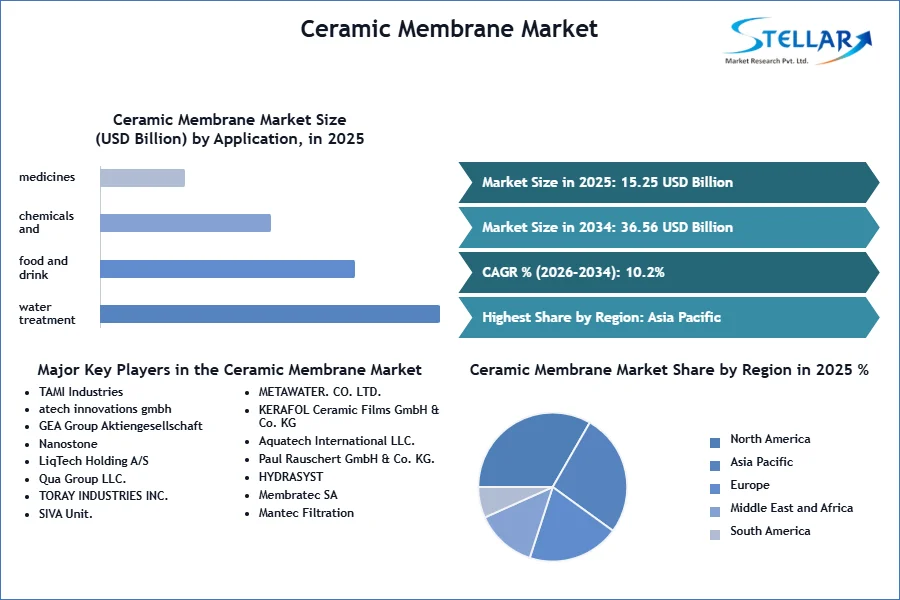
The Ceramic Membrane Market has become an essential part of modern filtration and separation systems by offering exceptional durability, chemical resistance, thermal stability, and long operational life. Unlike polymeric membranes, ceramic membranes are manufactured using inorganic materials such as alumina, zirconia, titania, and silicon carbide, making them suitable for demanding industrial environments where high temperatures, corrosive chemicals, and abrasive materials are common.
Growing concerns over water scarcity, stricter environmental regulations, and increasing industrial wastewater generation are encouraging industries to invest in advanced membrane filtration technologies. Ceramic membranes are increasingly used across water treatment, food and beverage processing, pharmaceuticals, biotechnology, chemicals, oil and gas, and mining applications.
Rising Demand for Water Treatment Drives Market Growth
One of the primary drivers of the Ceramic Membrane Market is the growing need for efficient water purification and wastewater treatment solutions. Governments and industries are investing heavily in sustainable water management to address increasing water stress and environmental challenges.
Ceramic membranes are widely used in:
Municipal water treatment
Industrial wastewater treatment
Drinking water purification
Desalination pre-treatment
Food and beverage processing
Pharmaceutical manufacturing
Biotechnology applications
Chemical processing
Their ability to remove suspended solids, bacteria, oils, and other contaminants makes them ideal for critical filtration processes.
𝐃𝐨𝐰𝐧𝐥𝐨𝐚𝐝 𝐅𝐫𝐞𝐞 𝐏𝐃𝐅 𝐁𝐫𝐨𝐜𝐡𝐮𝐫𝐞: https://www.stellarmr.com/report/req_sample/Ceramic-Membrane-Market/1412
Industrial Expansion Increases Demand for Advanced Filtration
Rapid industrialization across emerging economies is creating strong demand for reliable filtration technologies capable of operating under harsh conditions.
Key industrial applications include:
Chemical manufacturing
Petrochemical processing
Oil and gas production
Dairy processing
Beverage clarification
Mining operations
Electronics manufacturing
Pulp and paper production
Ceramic membranes improve product quality while reducing operational downtime and maintenance costs.
Superior Material Properties Enhance Performance
Continuous advancements in material science are improving the efficiency and durability of ceramic membrane systems.
Major technological developments include:
Alumina-based membranes
Zirconia ceramic membranes
Titania membrane technologies
Silicon carbide membranes
Multi-channel membrane designs
Nanofiltration systems
Ultrafiltration membranes
Microfiltration technologies
These innovations offer excellent resistance to fouling, high temperatures, extreme pH levels, and aggressive cleaning agents.
𝐃𝐨𝐰𝐧𝐥𝐨𝐚𝐝 𝐅𝐫𝐞𝐞 𝐏𝐃𝐅 𝐁𝐫𝐨𝐜𝐡𝐮𝐫𝐞: https://www.stellarmr.com/report/req_sample/Ceramic-Membrane-Market/1412
Sustainability and Circular Water Management Fuel Adoption
As industries prioritize environmental sustainability, ceramic membrane technology is playing a vital role in reducing water consumption and supporting resource recovery.
Industry initiatives include:
Water reuse and recycling
Zero liquid discharge (ZLD) systems
Energy-efficient filtration
Industrial water recovery
Reduced chemical consumption
Sustainable wastewater management
Circular water economy
Environmental compliance solutions
These initiatives help organizations achieve both sustainability goals and operational efficiency.
Digital Monitoring and Smart Filtration Improve Operations
The integration of digital technologies is enhancing membrane system performance and maintenance.
Emerging innovations include:
IoT-enabled filtration monitoring
AI-powered predictive maintenance
Automated process control
Real-time water quality monitoring
Cloud-based asset management
Digital twin technology
Remote diagnostics
Smart industrial filtration systems
These technologies optimize membrane lifespan while reducing maintenance costs and unplanned downtime.
Regional Market Insights
Asia Pacific
Asia Pacific dominates the Ceramic Membrane Market, driven by rapid industrialization, expanding manufacturing activities, increasing investments in water infrastructure, and stringent environmental regulations across China, India, Japan, and South Korea.
Europe
Europe remains a significant market due to strong environmental legislation, advanced wastewater treatment infrastructure, and growing adoption of sustainable industrial processes.
North America
North America continues to witness substantial growth through increasing investments in industrial water treatment, pharmaceutical manufacturing, food processing, and municipal water management projects.
Latin America, Middle East, and Africa
These regions are experiencing steady market expansion as governments invest in desalination, wastewater recycling, industrial development, and sustainable water resource management.
Competitive Landscape
The Ceramic Membrane Market is highly competitive, with membrane manufacturers, water treatment companies, industrial filtration providers, and material science firms investing heavily in innovation.
Major competitive strategies include:
Development of high-performance membrane materials
Expansion of filtration product portfolios
Strategic partnerships
Sustainable manufacturing processes
Smart filtration system integration
Research and development investments
Global production capacity expansion
Customized industrial filtration solutions
Companies continue focusing on improving filtration efficiency, membrane durability, and cost-effective operation.
Emerging Opportunities
Several trends are expected to shape future market growth:
Advanced wastewater recycling
Green hydrogen water purification
Smart membrane monitoring
AI-driven filtration optimization
Industrial resource recovery
Membrane bioreactor (MBR) technologies
Sustainable desalination systems
High-performance nanoceramic membranes
These innovations are expected to improve filtration efficiency while supporting industrial sustainability initiatives.
Future Outlook
The future of the Ceramic Membrane Market remains highly promising as industries continue investing in advanced filtration systems, water reuse technologies, and environmentally responsible manufacturing. Continued advancements in ceramic materials, digital monitoring, automation, and membrane engineering will support long-term market expansion.
Manufacturers that prioritize innovation, energy efficiency, sustainability, and application-specific membrane solutions will be well positioned to capitalize on the increasing global demand for high-performance filtration technologies.
Conclusion
The Ceramic Membrane Market is playing a pivotal role in addressing global water treatment challenges and enabling efficient industrial separation processes. Rising investments in wastewater treatment, stricter environmental regulations, rapid industrialization, and technological innovation are creating significant growth opportunities across multiple industries.
As organizations increasingly focus on water conservation, resource efficiency, and sustainable production, the Ceramic Membrane Market is expected to witness sustained long-term growth, benefiting membrane manufacturers, water treatment providers, industrial processors, environmental technology companies, and investors worldwide.
