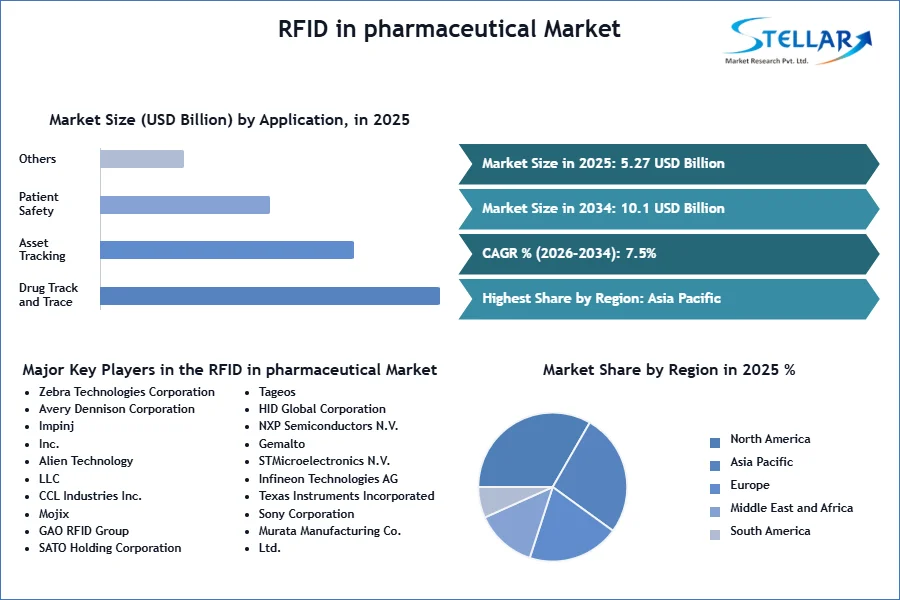
The RFID in Pharmaceutical Market has become a critical component of the pharmaceutical industry’s digital transformation. Radio Frequency Identification (RFID) technology enables real-time identification, tracking, and monitoring of pharmaceutical products throughout the supply chain. By attaching RFID tags to medicines, medical devices, and packaging, manufacturers, distributors, hospitals, and pharmacies can achieve greater visibility, reduce operational inefficiencies, and strengthen patient safety.
Growing concerns over counterfeit drugs, increasing regulatory requirements for product serialization, and the need for end-to-end supply chain transparency are accelerating the adoption of RFID solutions across the global pharmaceutical sector. Integration with cloud computing, Internet of Things (IoT), artificial intelligence (AI), and analytics platforms is further enhancing the value of RFID-enabled pharmaceutical operations.
Increasing Demand for Drug Traceability Drives Market Growth
One of the primary drivers of the RFID in Pharmaceutical Market is the growing need to monitor pharmaceutical products throughout their lifecycle. Real-time tracking improves product authenticity, inventory accuracy, and supply chain efficiency.
RFID technology is widely used for:
Drug serialization
Inventory management
Asset tracking
Cold chain monitoring
Warehouse automation
Distribution tracking
Hospital pharmacy management
Clinical trial logistics
These applications help reduce losses, minimize stock shortages, and improve operational visibility.
𝐃𝐨𝐰𝐧𝐥𝐨𝐚𝐝 𝐅𝐫𝐞𝐞 𝐏𝐃𝐅 𝐁𝐫𝐨𝐜𝐡𝐮𝐫𝐞: https://www.stellarmr.com/report/req_sample/Global-RFID-in-Pharmaceutical-Market-/1415
Anti-Counterfeiting Initiatives Accelerate Adoption
Counterfeit medicines remain a major global healthcare challenge, prompting pharmaceutical companies and regulatory authorities to strengthen product authentication measures.
Key RFID-enabled capabilities include:
Product authentication
Real-time product verification
Tamper detection
End-to-end supply chain visibility
Batch and lot tracking
Recall management
Expiration date monitoring
Diversion prevention
These features enhance patient safety while protecting pharmaceutical brands from fraud and unauthorized distribution.
Smart Supply Chains Improve Operational Efficiency
The pharmaceutical industry is increasingly investing in intelligent supply chain technologies to improve logistics performance and reduce manual processes.
Emerging technologies include:
IoT-enabled RFID systems
Cloud-based inventory management
AI-powered demand forecasting
Automated warehouse management
Smart logistics platforms
Predictive inventory analytics
Digital supply chain monitoring
Real-time shipment tracking
These technologies improve inventory accuracy, reduce waste, and enhance decision-making across pharmaceutical operations.
𝐃𝐨𝐰𝐧𝐥𝐨𝐚𝐝 𝐅𝐫𝐞𝐞 𝐏𝐃𝐅 𝐁𝐫𝐨𝐜𝐡𝐮𝐫𝐞: https://www.stellarmr.com/report/req_sample/Global-RFID-in-Pharmaceutical-Market-/1415
Regulatory Compliance Supports Market Expansion
Global regulatory frameworks increasingly require greater transparency and traceability throughout pharmaceutical supply chains.
RFID solutions help organizations support:
Drug serialization requirements
Product traceability
Good Distribution Practices (GDP)
Good Manufacturing Practices (GMP)
Quality assurance
Electronic documentation
Regulatory audits
Recall readiness
Compliance with these standards improves operational reliability while strengthening consumer confidence.
Healthcare Digitalization Creates New Opportunities
The rapid digital transformation of healthcare systems is expanding the role of RFID beyond supply chain management.
Growing applications include:
Smart hospital inventory
Medical device tracking
Vaccine distribution monitoring
Laboratory sample management
Automated pharmacy dispensing
Healthcare asset management
Connected healthcare infrastructure
Digital patient safety initiatives
These innovations improve workflow efficiency while supporting better healthcare outcomes.
Regional Market Insights
North America
North America leads the RFID in Pharmaceutical Market, supported by advanced healthcare infrastructure, strict pharmaceutical regulations, strong adoption of digital health technologies, and increasing investments in intelligent supply chain solutions.
Europe
Europe continues to witness strong market growth due to stringent pharmaceutical traceability regulations, expanding healthcare digitalization, and increasing emphasis on product authentication and patient safety.
Asia Pacific
Asia Pacific is projected to register the fastest growth, driven by expanding pharmaceutical manufacturing, rising healthcare investments, increasing adoption of automation technologies, and stronger anti-counterfeiting initiatives across countries such as China, India, Japan, and South Korea.
Latin America, Middle East, and Africa
These regions are gradually strengthening market adoption through improvements in pharmaceutical infrastructure, regulatory modernization, and growing investments in healthcare supply chain technologies.
Competitive Landscape
The RFID in Pharmaceutical Market is highly competitive, with RFID technology providers, healthcare IT companies, pharmaceutical packaging manufacturers, and supply chain solution providers investing heavily in innovation.
Major competitive strategies include:
Development of advanced RFID tags
Cloud-based tracking platforms
IoT integration
AI-powered analytics
Smart packaging solutions
Strategic technology partnerships
Global distribution network expansion
Research and development investments
Companies continue focusing on improving tracking accuracy, system interoperability, security, and operational efficiency.
Emerging Opportunities
Several trends are expected to shape future market growth:
AI-powered pharmaceutical logistics
Blockchain-enabled drug traceability
Smart pharmaceutical packaging
Real-time cold chain monitoring
Digital twin supply chain management
Predictive inventory optimization
Connected hospital ecosystems
Automated compliance reporting
These innovations are expected to improve pharmaceutical supply chain resilience while enhancing patient safety and regulatory compliance.
Future Outlook
The future of the RFID in Pharmaceutical Market remains highly promising as pharmaceutical companies continue investing in digital supply chains, intelligent inventory systems, and advanced product authentication technologies. Continued innovation in RFID, IoT, AI, and cloud computing will support more transparent, secure, and efficient pharmaceutical operations.
Organizations that prioritize end-to-end traceability, regulatory compliance, automation, and patient-centric supply chain management will be well positioned to capitalize on the expanding opportunities within the global pharmaceutical ecosystem.
Conclusion
The RFID in Pharmaceutical Market is transforming pharmaceutical manufacturing and distribution by enabling real-time product tracking, inventory optimization, counterfeit prevention, and enhanced regulatory compliance. Growing demand for digital healthcare infrastructure, intelligent logistics, and secure pharmaceutical supply chains is creating significant opportunities across the industry.
As healthcare systems increasingly embrace connected technologies and data-driven operations, the RFID in Pharmaceutical Market is expected to witness sustained long-term growth, benefiting pharmaceutical manufacturers, healthcare providers, logistics companies, technology vendors, and patients worldwide.
