The Speed Sensor Market is experiencing robust growth as industries increasingly adopt automation, intelligent transportation systems, and connected vehicles. Speed sensors play a critical role in measuring rotational or linear speed in automotive systems, industrial machinery, aerospace equipment, railways, and consumer electronics. Their ability to deliver accurate real-time data enhances operational efficiency, safety, and equipment reliability.
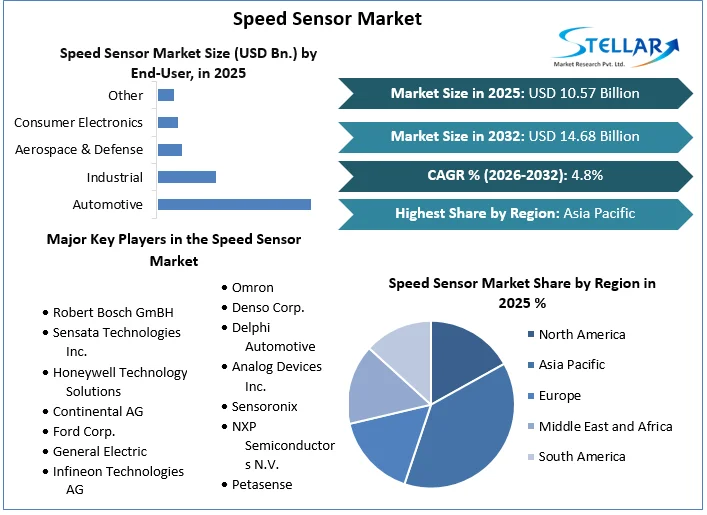
According to Stellar Market Research, the Speed Sensor Market was valued at USD 10.57 Bn. in 2025 and is expected to reach nearly USD 14.68 billion by 2032, expanding at a CAGR of 4.8% during 2025–2032. Growing investments in electric vehicles (EVs), Industry 4.0 technologies, smart manufacturing, and predictive maintenance are expected to remain the primary drivers of market expansion throughout the forecast period.
Download Free PDF Brochure: https://www.stellarmr.com/report/req_sample/Speed-Sensor-Market/200
Market overview
Speed sensors are indispensable components in modern automation systems. These sensors detect the speed and rotational movement of motors, wheels, shafts, turbines, conveyors, and various industrial equipment. They provide critical input to electronic control units (ECUs), enabling precise monitoring and efficient system performance.
In the automotive sector, speed sensors support anti-lock braking systems (ABS), electronic stability control (ESC), transmission control, engine management, and advanced driver assistance systems (ADAS). Beyond automotive applications, speed sensors are widely utilized in manufacturing plants, robotics, aerospace systems, medical devices, renewable energy installations, and railway infrastructure.
As industries increasingly rely on data-driven operations and real-time monitoring, demand for high-performance speed sensing technologies continues to rise worldwide.
Key market growth drivers
Rapid expansion of the automotive industry
One of the strongest drivers of the Speed Sensor Market is the continued growth of global automobile production. Modern vehicles require multiple speed sensors to ensure efficient operation of braking systems, engine management, transmission control, cruise control, and traction control systems.
The rapid adoption of electric vehicles further increases sensor demand, as EVs require highly accurate speed monitoring for electric motors, regenerative braking, and battery management systems.
Growth of industrial automation
Manufacturing companies are accelerating investments in Industry 4.0 technologies to improve productivity, reduce operational costs, and minimize equipment downtime. Speed sensors play a vital role in automated production lines by providing continuous feedback for motors, conveyors, robotic systems, and industrial machinery.
Predictive maintenance solutions increasingly rely on speed sensor data to identify performance issues before equipment failures occur, reducing maintenance expenses and improving operational efficiency.
Rising adoption of smart transportation
Governments worldwide are investing in intelligent transportation infrastructure that depends on advanced sensing technologies. Speed sensors enable traffic monitoring, railway control systems, autonomous mobility solutions, and logistics automation.
Growing urbanization and increasing transportation efficiency requirements continue to create new growth opportunities across developed and emerging economies.
Emerging market opportunities
The transition toward connected vehicles and autonomous driving technologies presents substantial opportunities for speed sensor manufacturers. Modern vehicles integrate numerous sensors that communicate with onboard control systems to enhance safety and driving performance.
Industrial robotics also represents a rapidly expanding application area. As factories deploy collaborative robots and automated production equipment, demand for precise motion monitoring continues to increase.
Renewable energy installations, particularly wind turbines, are creating additional market opportunities. Speed sensors monitor turbine shaft rotation, optimize power generation, and improve equipment reliability.
Furthermore, increasing investments in aerospace modernization, smart factories, and digital manufacturing are expected to support sustained long-term market growth.
Technology trends transforming the industry
Technological innovation remains one of the defining characteristics of the Speed Sensor Market. Manufacturers are introducing compact, highly accurate, and energy-efficient sensing solutions capable of operating in harsh industrial environments.
Hall-effect sensors, magnetoresistive sensors, and optical speed sensors are becoming increasingly popular due to their superior precision, durability, and reduced maintenance requirements.
The integration of Internet of Things (IoT) connectivity is enabling real-time monitoring, cloud-based analytics, and predictive maintenance. Smart sensors equipped with self-diagnostic capabilities help manufacturers improve operational efficiency while minimizing downtime.
Artificial intelligence and machine learning are also enhancing sensor performance by enabling advanced data analysis, anomaly detection, and automated maintenance scheduling.
Sustainability and regulatory landscape
Governments and regulatory authorities continue to strengthen vehicle safety standards and industrial equipment regulations. Mandatory implementation of advanced braking systems, emission control technologies, and vehicle safety features has increased the adoption of speed sensors across the automotive industry.
Manufacturers are simultaneously focusing on developing environmentally sustainable production processes that reduce energy consumption and electronic waste. Lightweight sensor designs, recyclable materials, and energy-efficient manufacturing technologies support corporate sustainability objectives while improving product performance.
Compliance with international quality and safety standards also remains a key competitive factor for sensor manufacturers serving automotive, aerospace, and industrial markets.
Regional insights
Asia-Pacific dominates the global Speed Sensor Market due to its strong automotive manufacturing base, expanding industrial automation, and growing investments in electronics production. China, Japan, South Korea, and India continue to drive regional demand through rapid industrialization and increasing adoption of smart manufacturing technologies.
North America remains a significant contributor, supported by advanced automotive technologies, widespread Industry 4.0 implementation, and increasing investments in autonomous vehicle development. The region’s focus on predictive maintenance and digital manufacturing further supports market expansion.
Europe continues to demonstrate strong demand due to stringent automotive safety regulations, advanced manufacturing capabilities, and growing investments in electric mobility. Germany, France, Italy, and the United Kingdom remain major centers for automotive innovation and industrial automation.
Latin America and the Middle East & Africa are emerging as attractive growth markets due to expanding manufacturing sectors, infrastructure modernization, and increasing industrial investments.
Competitive landscape
- Robert Bosch GmBH
- Sensata Technologies Inc.
- Honeywell Technology Solutions
- Continental AG
- Ford Corp.
- General Electric
- Infineon Technologies AG
- Omron
- Denso Corp.
Download Free PDF Brochure: https://www.stellarmr.com/report/req_sample/Speed-Sensor-Market/200
Future outlook
The outlook for the Speed Sensor Market remains highly promising as automation, electrification, and digital transformation continue reshaping industries worldwide. Rising demand for electric vehicles, intelligent manufacturing systems, and connected industrial equipment will sustain long-term market growth.
Continuous advancements in sensor miniaturization, wireless communication, artificial intelligence, and IoT integration are expected to improve sensing capabilities while creating new application opportunities. Companies investing in smart sensor technologies, predictive maintenance solutions, and sustainable manufacturing practices are likely to strengthen their competitive position.
As governments promote industrial modernization, vehicle safety improvements, and clean transportation technologies, speed sensors will remain essential components supporting operational efficiency, reliability, and intelligent decision-making. With expanding applications across automotive, industrial, aerospace, healthcare, and renewable energy sectors, the global Speed Sensor Market is well positioned for sustained growth through 2032.
Media Contact
Stellar Market Research
Website: Stellar Market Research – Global Research Reports & Consulting
Email: sales@stellarmr.com
