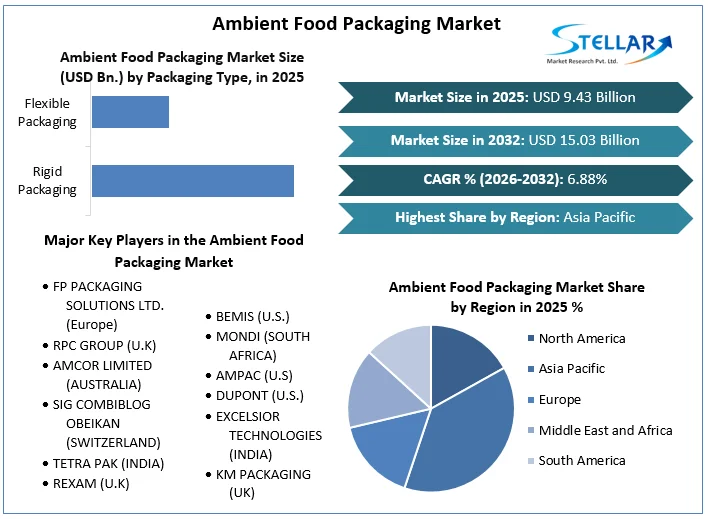
Ambient Food Packaging Market was valued at US$ 9.43 Bn. in 2025. Global Ambient Food Packaging Market size is estimated to grow at a CAGR of 6.88 %.
The Ambient Food Packaging Market is witnessing significant growth as food manufacturers increasingly focus on extending product shelf life while meeting consumer demand for convenience, sustainability, and food safety. Ambient food packaging refers to packaging solutions designed to preserve food products at room temperature without requiring refrigeration during storage or transportation. These packaging systems are widely used for ready-to-eat meals, dairy alternatives, beverages, sauces, soups, canned products, bakery items, and processed foods.
The growing popularity of packaged and convenience foods, rapid urbanization, and expanding retail distribution networks are driving demand for advanced ambient food packaging solutions worldwide. At the same time, innovations in barrier materials, recyclable packaging, and aseptic processing technologies are transforming the industry by improving product protection while supporting sustainability goals. As consumer lifestyles continue to evolve, the Ambient Food Packaging Market is expected to maintain steady growth throughout the forecast period.
Download Free PDF Brochure: https://www.stellarmr.com/report/req_sample/Ambient-Food-Packaging-Market/244
Market overview
Ambient food packaging plays a vital role in maintaining food quality, freshness, and nutritional value without relying on cold-chain logistics. These packaging solutions protect products from moisture, oxygen, light, and microbial contamination, helping manufacturers reduce food waste while lowering transportation and storage costs.
The market includes a wide range of packaging formats such as cartons, flexible pouches, plastic containers, metal cans, glass bottles, trays, and multilayer packaging materials. Food and beverage manufacturers continue to invest in innovative packaging technologies that enhance product safety, improve consumer convenience, and meet evolving environmental regulations.
The rapid expansion of organized retail, e-commerce grocery platforms, and global food trade has further increased the demand for reliable and cost-effective ambient packaging solutions.
Key market growth drivers
Increasing demand for convenience foods
Busy lifestyles, urbanization, and changing consumer eating habits have significantly increased demand for ready-to-eat and ready-to-cook food products. Ambient food packaging enables manufacturers to offer convenient products with extended shelf life while maintaining quality and taste.
Single-serve packaging, portable meal solutions, and easy-to-open designs have become increasingly popular among consumers seeking convenience without compromising food safety.
Growth of the food and beverage industry
The expanding global food processing industry remains a major driver of the Ambient Food Packaging Market. Rising production of packaged beverages, dairy alternatives, sauces, soups, confectionery products, and processed foods continues to generate strong demand for advanced packaging materials.
Food manufacturers are investing in high-performance packaging that enhances product stability while reducing spoilage throughout distribution networks.
Expansion of modern retail and e-commerce
The rapid growth of supermarkets, hypermarkets, convenience stores, and online grocery platforms has increased the need for durable packaging capable of protecting products during transportation and long-term storage.
As global food distribution networks become increasingly complex, manufacturers are prioritizing packaging solutions that improve logistics efficiency while minimizing product damage and waste.
Emerging opportunities in the market
One of the most promising opportunities lies in the development of sustainable packaging materials. Consumers and governments increasingly favor recyclable, biodegradable, and renewable packaging solutions that reduce environmental impact.
Companies are investing in paper-based packaging, recyclable flexible films, mono-material structures, and bio-based polymers to meet evolving sustainability expectations.
Smart packaging technologies also present significant growth opportunities. Features such as freshness indicators, QR codes, traceability systems, and intelligent labels enhance product transparency while improving consumer confidence and supply chain efficiency.
Growing demand from emerging economies across Asia-Pacific, Latin America, and Africa further creates opportunities as rising disposable incomes and expanding food processing industries stimulate packaging consumption.
Technology transforming ambient food packaging
Innovation continues to reshape the Ambient Food Packaging Market. Aseptic packaging technology has become increasingly important for preserving beverages, dairy products, and liquid foods without refrigeration.
Advanced multilayer barrier materials effectively protect food from oxygen, moisture, ultraviolet light, and contamination, significantly extending product shelf life.
Digital printing technologies enable manufacturers to produce customized packaging with improved branding, variable information, and enhanced product traceability.
Automation and artificial intelligence are also improving packaging production by optimizing manufacturing efficiency, minimizing material waste, and enhancing quality control throughout production processes.
Sustainability and regulatory developments
Sustainability has become one of the defining trends within the ambient food packaging industry. Governments worldwide are introducing stricter regulations regarding plastic waste, packaging recyclability, and food contact safety.
Manufacturers are responding by reducing packaging weight, increasing recycled content, and developing environmentally responsible materials that comply with international sustainability standards.
Circular economy initiatives encourage companies to design packaging that supports recycling, reuse, and reduced resource consumption. Many food producers have established ambitious sustainability targets aimed at reducing carbon emissions and minimizing packaging waste across their operations.
Compliance with food safety regulations remains equally important. Packaging manufacturers continue investing in high-quality materials that meet stringent standards for food contact applications while maintaining product integrity throughout the supply chain.
Regional insights
North America represents a mature market supported by advanced food processing industries, widespread consumption of packaged foods, and continuous innovation in sustainable packaging technologies.
Europe remains a leader in environmentally responsible packaging, driven by stringent recycling regulations and strong consumer preference for sustainable products. Food manufacturers across the region increasingly adopt recyclable and bio-based packaging materials to meet evolving regulatory requirements.
Asia-Pacific is expected to experience the fastest market growth due to rapid urbanization, expanding middle-class populations, rising disposable incomes, and significant investments in food manufacturing. China, India, Japan, and Southeast Asian countries continue to drive regional demand through growing consumption of packaged food products.
Latin America and the Middle East & Africa are also emerging as promising markets as improvements in retail infrastructure, food processing capabilities, and consumer purchasing power increase demand for ambient food packaging solutions.
Competitive landscape
- FP PACKAGING SOLUTIONS LTD. (Europe)
- RPC GROUP (U.K)
- AMCOR LIMITED (AUSTRALIA)
- SIG COMBIBLOG OBEIKAN (SWITZERLAND)
- TETRA PAK (INDIA)
- REXAM (U.K)
- BEMIS (U.S.)
- MONDI (SOUTH AFRICA)
Download Free PDF Brochure: https://www.stellarmr.com/report/req_sample/Ambient-Food-Packaging-Market/244
Future outlook
The future of the Ambient Food Packaging Market appears highly promising as consumer demand for convenient, safe, and sustainable food products continues to increase. Rapid growth in packaged food consumption, expanding e-commerce grocery channels, and advancements in packaging technology will remain major growth drivers throughout the forecast period.
Sustainability will continue shaping product development, with manufacturers investing in recyclable materials, renewable resources, and circular packaging solutions that align with global environmental objectives. At the same time, digital technologies, smart packaging features, and automation will improve manufacturing efficiency while enhancing product safety and supply chain visibility.
As food producers seek innovative ways to reduce waste, extend shelf life, and improve consumer convenience, ambient food packaging will remain an essential component of the global food industry. Companies that successfully combine sustainability, technological innovation, regulatory compliance, and operational efficiency will be well positioned to capitalize on the expanding opportunities in this dynamic market.
Media Contact
Stellar Market Research
Website: Stellar Market Research – Global Research Reports & Consulting
Email: sales@stellarmr.com
