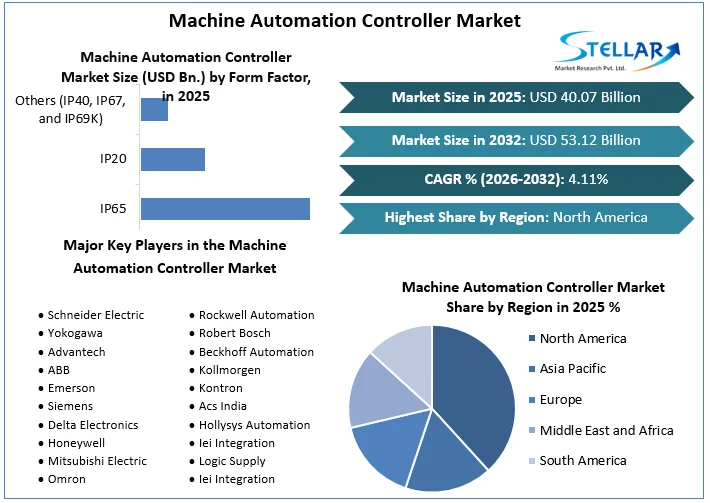
Machine Automation Controller Market was valued nearly USD 40.07 Bn. in 2025. Global Machine Automation Controller Market size is estimated to grow at a CAGR of 4.11 % and is expected to reach at USD 53.12 Bn. by 2032.
The global Machine Automation Controller Market is experiencing robust growth as industries increasingly embrace smart manufacturing, industrial automation, and digital transformation. Machine automation controllers are at the heart of modern production systems, enabling seamless communication between machines, sensors, robotics, and industrial software. They help manufacturers improve productivity, reduce downtime, optimize operational efficiency, and maintain consistent product quality.
The rapid adoption of Industry 4.0 technologies, combined with growing investments in factory automation, is accelerating demand for advanced automation controllers across sectors such as automotive, electronics, food and beverages, pharmaceuticals, oil and gas, chemicals, and logistics. As manufacturers focus on improving flexibility and competitiveness, the Machine Automation Controller Market is expected to witness sustained expansion throughout the forecast period.
Download Free PDF Brochure: https://www.stellarmr.com/report/req_sample/Machine-Automation-Controller-Market/285
Market overview
Machine automation controllers are intelligent devices used to monitor, control, and coordinate industrial equipment and manufacturing processes. These controllers include programmable logic controllers (PLCs), programmable automation controllers (PACs), distributed control systems (DCS), industrial PCs, and motion controllers that work together to automate production environments.
Modern controllers collect real-time operational data, execute control algorithms, and communicate with industrial networks to ensure efficient manufacturing processes. Their integration with Industrial Internet of Things (IIoT) platforms enables predictive maintenance, remote monitoring, and advanced analytics, helping businesses improve productivity while minimizing operational costs.
Growing demand for connected factories and intelligent production systems continues to strengthen the global market for machine automation controllers.
Key market growth drivers
Rising adoption of Industry 4.0
Industry 4.0 remains one of the most significant drivers of the Machine Automation Controller Market. Manufacturers are increasingly adopting digital technologies to automate production, optimize workflows, and improve decision-making through real-time data analytics.
Automation controllers serve as the foundation of smart factories by connecting machinery, sensors, robotics, and enterprise management systems. This integration enables manufacturers to improve production efficiency while reducing human intervention.
Increasing demand for industrial automation
Global manufacturers are under constant pressure to increase productivity while controlling operational expenses. Automation controllers enable precise machine control, reduce production errors, improve consistency, and enhance workplace safety.
Industries experiencing labor shortages are accelerating automation investments to maintain production capacity and improve long-term operational resilience.
Expansion of robotics and intelligent manufacturing
Industrial robots have become essential components of modern manufacturing facilities. Automation controllers synchronize robotic movement, machine operations, and production lines to ensure high-speed and accurate manufacturing.
The growing adoption of collaborative robots (cobots) further increases demand for advanced controllers capable of managing increasingly complex industrial environments.
Emerging opportunities
The integration of artificial intelligence and machine learning into automation systems presents substantial opportunities for market participants. AI-powered controllers can analyze production data, optimize machine performance, predict equipment failures, and automatically adjust operational parameters to improve efficiency.
Cloud-based automation platforms are creating additional growth opportunities by enabling centralized monitoring of multiple manufacturing facilities. Remote diagnostics, software updates, and predictive maintenance services help manufacturers reduce downtime while improving asset utilization.
Emerging economies across Asia-Pacific, Latin America, and the Middle East are also creating significant opportunities as governments encourage industrial modernization and manufacturers expand production capacity.
The rapid growth of electric vehicle manufacturing, semiconductor production, renewable energy equipment, and pharmaceutical manufacturing continues to generate strong demand for intelligent automation solutions.
Technology trends transforming the industry
Technological innovation continues to redefine the Machine Automation Controller Market. Modern controllers offer greater processing power, faster communication speeds, enhanced cybersecurity, and seamless integration with cloud computing platforms.
Edge computing has become increasingly important by enabling data processing directly within manufacturing environments. This reduces latency, improves system responsiveness, and supports real-time decision-making without relying entirely on cloud infrastructure.
Industrial Ethernet, 5G connectivity, and wireless communication technologies are improving connectivity between machines and enterprise systems. These technologies enable highly flexible production environments while supporting predictive maintenance and digital twins.
Artificial intelligence and digital twin technologies allow manufacturers to simulate production processes, identify bottlenecks, and optimize machine performance before implementing physical changes.
Sustainability and regulatory developments
Sustainability has become an important focus within industrial automation. Manufacturers increasingly deploy automation controllers to reduce energy consumption, optimize resource utilization, and minimize production waste.
Smart energy management systems powered by automation controllers continuously monitor equipment performance and adjust operations to improve efficiency while lowering carbon emissions.
Governments worldwide continue promoting industrial digitalization through various manufacturing modernization initiatives. Compliance with workplace safety regulations, cybersecurity standards, and industrial communication protocols has become increasingly important for automation system providers.
Manufacturers are also investing in environmentally responsible production practices supported by intelligent automation technologies that reduce operational waste and improve overall sustainability.
Regional insights
North America remains a major market for machine automation controllers due to its advanced manufacturing capabilities, strong adoption of Industry 4.0 technologies, and substantial investments in smart factories. The United States continues to lead innovation across industrial automation, robotics, and digital manufacturing.
Europe represents another significant market, driven by advanced automotive manufacturing, industrial engineering expertise, and government initiatives supporting digital transformation. Germany, Italy, France, and the United Kingdom continue investing heavily in automation technologies to maintain manufacturing competitiveness.
Asia-Pacific is expected to experience the fastest growth during the forecast period. China, Japan, South Korea, and India continue expanding manufacturing capacity while investing aggressively in industrial automation and intelligent production systems. Rising labor costs, increasing exports, and supportive government policies further accelerate regional demand.
Latin America and the Middle East & Africa are gradually emerging as promising markets as industrialization, infrastructure development, and manufacturing modernization continue to progress.
Competitive landscape
- Advantech
- ABB
- Emerson
- Siemens
- Delta Electronics
- Honeywell
- Mitsubishi Electric
- Omron
Download Free PDF Brochure: https://www.stellarmr.com/report/req_sample/Machine-Automation-Controller-Market/285
Future outlook
The future of the Machine Automation Controller Market remains highly promising as manufacturers continue embracing digital transformation and intelligent production technologies. Industry 4.0, artificial intelligence, robotics, Industrial Internet of Things, and cloud computing will continue driving market expansion over the coming years.
Growing investments in electric vehicles, semiconductor fabrication, renewable energy equipment, pharmaceuticals, and advanced manufacturing facilities will create new opportunities for automation controller suppliers. Continuous innovation in edge computing, cybersecurity, digital twins, and predictive maintenance solutions will further enhance operational efficiency and manufacturing flexibility.
As industries increasingly prioritize productivity, quality, sustainability, and resilience, machine automation controllers will remain fundamental components of modern manufacturing systems. Companies capable of delivering intelligent, secure, scalable, and energy-efficient automation solutions will be well positioned to capitalize on the expanding global demand and shape the future of smart manufacturing.
Media Contact
Stellar Market Research
Website: Stellar Market Research – Global Research Reports & Consulting
Email: sales@stellarmr.com
