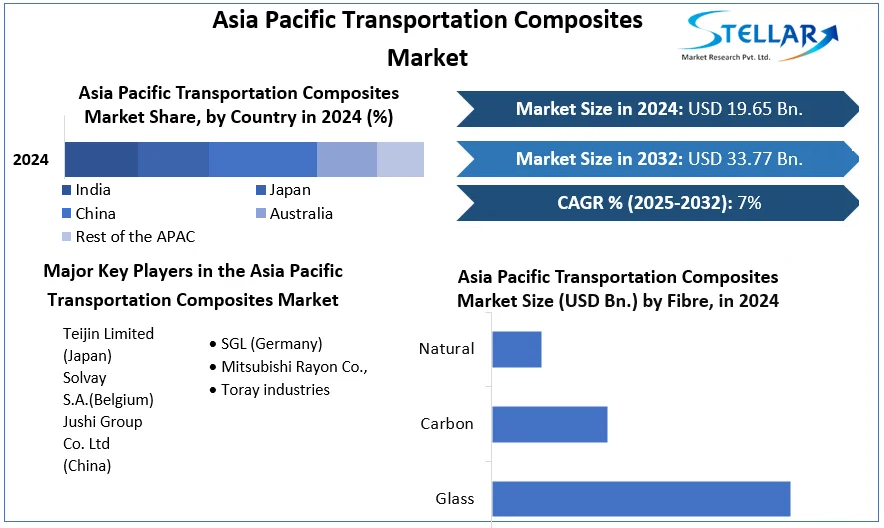
The Asia Pacific Transportation Composites Market is experiencing robust growth as automotive, railway, aerospace, and marine manufacturers increasingly adopt lightweight composite materials to improve fuel efficiency, reduce emissions, and enhance vehicle performance. Transportation composites, including carbon fiber composites, glass fiber composites, and natural fiber-reinforced materials, offer superior strength-to-weight ratios, corrosion resistance, durability, and design flexibility compared to conventional materials such as steel and aluminum. Rapid industrialization, expanding transportation infrastructure, and the growing production of electric vehicles (EVs) are significantly driving demand for advanced composite materials across the Asia Pacific region.
Manufacturers are investing in innovative composite technologies, automated production processes, and sustainable material development to meet evolving industry requirements. As governments across the region promote low-emission transportation and advanced manufacturing, transportation composites are becoming a critical component of next-generation mobility solutions.
𝐃𝐨𝐰𝐧𝐥𝐨𝐚𝐝 𝐅𝐫𝐞𝐞 𝐏𝐃𝐅 𝐁𝐫𝐨𝐜𝐡𝐮𝐫𝐞: https://www.stellarmr.com/report/req_sample/Asia-Pacific-Transportation-Composites-Market/777
Electric Vehicle Production Drives Market Growth
One of the primary drivers of the Asia Pacific Transportation Composites Market is the rapid expansion of electric vehicle manufacturing. Automakers are increasingly incorporating lightweight composite materials into vehicle structures, battery enclosures, body panels, and interior components to reduce overall vehicle weight and improve driving range.
Composite materials help enhance energy efficiency while maintaining structural strength, crash performance, and design flexibility. As Asia Pacific continues leading global EV production, demand for advanced transportation composites is expected to grow substantially.
Government incentives supporting electric mobility further strengthen long-term market expansion.
Automotive Lightweighting Enhances Commercial Demand
The automotive industry remains the largest consumer of transportation composites across the region. Vehicle manufacturers are replacing traditional metal components with composite materials to comply with fuel economy regulations and reduce carbon emissions.
Glass fiber-reinforced plastics, carbon fiber composites, and hybrid composite structures are increasingly used in passenger vehicles, commercial vehicles, buses, and specialty transportation equipment. These materials improve fuel efficiency, reduce maintenance requirements, and provide greater resistance to corrosion and environmental degradation.
Growing consumer demand for safer, more efficient, and environmentally friendly vehicles continues supporting market growth.
Railway and Aerospace Industries Expand Opportunities
The Asia Pacific Transportation Composites Market is benefiting from increasing investments in railway modernization and aerospace manufacturing. High-speed rail projects across China, Japan, India, and Southeast Asia require lightweight composite materials for train interiors, exterior panels, seating systems, and structural components.
Similarly, aerospace manufacturers use advanced composites in aircraft fuselages, cabin interiors, cargo systems, and engine components to improve fuel efficiency and reduce operational costs. Rising regional air travel and aircraft production continue creating significant opportunities for composite manufacturers.
Infrastructure development remains a key contributor to sustained market expansion.
Sustainable Materials Drive Industry Innovation
Sustainability has become a major focus within the transportation composites industry. Manufacturers are developing recyclable composite materials, bio-based resins, and natural fiber composites that reduce environmental impact while maintaining high mechanical performance.
Research into circular economy solutions, composite recycling technologies, and low-carbon manufacturing processes is gaining momentum across Asia Pacific. Automotive and transportation companies increasingly prioritize environmentally responsible materials that support long-term sustainability goals and regulatory compliance.
These innovations continue strengthening the competitiveness of advanced composite solutions.
𝐀𝐜𝐜𝐞𝐬𝐬 𝐭𝐡𝐞 𝐅𝐮𝐥𝐥 𝐑𝐞𝐩𝐨𝐫𝐭: https://www.stellarmr.com/report/Asia-Pacific-Transportation-Composites-Market/777
Automation and Advanced Manufacturing Improve Efficiency
Technological advancements are transforming composite manufacturing through automated fiber placement, robotic molding systems, additive manufacturing, and digital production monitoring. Artificial intelligence, machine learning, and predictive quality control improve manufacturing precision while reducing production costs and material waste.
Modern manufacturing techniques enable higher production volumes with consistent product quality, supporting the growing demand from automotive, railway, aerospace, and marine industries. Industry 4.0 technologies further enhance supply chain efficiency and operational productivity across composite manufacturing facilities.
Digital transformation continues accelerating market development throughout the region.
Regional Market Outlook
China dominates the Asia Pacific Transportation Composites Market, supported by its leadership in automotive manufacturing, electric vehicle production, railway infrastructure development, and aerospace expansion. Government initiatives promoting advanced manufacturing and clean mobility continue driving strong demand for lightweight materials.
Japan remains a significant market due to its advanced automotive industry, aerospace engineering capabilities, and continuous investment in composite material innovation. Leading manufacturers continue developing high-performance composites for premium transportation applications.
India is emerging as one of the fastest-growing markets, driven by expanding automobile production, railway modernization programs, infrastructure investments, and increasing adoption of electric vehicles under national mobility initiatives.
South Korea, Taiwan, Thailand, Malaysia, Indonesia, Vietnam, and Australia are also experiencing increasing demand for transportation composites as industrial production, mobility infrastructure, and advanced manufacturing capabilities continue expanding.
Competitive Landscape
The Asia Pacific Transportation Composites Market is highly competitive, with composite material manufacturers, automotive suppliers, aerospace companies, resin producers, and fiber manufacturers focusing on lightweight engineering, sustainable materials, and manufacturing efficiency. Companies are investing in carbon fiber production, advanced resin systems, automated processing technologies, and recyclable composite solutions to strengthen their market positions.
Strategic collaborations with automotive OEMs, railway equipment manufacturers, aerospace companies, and research institutions continue accelerating product innovation and commercialization. Research and development efforts remain focused on improving material performance, reducing production costs, increasing recyclability, and enhancing structural reliability.
Manufacturers are also expanding regional production facilities to meet the growing demand for high-performance transportation composites.
Future Outlook
The future of the Asia Pacific Transportation Composites Market remains highly promising as electric mobility, sustainable transportation, railway modernization, and aerospace expansion continue driving demand for lightweight materials. Advances in carbon fiber technology, bio-based composites, recyclable materials, digital manufacturing, and automated production systems will further improve product performance and commercial scalability.
Growing investments in electric vehicles, high-speed rail networks, aerospace manufacturing, marine transportation, and smart mobility infrastructure are expected to sustain long-term market growth. Companies that prioritize innovation, sustainability, advanced manufacturing, and strategic partnerships will be well positioned to capitalize on evolving transportation requirements, ensuring continued expansion of the Asia Pacific transportation composites market.
About Stellar Market Research:
Stellar Market Research is a multifaceted market research and consulting company with professionals from several industries. Some industries we cover include medical devices, pharmaceutical manufacturers, science and engineering, electronic components, industrial equipment, technology and communication, cars and automobiles, chemical products and substances, general merchandise, beverages, personal care, and automated systems.
Contact Stellar Market Research:
Address: Phase 3, Navale IT Zone, S.No. 51/2A/2, Office No. 202, 2nd floor, Near, Navale Brg, Narhe, Pune, Maharashtra 411041
Website: http://stellarmr.com/
Email: sales@stellarmr.com
Mobile: +91 9607365656
