Introduction
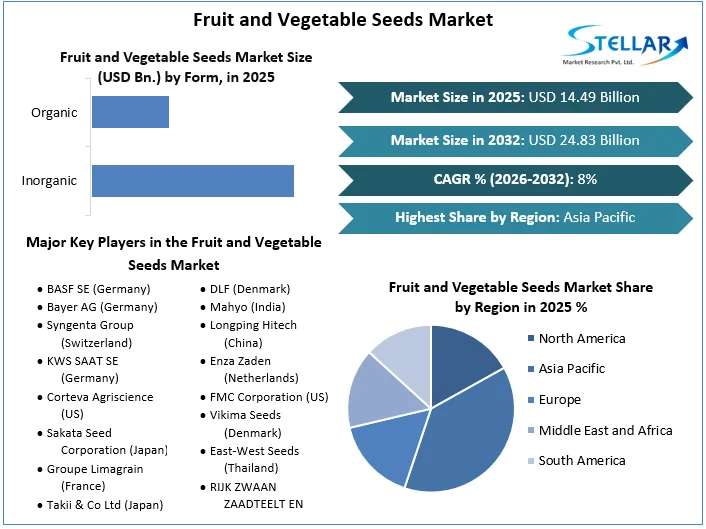
Fruit and Vegetable Seeds Market size was valued at USD 14.49 Bn. in 2025 and the total revenue is expected to grow at a CAGR of 8% through 2026 to 2032, reaching nearly USD 24.83 Bn.
The global Fruit and Vegetable Seeds Market is experiencing strong growth as rising food demand, changing dietary preferences, and advancements in agricultural biotechnology reshape modern farming. High-quality seeds are the foundation of agricultural productivity, directly influencing crop yield, disease resistance, nutritional value, and overall farm profitability. As consumers increasingly prefer fresh fruits and vegetables rich in nutrients, growers are investing in improved seed varieties that offer higher productivity and better resilience to changing climatic conditions.
The expansion of commercial farming, greenhouse cultivation, and precision agriculture is further accelerating market growth. Seed manufacturers are continuously introducing hybrid and genetically improved varieties that provide better resistance to pests, diseases, and environmental stress. With governments promoting food security and sustainable agricultural practices, the Fruit and Vegetable Seeds Market is expected to witness steady expansion during the coming years.
Download Free PDF Brochure: https://www.stellarmr.com/report/req_sample/Fruit-and-Vegetable-Seeds-Market/373
Market overview
Fruit and vegetable seeds represent one of the most important segments of the global agricultural industry. These seeds are developed to improve crop quality, maximize production efficiency, and meet the growing demand for fresh produce across domestic and international markets.
The market includes seeds for tomatoes, peppers, cucumbers, onions, carrots, lettuce, cabbage, spinach, melons, watermelon, berries, citrus fruits, grapes, and numerous other horticultural crops. Hybrid seeds continue to gain widespread popularity due to their higher yields, improved uniformity, and enhanced resistance to diseases.
Growing investments in protected cultivation, vertical farming, hydroponics, and controlled-environment agriculture are creating additional demand for premium-quality fruit and vegetable seeds capable of delivering consistent performance.
Key market growth drivers
Increasing demand for nutritious foods
Consumers worldwide are becoming more health-conscious and are incorporating greater quantities of fruits and vegetables into their daily diets. This trend has increased demand for high-yield crop varieties capable of supporting expanding production while maintaining quality and nutritional value.
Retailers and food processing companies also require consistent supplies of premium-quality produce, encouraging farmers to adopt advanced seed technologies.
Expansion of commercial agriculture
Commercial farming operations continue to replace traditional cultivation methods across many regions. Large-scale growers increasingly invest in certified hybrid seeds to maximize productivity, reduce crop losses, and improve profitability.
Protected cultivation methods such as greenhouses and net houses further increase demand for specialized seed varieties designed for controlled growing environments.
Technological advancements in seed breeding
Modern breeding techniques have significantly improved seed performance. Hybrid breeding, marker-assisted selection, biotechnology, and precision breeding enable the development of crop varieties with higher yields, improved disease resistance, enhanced shelf life, and better tolerance to drought, salinity, and temperature fluctuations.
Continuous research and development by seed companies continues to strengthen market growth.
Emerging opportunities
Climate-resilient agriculture represents one of the largest opportunities in the Fruit and Vegetable Seeds Market. Farmers increasingly require seed varieties capable of withstanding unpredictable weather conditions, water scarcity, and changing environmental patterns.
Organic farming also presents substantial growth opportunities. As demand for organic produce increases worldwide, seed manufacturers are developing untreated and organically certified seed varieties suitable for sustainable farming systems.
The rapid adoption of precision agriculture technologies further enhances market opportunities. Data-driven farming practices allow growers to optimize planting schedules, irrigation, nutrient management, and crop protection, maximizing the value of premium seed varieties.
Emerging markets across Asia-Pacific, Latin America, and Africa continue to offer attractive growth potential as governments prioritize food security and agricultural modernization.
Technology transforming the seed industry
Innovation remains a defining feature of the Fruit and Vegetable Seeds Market. Advanced breeding technologies have significantly reduced product development timelines while improving genetic performance.
Marker-assisted breeding enables researchers to identify desirable plant traits more efficiently, accelerating the development of disease-resistant and climate-tolerant varieties.
Digital agriculture platforms supported by artificial intelligence, satellite imaging, drones, and Internet of Things (IoT) technologies help farmers monitor crop performance and optimize field management throughout the growing season.
Seed treatment technologies are also improving germination rates while protecting seedlings against pests, fungal diseases, and adverse environmental conditions during the early stages of plant growth.
The integration of biotechnology and precision breeding continues to improve agricultural productivity while supporting sustainable farming practices.
Sustainability and regulatory landscape
Sustainability has become a major priority across the global seed industry. Governments and agricultural organizations are encouraging farming practices that improve resource efficiency while reducing environmental impact.
Seed companies are investing in varieties requiring fewer chemical inputs, less irrigation, and improved resistance to pests and diseases. These innovations help farmers reduce pesticide usage, conserve water, and lower production costs while supporting environmental sustainability.
Regulatory authorities continue to strengthen seed certification standards, quality control procedures, and phytosanitary regulations to ensure high-quality planting materials. Compliance with intellectual property rights, plant variety protection, and biosafety regulations also plays a critical role in market development.
The increasing emphasis on sustainable agriculture and climate adaptation is expected to accelerate demand for advanced seed technologies in the years ahead.
Regional insights
Asia-Pacific dominates the Fruit and Vegetable Seeds Market due to its large agricultural sector, expanding population, and increasing demand for fresh produce. Countries such as China and India continue investing in improved agricultural technologies to enhance food production and farm productivity.
North America remains a significant market driven by advanced farming practices, strong research capabilities, and widespread adoption of hybrid and genetically improved seed varieties. The United States continues to lead innovation in seed breeding and agricultural biotechnology.
Europe maintains steady market growth through sustainable farming initiatives, stringent seed quality standards, and growing demand for organic fruits and vegetables. Countries including the Netherlands, France, Spain, and Italy remain major producers of high-value horticultural crops.
Latin America is emerging as an important production region due to favorable climatic conditions and expanding exports of fruits and vegetables. Meanwhile, the Middle East & Africa are gradually increasing investments in protected cultivation, irrigation systems, and climate-resilient agriculture to improve domestic food security.
Competitive landscape
- Syngenta Group (Switzerland)
- KWS SAAT SE (Germany)
- Corteva Agriscience (US)
- Sakata Seed Corporation (Japan)
- Groupe Limagrain (France)
- Takii & Co Ltd (Japan)
- UPL (Advanta Seeds) (India)
- DLF (Denmark)
Download Free PDF Brochure: https://www.stellarmr.com/report/req_sample/Fruit-and-Vegetable-Seeds-Market/373
Future outlook
The future of the Fruit and Vegetable Seeds Market appears highly promising as global agriculture continues evolving toward higher productivity, sustainability, and climate resilience. Rising food consumption, population growth, urbanization, and changing dietary preferences will continue driving demand for superior-quality fruit and vegetable seeds.
Technological advancements in plant breeding, biotechnology, artificial intelligence, and precision agriculture will enable farmers to achieve higher yields while using fewer natural resources. Increasing investments in protected cultivation, organic farming, and climate-smart agriculture will further strengthen market growth.
As governments prioritize food security and sustainable agricultural development, seed manufacturers will continue introducing innovative crop varieties capable of meeting future production challenges. Companies that successfully combine scientific innovation, environmental responsibility, and farmer-focused solutions will be well positioned to capitalize on the expanding opportunities in the global Fruit and Vegetable Seeds Market.
Media Contact
Stellar Market Research
Website: Stellar Market Research – Global Research Reports & Consulting
Email: sales@stellarmr.com
