Introduction
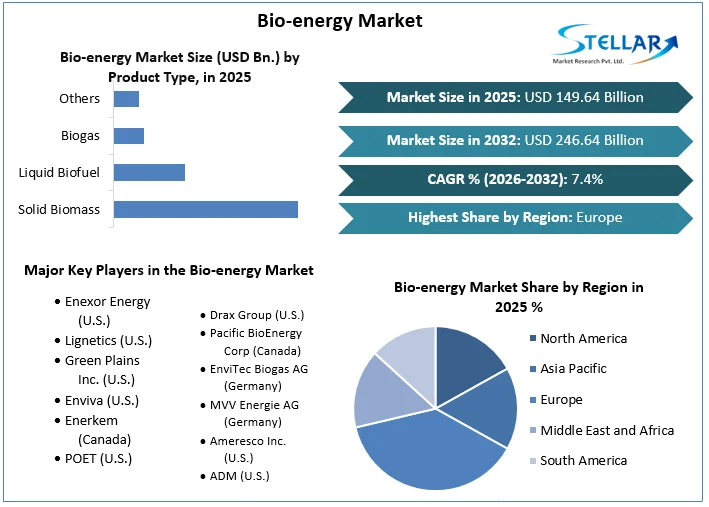
Bio-energy Market size was valued at US$ 149.64 Bn. in 2025. Global Bio-energy Market is estimated to grow at a CAGR of 7.4% over the forecast period.
The Bio-energy Market is gaining remarkable momentum as governments, industries, and consumers accelerate the transition toward cleaner and more sustainable energy sources. Bio-energy, derived from organic materials such as agricultural residues, forestry waste, municipal solid waste, and dedicated energy crops, has emerged as a critical component of the global renewable energy mix. As countries strive to reduce greenhouse gas emissions and achieve carbon neutrality, bio-energy is becoming an increasingly attractive alternative to conventional fossil fuels.
Growing investments in renewable energy infrastructure, favorable government policies, and continuous technological advancements are driving the expansion of the Bio-energy Market. From electricity generation and district heating to transportation fuels and industrial applications, bio-energy is playing a vital role in supporting global energy security while promoting circular economy practices.
Download Free PDF Brochure: https://www.stellarmr.com/report/req_sample/Bio-energy-Market/399
Market overview
Bio-energy refers to renewable energy generated from biomass, including plant materials, agricultural waste, forestry residues, organic municipal waste, animal manure, and biodegradable industrial by-products. Various conversion technologies—including combustion, gasification, anaerobic digestion, pyrolysis, and fermentation—transform biomass into electricity, heat, biogas, biofuels, and bio-based chemicals.
The market includes several energy products such as bioethanol, biodiesel, biogas, renewable natural gas (RNG), biomass power, and advanced biofuels. Increasing concerns regarding fossil fuel depletion and climate change have encouraged governments and private organizations to invest heavily in bio-energy production facilities and sustainable feedstock supply chains.
As energy diversification becomes a global priority, bio-energy continues to strengthen its position as a reliable and environmentally responsible energy source.
Key market growth drivers
Increasing focus on decarbonization
One of the primary factors driving the Bio-energy Market is the growing commitment of countries to reduce carbon emissions. Governments worldwide have established ambitious climate goals that encourage greater adoption of renewable energy technologies, including biomass-based power generation and biofuels.
Bio-energy contributes to lower greenhouse gas emissions by utilizing renewable organic materials while reducing dependence on coal, oil, and natural gas.
Government support and renewable energy policies
Supportive government initiatives continue to accelerate market growth. Renewable portfolio standards, carbon pricing mechanisms, tax incentives, production subsidies, and blending mandates encourage investment in bio-energy infrastructure.
Many countries have introduced policies promoting sustainable biomass utilization, advanced biofuel production, and renewable electricity generation, creating favorable conditions for long-term market expansion.
Rising demand for waste-to-energy solutions
The increasing volume of agricultural waste, municipal solid waste, and industrial organic residues has created significant opportunities for waste-to-energy technologies. Converting organic waste into electricity, heat, or renewable fuels helps reduce landfill usage while generating valuable renewable energy.
This approach supports both environmental sustainability and resource efficiency by promoting circular economy principles.
Emerging opportunities
Advanced biofuels represent one of the most promising growth opportunities within the Bio-energy Market. Sustainable aviation fuel (SAF), renewable diesel, cellulosic ethanol, and renewable natural gas are gaining significant attention as industries seek cleaner alternatives to conventional fuels.
The transportation sector is increasingly adopting biofuels to reduce carbon emissions, particularly in aviation, shipping, and heavy commercial vehicles where complete electrification remains challenging.
Another major opportunity lies in integrating bio-energy with carbon capture and storage (BECCS). This emerging technology has the potential to generate renewable energy while removing carbon dioxide from the atmosphere, supporting long-term climate objectives.
Developing economies also offer substantial growth potential as governments invest in rural electrification, agricultural modernization, and decentralized renewable energy systems.
Technology trends transforming the market
Technological innovation continues to improve the efficiency and sustainability of bio-energy production. Advanced gasification technologies convert biomass into high-quality synthetic gas that can be used for electricity generation, hydrogen production, or chemical manufacturing.
Anaerobic digestion systems are becoming increasingly efficient, enabling municipalities and agricultural facilities to convert organic waste into biogas while producing nutrient-rich fertilizers as valuable by-products.
Artificial intelligence and digital monitoring technologies are improving biomass supply chain management by optimizing feedstock collection, transportation, storage, and processing.
Automation, predictive maintenance, and smart energy management systems also enhance operational efficiency, reduce production costs, and improve overall plant performance.
Sustainability and regulatory landscape
Sustainability remains central to the Bio-energy Market. Responsible biomass sourcing ensures that renewable energy production does not contribute to deforestation, biodiversity loss, or excessive land-use changes.
Governments and international organizations continue implementing sustainability certification programs that verify responsible feedstock production and greenhouse gas reductions throughout the supply chain.
Carbon reduction initiatives, renewable fuel standards, and international climate agreements continue encouraging investment in bio-energy technologies. Companies increasingly adopt lifecycle assessment methodologies to measure environmental performance and improve sustainability across production operations.
The growing emphasis on environmental, social, and governance (ESG) principles further strengthens investment in renewable bio-energy projects worldwide.
Regional insights
Europe remains one of the leading regions in the Bio-energy Market due to ambitious climate policies, advanced renewable energy infrastructure, and strong government support for sustainable biomass utilization. Countries including Germany, Sweden, Finland, Denmark, and the Netherlands continue expanding bio-energy capacity through investments in district heating, biomass power generation, and advanced biofuels.
North America represents another major market driven by abundant biomass resources, supportive renewable fuel programs, and increasing investments in renewable natural gas and sustainable aviation fuel. The United States and Canada continue developing advanced bio-energy technologies while expanding waste-to-energy infrastructure.
Asia-Pacific is expected to experience the fastest growth during the forecast period. Rapid industrialization, increasing energy demand, and government initiatives promoting renewable energy are driving investments across China, India, Japan, and Southeast Asia. Large agricultural sectors provide abundant biomass feedstock, creating significant opportunities for bio-energy production.
Latin America also benefits from extensive agricultural resources and established bioethanol industries, while the Middle East & Africa are gradually expanding renewable energy investments to diversify their energy portfolios.
Competitive landscape
- Enerkem (Canada)
- POET (U.S.)
- Drax Group (U.S.)
- Pacific BioEnergy Corp (Canada)
- EnviTec Biogas AG (Germany)
- MVV Energie AG (Germany)
- Ameresco Inc. (U.S.)
- ADM (U.S.)
Download Free PDF Brochure: https://www.stellarmr.com/report/req_sample/Bio-energy-Market/399
Future outlook
The future of the Bio-energy Market remains highly promising as countries intensify efforts to achieve net-zero emissions and strengthen energy security. Rising investments in renewable infrastructure, supportive regulatory frameworks, and increasing demand for low-carbon fuels will continue driving market expansion.
Technological innovations in biomass conversion, digital energy management, advanced biofuels, and carbon capture technologies will improve efficiency while expanding commercial applications. Growing adoption of circular economy practices and sustainable waste management will further reinforce bio-energy’s role in the global energy transition.
As governments, industries, and consumers prioritize clean energy solutions, bio-energy will remain a key pillar of sustainable development. Companies that invest in advanced technologies, responsible feedstock sourcing, and strategic partnerships will be well positioned to capitalize on the expanding opportunities in the global Bio-energy Market while contributing to a cleaner and more resilient energy future.
Media Contact
Stellar Market Research
Website: Stellar Market Research – Global Research Reports & Consulting
Email: sales@stellarmr.com
