Market overview
The global Shredder Blades Market is experiencing steady growth as industries worldwide increase investments in recycling infrastructure, waste management systems, and resource recovery technologies. Shredder blades are critical components in industrial shredding equipment used to process metals, plastics, wood, paper, rubber, e-waste, and other materials for recycling and disposal. Their durability, cutting precision, and wear resistance directly influence operational efficiency across numerous industrial applications.
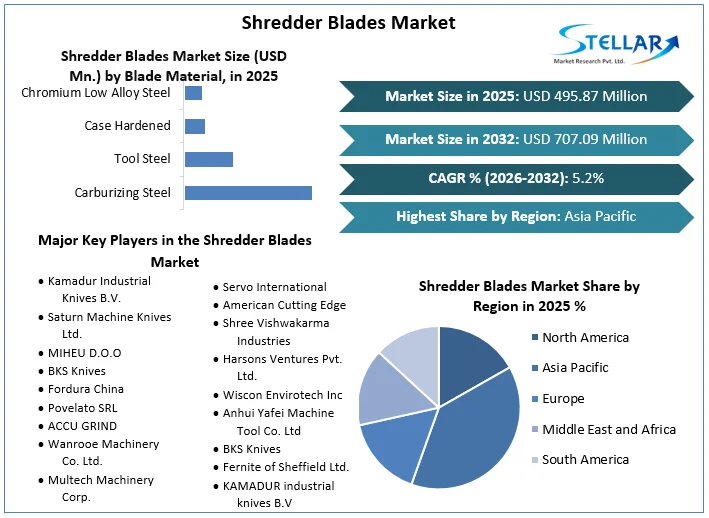
According to Stellar Market Research, the Shredder Blades Market was valued at USD 495.87 million in 2025 and is projected to reach nearly USD 707.09 million by 2032, expanding at a CAGR of 5.2% during the forecast period. The market is benefiting from stricter environmental regulations, growing industrial automation, and increasing demand for efficient material processing solutions.
Download Free PDF Brochure: https://www.stellarmr.com/report/req_sample/Shredder-Blades-Market/2164
Growing focus on recycling boosts market demand
The transition toward a circular economy is significantly increasing the need for advanced shredding technologies. Governments and private organizations are investing in recycling facilities to reduce landfill waste, recover valuable materials, and comply with environmental regulations. These initiatives are driving demand for high-performance shredder blades capable of handling challenging materials while maintaining long service life.
Rapid industrialization across emerging economies is also contributing to market growth. Manufacturing facilities, metal processing plants, plastic recyclers, and waste management companies require reliable shredding equipment to improve operational productivity and reduce processing costs.
In addition, the expansion of e-waste recycling presents lucrative opportunities for manufacturers. Electronic waste contains valuable metals that require efficient shredding before recovery, increasing demand for specialized blades with superior wear resistance.
Key market drivers
Expansion of recycling infrastructure
Governments worldwide continue investing in recycling plants and waste processing facilities to improve resource recovery rates. Growing recycling activities across plastics, metals, batteries, and electronic waste are increasing demand for durable industrial shredder blades.
Rising industrial automation
Manufacturing companies are increasingly automating material handling and waste processing operations. Automated shredding systems require precision-engineered blades that deliver consistent cutting performance while minimizing downtime and maintenance requirements.
Increasing waste generation
Rapid urbanization, industrial growth, and higher consumption levels continue generating larger volumes of municipal and industrial waste. Efficient shredding has become an essential step in modern waste management, supporting continued demand for replacement blades.
Market segmentation
The Shredder Blades Market is segmented by blade material, blade design, shaft count, application, end-use industry, and region.
Blade materials commonly include carburizing steel, tool steel, case-hardened steel, and chromium low-alloy steel. These materials are selected based on application requirements such as wear resistance, toughness, and cutting performance.
Applications span plastic recycling, metal processing, rubber recycling, wood processing, paper recycling, and e-waste management. Among end-use industries, waste management and recycling continue to represent the largest demand segment due to expanding global sustainability initiatives.
Technology transforming shredder blade manufacturing
Material science innovations are improving blade performance through advanced heat treatment processes, carbide reinforcement, precision machining, and optimized blade geometries. These technologies extend operational life while reducing maintenance frequency and replacement costs.
Manufacturers are increasingly adopting computer-aided design, CNC machining, and precision metallurgy to improve blade consistency and cutting efficiency. Some industrial operators are also implementing predictive maintenance systems that monitor blade wear and optimize replacement schedules, reducing unexpected equipment failures.
Research into advanced alloys and specialized coatings continues to improve resistance to abrasion, corrosion, and impact damage, particularly in demanding recycling environments.
Sustainability and regulatory landscape
Environmental regulations promoting recycling and landfill reduction continue supporting market growth. Many countries have introduced stricter policies encouraging recovery of metals, plastics, batteries, and electronic waste, increasing demand for industrial shredding equipment.
Corporate sustainability initiatives are also encouraging manufacturers to improve resource efficiency through advanced recycling technologies. Modern shredder blades contribute to sustainable operations by enabling higher recovery rates and reducing energy consumption during material processing.
Manufacturers are additionally investing in recyclable blade materials and environmentally responsible production processes to align with evolving ESG expectations.
Regional outlook
Asia Pacific
Asia Pacific represents the leading growth region, supported by rapid industrialization, expanding manufacturing capacity, and increasing investment in recycling infrastructure. Countries including China, India, Japan, and South Korea continue strengthening waste management systems while expanding industrial production.
North America
North America remains a mature market driven by advanced recycling facilities, stringent waste management regulations, and increasing investments in industrial automation. Growing e-waste recycling activities continue creating demand for specialized shredding solutions.
Europe
Europe continues expanding recycling capacity under circular economy initiatives and environmental legislation. Investments in metal recycling, plastic recovery, and industrial waste processing support stable demand for high-performance shredder blades.
Competitive landscape
The market remains moderately competitive, with manufacturers emphasizing product durability, metallurgy innovation, customized blade designs, and expanded aftermarket services.
Leading companies include Saturn Machine Knives Ltd., MIHEU d.o.o., Kamadur Industrial Knives B.V., BKS Knives, Fordura, Povelato SRL, American Cutting Edge, Wanrooe Machinery Co. Ltd., Shred Tools India, and Wiscon Envirotech. Companies continue investing in research and development to improve blade life, cutting precision, and operational efficiency while expanding their global distribution networks.
Download Free PDF Brochure: https://www.stellarmr.com/report/req_sample/Shredder-Blades-Market/2164
Challenges facing the market
Despite positive growth prospects, manufacturers continue facing volatility in raw material prices, particularly for high-strength steels and specialty alloys used in premium blades. Supply chain disruptions and rising production costs also affect pricing strategies and profit margins.
Intense competition among manufacturers and increasing customer expectations for longer blade life require continuous innovation, placing pressure on research and development investments.
Future outlook
The outlook for the Shredder Blades Market remains favorable as recycling becomes a central pillar of global sustainability strategies. Rising investments in industrial waste processing, battery recycling, and circular economy infrastructure will continue supporting steady market expansion through 2032.
Manufacturers that focus on advanced metallurgy, longer-lasting blade materials, predictive maintenance compatibility, and sustainable manufacturing practices are expected to strengthen their competitive position. As industrial automation and recycling technologies continue evolving, high-performance shredder blades will remain essential for improving operational efficiency, resource recovery, and environmental sustainability across global industries.
Media Contact
Stellar Market Research
Website: Stellar Market Research – Global Research Reports & Consulting
Email: sales@stellarmr.com
