Introduction
The global Chondrosarcoma Market is entering a period of transformation as advancements in oncology research, improved diagnostic technologies, and increasing investments in rare cancer therapies reshape the treatment landscape. Chondrosarcoma is a rare type of bone cancer that develops from cartilage-producing cells and represents one of the most common primary malignant bone tumors among adults. Due to its resistance to conventional chemotherapy and radiation treatments, the disease has created a significant need for innovative therapeutic approaches and precision-based treatment solutions.
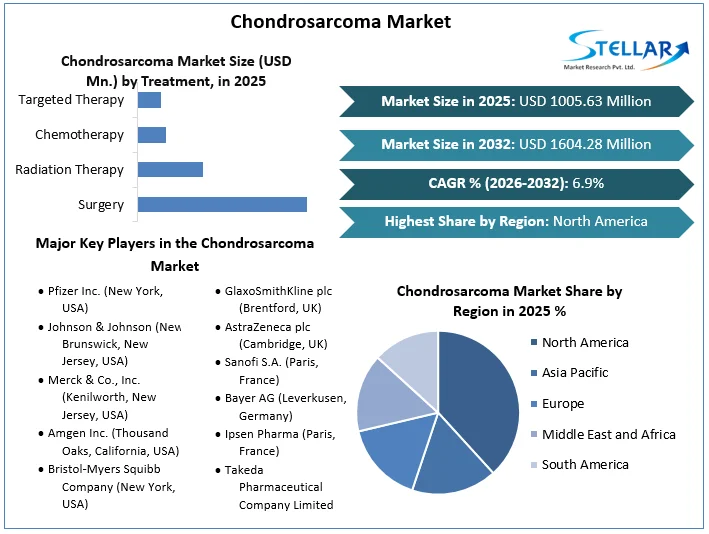
According to Stellar Market Research, the Chondrosarcoma Market was valued at USD 1,005.63 million in 2025 and is projected to reach USD 1,604.28 million by 2032, expanding at a CAGR of 6.9% during 2026–2032. The market growth is supported by increasing disease awareness, rising research investments, advancements in imaging technologies, and the development of targeted therapies for patients with limited treatment options.
Market Overview
Chondrosarcoma originates in cartilage-forming tissues and primarily affects bones such as the pelvis, femur, ribs, and shoulder regions. The disease commonly occurs in adults, particularly individuals between 20 and 60 years of age. While many cases progress slowly, high-grade tumors can become aggressive and may lead to metastasis and recurrence.
The Chondrosarcoma Market includes diagnostic procedures, surgical interventions, radiation therapies, chemotherapy, targeted therapies, and emerging treatment approaches. Surgery remains the primary treatment option because many chondrosarcoma tumors show limited response to traditional systemic therapies.
The increasing focus on personalized medicine is changing the treatment environment by encouraging researchers to explore molecular pathways, genetic mutations, and tumor-specific characteristics. These developments are creating opportunities for pharmaceutical companies and biotechnology firms to introduce more effective therapies.
Download Free PDF Brochure: https://www.stellarmr.com/report/req_sample/Chondrosarcoma-Market/2085
Key Factors Driving Market Growth
Increasing prevalence and diagnosis of rare bone cancers
Growing awareness about rare cancers and improvements in diagnostic capabilities are major factors supporting market expansion. Advanced imaging techniques, including magnetic resonance imaging (MRI), computed tomography (CT), and molecular diagnostic tools, enable earlier and more accurate detection of tumors.
Early diagnosis improves treatment planning and allows healthcare professionals to select appropriate surgical and therapeutic approaches based on tumor characteristics.
Growth of precision oncology and targeted therapies
Precision medicine is becoming a significant growth driver in the Chondrosarcoma Market. Researchers are increasingly studying genetic alterations associated with chondrosarcoma, including mutations affecting pathways involved in tumor growth and progression.
Targeted therapies designed to interfere with specific molecular mechanisms are creating new opportunities for patients with advanced or unresectable disease. Emerging treatment approaches such as IDH inhibitors, immune-based therapies, and novel molecular drugs are expanding the future potential of chondrosarcoma management.
Rising investments in cancer research
Pharmaceutical companies, biotechnology firms, academic institutions, and government organizations are increasing investments in oncology research. Rare cancer categories such as chondrosarcoma are receiving greater attention due to unmet medical needs and opportunities for breakthrough treatments.
Clinical trials, drug discovery programs, and collaborations between research organizations are expected to accelerate innovation within the market.
Market Segmentation Insights
The Chondrosarcoma Market is segmented based on type, treatment, end-user, and region. The major types include conventional chondrosarcoma, dedifferentiated chondrosarcoma, clear cell chondrosarcoma, mesenchymal chondrosarcoma, and other variants.
Conventional chondrosarcoma represents a significant segment due to its higher occurrence compared with other subtypes. However, rare and aggressive subtypes continue attracting research attention because of their complex treatment requirements.
Based on treatment, surgery remains a dominant segment due to its effectiveness in removing localized tumors. However, targeted therapies are expected to witness increasing adoption as research progresses and new treatment options become available.
Hospitals, specialized cancer treatment centers, and ambulatory surgical centers represent key end-user segments, with cancer centers playing an important role due to their specialized expertise in managing rare tumors.
Technology Trends Transforming the Market
Technological advancements are significantly influencing diagnosis and treatment strategies for chondrosarcoma. Advanced imaging technologies help physicians understand tumor location, size, and progression, supporting more precise surgical planning.
Artificial intelligence and machine learning are increasingly being explored in oncology diagnostics to analyze medical images, identify disease patterns, and support clinical decision-making.
Genomic sequencing technologies are also becoming important in understanding tumor biology. Molecular profiling helps researchers identify genetic abnormalities and develop therapies targeting specific disease mechanisms.
Minimally invasive surgical techniques, advanced radiation technologies, and improved treatment monitoring systems are further enhancing patient care.
Regulatory and Research Landscape
Regulatory agencies worldwide are encouraging innovation in rare disease treatments through orphan drug programs, accelerated approval pathways, and research incentives. These initiatives help pharmaceutical companies invest in therapies targeting smaller patient populations with significant unmet needs.
The development of new chondrosarcoma treatments requires extensive clinical evaluation due to the complexity of the disease and limited patient populations. Regulatory support and collaboration between healthcare institutions are expected to play an important role in bringing innovative therapies to market.
Regional Market Insights
North America currently dominates the Chondrosarcoma Market due to its advanced healthcare infrastructure, strong oncology research ecosystem, and presence of leading cancer treatment centers. The United States contributes significantly through pharmaceutical investments, clinical trials, and rare cancer research initiatives.
Europe represents another important market supported by advanced healthcare systems, increasing research collaborations, and growing adoption of precision oncology approaches.
Asia-Pacific is expected to witness significant growth during the forecast period due to improving healthcare infrastructure, increasing cancer awareness, expanding diagnostic capabilities, and rising investments in biotechnology research. Countries such as China, Japan, South Korea, and India are strengthening their oncology capabilities and creating new opportunities for market participants.
Emerging regions, including Latin America and the Middle East & Africa, are gradually improving access to specialized cancer diagnosis and treatment services.
Competitive Landscape
The Chondrosarcoma Market includes pharmaceutical companies, biotechnology firms, and research organizations focused on developing advanced oncology solutions. Key players identified in the market include Pfizer Inc., Johnson & Johnson, Merck & Co., Inc., Amgen Inc., and Bristol Myers Squibb.
Companies are focusing on research partnerships, clinical development programs, targeted therapy innovation, and expansion of oncology portfolios. Strategic collaborations between biotechnology companies and research institutions are expected to accelerate treatment development.
Download Free PDF Brochure: https://www.stellarmr.com/report/req_sample/Chondrosarcoma-Market/2085
Future Outlook
The future of the Chondrosarcoma Market is expected to be shaped by advancements in precision medicine, molecular diagnostics, and targeted cancer therapies. Increasing investments in rare disease research, improved healthcare infrastructure, and growing awareness of bone cancers will continue supporting market expansion.
While challenges such as limited patient populations, complex clinical trials, and high treatment development costs remain, innovation in biotechnology and personalized medicine offers significant growth opportunities.
As the healthcare industry continues shifting toward patient-specific treatment approaches, the Chondrosarcoma Market is expected to evolve from traditional treatment methods toward more targeted, effective, and technologically advanced solutions. Companies investing in research, partnerships, and next-generation oncology therapies will play a critical role in shaping the future of rare cancer treatment.
Media Contact
Stellar Market Research
Website: Stellar Market Research – Global Research Reports & Consulting
Email: sales@stellarmr.com
