Market Overview
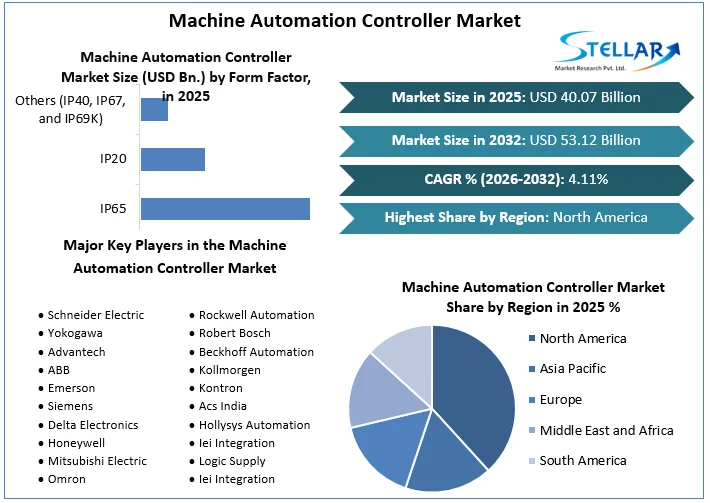
Machine Automation Controller Market was valued nearly USD 40.07 Bn. in 2025. Global Machine Automation Controller Market size is estimated to grow at a CAGR of 4.11 % and is expected to reach at USD 53.12 Bn. by 2032.
The Machine Automation Controller Market is witnessing significant growth as industries increasingly adopt automation technologies to improve operational efficiency, reduce production costs, and enhance manufacturing accuracy. Machine automation controllers serve as critical components in industrial automation systems by managing, monitoring, and controlling machinery operations across manufacturing facilities. The rising adoption of smart factories, Industry 4.0 technologies, and advanced control systems is accelerating demand for high-performance automation controllers across multiple industries.
Machine automation controllers integrate programmable logic control, motion control, robotics management, data processing, and industrial communication capabilities into a unified platform. These systems enable manufacturers to achieve greater productivity, minimize downtime, and optimize complex production processes. Increasing investments in industrial digitalization, robotics, and connected manufacturing solutions are expected to create strong growth opportunities for market participants.
Download Free PDF Brochure: https://www.stellarmr.com/report/req_sample/Machine-Automation-Controller-Market/285
Growing Adoption of Smart Manufacturing and Industry 4.0
One of the primary factors driving the growth of the Machine Automation Controller Market is the rapid transition toward smart manufacturing. Industries worldwide are upgrading traditional production facilities with connected automation systems that support real-time monitoring, predictive maintenance, and data-driven decision-making.
Manufacturers are increasingly integrating machine automation controllers with industrial Internet of Things (IIoT) platforms, artificial intelligence, and cloud-based analytics systems. These technologies allow businesses to collect operational data, identify equipment issues before failures occur, and improve overall production efficiency.
The expansion of Industry 4.0 initiatives has increased demand for intelligent controllers capable of handling complex industrial processes. Modern automation controllers offer enhanced processing capabilities, improved connectivity, and greater flexibility, making them essential for advanced manufacturing environments.
Key Growth Drivers of the Machine Automation Controller Market
Increasing Industrial Automation Across Manufacturing Sectors
The growing need for automation across industries such as automotive, electronics, pharmaceuticals, food and beverages, and semiconductor manufacturing is a major factor supporting market expansion. Companies are investing in automated production lines to improve product quality, increase output, and reduce dependency on manual operations.
The automotive sector, in particular, is driving demand for machine automation controllers due to the increasing use of robotic assembly systems, electric vehicle manufacturing, and advanced production technologies. Similarly, semiconductor and electronics manufacturers require highly precise automation solutions to manage complex manufacturing processes.
Rising Demand for Robotics and Motion Control Systems
The rapid adoption of industrial robots is creating new opportunities for machine automation controller manufacturers. Robots require advanced controllers to coordinate movement, process inputs, and execute precise operations.
Industries are deploying robotic systems for applications such as assembly, packaging, material handling, welding, and inspection. Automation controllers with advanced motion control capabilities enable improved accuracy and faster production cycles, supporting the expansion of automated manufacturing systems.
Growing Focus on Energy Efficiency and Operational Optimization
Energy efficiency has become a major priority for industries seeking to reduce operational expenses and achieve sustainability goals. Machine automation controllers help optimize energy consumption by improving equipment performance, reducing unnecessary machine operations, and enabling intelligent resource management.
Manufacturers are increasingly adopting automation technologies that support environmental objectives while improving productivity. This trend is encouraging the development of energy-efficient controllers with advanced monitoring capabilities.
Challenges Affecting Market Growth
Despite strong growth prospects, the Machine Automation Controller Market faces certain challenges. The high initial investment required for implementing advanced automation systems can limit adoption, particularly among small and medium-sized enterprises. Automation infrastructure requires significant spending on hardware, software, installation, and employee training.
Another challenge is the complexity of integrating modern automation controllers with existing industrial systems. Many companies operate legacy equipment that may require upgrades or customized solutions to support advanced control technologies.
Additionally, cybersecurity concerns are increasing as industrial systems become more connected. Connected automation controllers are vulnerable to cyber threats, making data protection and secure communication protocols essential for manufacturers.
Technology Trends Transforming Machine Automation Controllers
Technological advancements are reshaping the automation controller landscape. Artificial intelligence and machine learning are being integrated into industrial control systems to enable predictive analytics, adaptive control, and autonomous decision-making.
Edge computing is also becoming an important trend, allowing automation controllers to process data closer to production equipment rather than relying entirely on centralized systems. This reduces response times and improves operational reliability.
Industrial communication technologies such as Ethernet-based networks, 5G connectivity, and advanced fieldbus systems are enhancing communication between machines, sensors, and enterprise platforms. These developments are enabling more flexible and scalable automation architectures.
Cybersecurity is also gaining importance, with manufacturers incorporating advanced security features such as encrypted communication, authentication systems, and secure software updates to protect industrial operations.
Sustainability and Regulatory Influence
Sustainability initiatives and industrial regulations are influencing the adoption of advanced automation solutions. Governments and organizations worldwide are encouraging manufacturers to improve energy efficiency, reduce emissions, and implement environmentally responsible production practices.
Machine automation controllers support sustainability objectives by optimizing machine performance, reducing energy waste, and improving resource utilization. Industries are increasingly adopting automation technologies as part of broader environmental, social, and governance (ESG) strategies.
Regulatory standards related to industrial safety, equipment efficiency, and cybersecurity are also shaping product development. Automation controller manufacturers are focusing on compliance with international standards to ensure reliability, safety, and secure operation.
Regional Analysis
North America holds a significant position in the Machine Automation Controller Market due to strong adoption of advanced manufacturing technologies, robotics, and industrial automation solutions. The United States is a major contributor, supported by investments in smart factories, automotive automation, semiconductor production, and industrial digital transformation.
Europe is another important market, driven by increasing focus on energy-efficient manufacturing, industrial modernization, and sustainability initiatives. Countries such as Germany, France, and the United Kingdom are investing heavily in automation technologies to maintain manufacturing competitiveness.
Asia Pacific is expected to witness strong growth due to rapid industrialization, expanding manufacturing sectors, and increasing investments in automation infrastructure. Countries including China, Japan, South Korea, and India are adopting automation solutions across automotive, electronics, and industrial production sectors.
The region’s growing focus on smart manufacturing and government-supported digital transformation programs is creating significant opportunities for automation controller providers.
Competitive Landscape
The Machine Automation Controller Market is highly competitive, with companies focusing on technological innovation, product development, partnerships, and expansion of automation portfolios. Leading manufacturers are investing in intelligent controllers that offer improved connectivity, processing power, and integration capabilities.
Major players operating in the market include Siemens AG, Rockwell Automation, Mitsubishi Electric Corporation, Schneider Electric, and ABB Ltd..
These companies are strengthening their market positions through advanced product launches, software integration, strategic collaborations, and investments in digital manufacturing solutions.
Download Free PDF Brochure: https://www.stellarmr.com/report/req_sample/Machine-Automation-Controller-Market/285
Future Outlook
The future of the Machine Automation Controller Market will be shaped by increasing automation adoption, smart factory development, and advancements in industrial digital technologies. As manufacturers continue transitioning toward connected and intelligent production environments, demand for flexible and high-performance automation controllers is expected to rise.
The integration of artificial intelligence, edge computing, robotics, and industrial IoT will further enhance controller capabilities, enabling more efficient and autonomous manufacturing operations. Companies investing in cybersecurity, sustainable solutions, and scalable automation platforms are expected to gain competitive advantages.
With industries prioritizing productivity, efficiency, and digital transformation, machine automation controllers will remain a critical technology supporting the next generation of industrial manufacturing. The market is positioned for continued expansion as businesses worldwide accelerate their move toward smarter, more connected, and sustainable production systems.
Media Contact
Stellar Market Research
Website: Stellar Market Research – Global Research Reports & Consulting
Email: sales@stellarmr.com
