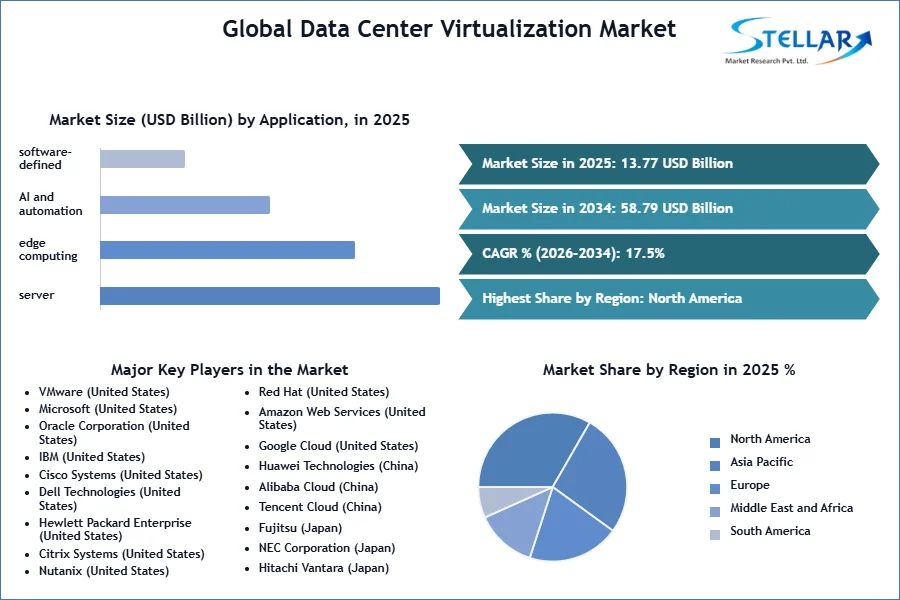
Data Center Virtualization Market has become a cornerstone of modern enterprise IT by enabling organizations to abstract physical computing resources into virtual environments. Through virtualization, businesses can optimize server utilization, reduce hardware dependency, improve workload management, and simplify data center operations. Virtualization technologies support servers, storage, networks, desktops, and applications, making them essential for cloud computing, hybrid IT, disaster recovery, and digital transformation initiatives.
Growing demand for scalable IT infrastructure, rising investments in cloud services, and increasing adoption of software-defined data centers (SDDCs) are driving significant market expansion. The integration of artificial intelligence (AI), automation, edge computing, and container technologies is further enhancing the capabilities of virtualized data center environments.
Cloud Computing Adoption Drives Market Growth
One of the primary drivers of the Data Center Virtualization Market is the rapid adoption of cloud computing across enterprises of all sizes. Organizations are virtualizing their infrastructure to improve flexibility, scalability, and resource efficiency.
Data center virtualization is widely used for:
Server virtualization
Storage virtualization
Network virtualization
Desktop virtualization
Application virtualization
Disaster recovery
Cloud infrastructure
Hybrid IT environments
These solutions help businesses maximize hardware utilization while reducing infrastructure costs.
𝐃𝐨𝐰𝐧𝐥𝐨𝐚𝐝 𝐅𝐫𝐞𝐞 𝐏𝐃𝐅 𝐁𝐫𝐨𝐜𝐡𝐮𝐫𝐞: https://www.stellarmr.com/report/req_sample/Global-Data-Center-Virtualization-Market/1420
Digital Transformation Accelerates Infrastructure Modernization
As enterprises modernize their IT operations, virtualization has become a key enabler of agile and software-defined infrastructure.
Major benefits include:
Improved resource allocation
Faster application deployment
Reduced hardware costs
Simplified IT management
Enhanced workload mobility
Business continuity
Higher system availability
Better energy efficiency
These advantages enable organizations to respond more quickly to changing business requirements.
AI and Automation Improve Data Center Operations
Artificial intelligence and automation technologies are transforming virtualized data centers by improving operational efficiency and infrastructure management.
Key technological advancements include:
AI-driven workload optimization
Predictive infrastructure monitoring
Automated resource provisioning
Intelligent capacity planning
Machine learning-based analytics
Self-healing infrastructure
Automated orchestration
Real-time performance monitoring
These capabilities reduce manual intervention while improving reliability and overall system performance.
𝐃𝐨𝐰𝐧𝐥𝐨𝐚𝐝 𝐅𝐫𝐞𝐞 𝐏𝐃𝐅 𝐁𝐫𝐨𝐜𝐡𝐮𝐫𝐞: https://www.stellarmr.com/report/req_sample/Global-Data-Center-Virtualization-Market/1420
Software-Defined Infrastructure Expands Commercial Opportunities
Organizations are increasingly investing in software-defined architectures to improve flexibility and simplify infrastructure management.
Emerging technologies include:
Software-defined networking (SDN)
Software-defined storage (SDS)
Hyper-converged infrastructure (HCI)
Container orchestration
Kubernetes integration
Virtual machine management
Infrastructure as Code (IaC)
Multi-cloud management platforms
These innovations enable organizations to build highly scalable and resilient digital infrastructure.
Sustainability and Energy Efficiency Support Market Expansion
Virtualization helps organizations reduce energy consumption and optimize data center operations by improving hardware utilization.
Key sustainability initiatives include:
Server consolidation
Reduced power consumption
Lower cooling requirements
Green data centers
Carbon footprint reduction
Efficient resource utilization
Sustainable IT infrastructure
Intelligent energy management
These practices help businesses lower operational costs while meeting environmental sustainability goals.
Regional Market Insights
North America
North America dominates the Data Center Virtualization Market, supported by advanced cloud infrastructure, widespread enterprise IT modernization, strong investments in hyperscale data centers, and rapid adoption of AI-driven infrastructure management.
Europe
Europe continues to experience significant growth due to increasing cloud migration, expanding digital transformation initiatives, strong cybersecurity investments, and growing demand for energy-efficient data centers.
Asia Pacific
Asia Pacific is projected to witness the fastest market growth, driven by rapid digitalization, expanding cloud service adoption, increasing enterprise IT spending, and large-scale data center investments across China, India, Japan, South Korea, Singapore, and Australia.
Latin America, Middle East, and Africa
These regions are gradually expanding their virtualization capabilities through investments in digital infrastructure, cloud services, smart city projects, and enterprise modernization.
Competitive Landscape
The Data Center Virtualization Market is highly competitive, with cloud service providers, virtualization software vendors, enterprise technology companies, and infrastructure solution providers investing in advanced virtualization platforms.
Major competitive strategies include:
Cloud-native virtualization platforms
AI-powered infrastructure management
Hybrid cloud solutions
Hyper-converged infrastructure development
Strategic technology partnerships
Product portfolio expansion
Research and development investments
Global data center expansion
Companies continue focusing on improving scalability, security, automation, interoperability, and operational efficiency.
Emerging Opportunities
Several trends are expected to shape future market growth:
AI-powered autonomous data centers
Edge computing virtualization
Multi-cloud orchestration
Container-native infrastructure
Virtual GPU technologies
Zero-trust data center security
Green cloud infrastructure
Intelligent workload automation
These innovations are expected to improve infrastructure performance while supporting next-generation digital services.
Future Outlook
The future of the Data Center Virtualization Market remains highly promising as enterprises continue investing in cloud computing, digital transformation, and software-defined infrastructure. Advances in AI, automation, edge computing, and hybrid cloud technologies will further accelerate virtualization adoption across industries.
Organizations that prioritize scalable infrastructure, cybersecurity, automation, and sustainable IT operations will be well positioned to capitalize on the expanding opportunities within the global data center ecosystem.
Conclusion
The Data Center Virtualization Market is transforming enterprise IT by enabling organizations to optimize infrastructure utilization, improve operational efficiency, strengthen business continuity, and accelerate cloud adoption. Rising demand for software-defined data centers, AI-powered automation, hybrid cloud environments, and sustainable IT infrastructure is creating substantial growth opportunities across the technology landscape.
As businesses increasingly embrace digital transformation and cloud-first strategies, the Data Center Virtualization Market is expected to witness sustained long-term growth, benefiting cloud providers, enterprise IT organizations, virtualization software vendors, managed service providers, and investors worldwide.
