Market overview
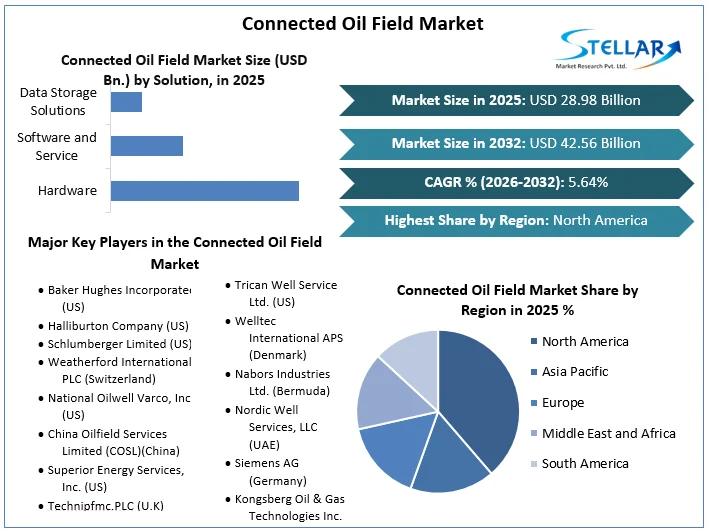
The Connected Oil Field Market is experiencing significant growth as oil and gas companies accelerate investments in digital technologies to improve operational efficiency, maximize production, and reduce operational costs. Connected oil field solutions integrate advanced software, sensors, cloud computing, industrial Internet of Things (IIoT), artificial intelligence (AI), and real-time analytics to enable intelligent decision-making across upstream oil and gas operations. These technologies help operators monitor reservoirs, optimize drilling, improve production performance, and enhance worker safety through data-driven insights. According to Stellar Market Research, the Connected Oil Field Market was valued at USD 28.98 billion in 2025 and is expected to reach USD 42.56 billion by 2032, registering a CAGR of 5.64% during the forecast period.
Growing pressure on energy companies to increase recovery rates while reducing production costs is driving widespread adoption of connected oil field technologies. As digital transformation becomes a strategic priority, operators are deploying smart field solutions that deliver real-time visibility into equipment performance, production assets, and reservoir conditions.
Download Free PDF Brochure: https://www.stellarmr.com/report/req_sample/connected-oil-field-market/2558
Digital oilfield technologies are transforming upstream operations
The oil and gas industry has traditionally relied on labor-intensive operations and periodic monitoring. However, increasing operational complexity and volatile energy prices are encouraging companies to adopt connected oil field technologies that enable continuous monitoring and predictive decision-making.
Modern connected oil fields combine operational technology (OT) with information technology (IT) to collect and analyze data from wells, drilling equipment, production facilities, and reservoirs. Using AI-powered analytics and predictive maintenance, operators can identify equipment failures before they occur, reduce unplanned downtime, and improve asset utilization.
The integration of cloud platforms and edge computing further enables remote monitoring of oil fields, allowing operators to optimize production while minimizing operational risks. As energy companies focus on maximizing return on investment (ROI), digital oil field solutions are becoming essential components of long-term operational strategies.
Key market drivers accelerating growth
Increasing focus on operational efficiency
One of the primary drivers of the Connected Oil Field Market is the industry’s need to improve operational efficiency while controlling production costs. Connected technologies provide continuous visibility into field operations, enabling faster decision-making and optimized resource utilization.
Predictive analytics helps operators detect anomalies, reduce equipment failures, and minimize maintenance expenses. Real-time production monitoring also supports improved reservoir management, increasing recovery rates and overall profitability.
Rising adoption of Industrial IoT and AI
The widespread adoption of Industrial Internet of Things (IIoT), artificial intelligence, machine learning, and advanced analytics is transforming upstream oil and gas operations. Smart sensors installed across production facilities continuously collect operational data, enabling automated analysis and intelligent workflow optimization.
AI-driven platforms assist engineers in forecasting equipment failures, optimizing drilling performance, and improving production planning. As digital technologies mature, connected oil fields are becoming more intelligent and autonomous.
Growing investments in digital transformation
Major energy companies continue investing heavily in digital transformation initiatives to improve competitiveness and operational resilience. Digital twins, cloud computing, remote asset management, and advanced automation are increasingly being integrated into exploration and production activities.
These investments help companies reduce operational risks, improve workforce safety, and enhance production efficiency while supporting sustainability goals through lower emissions and optimized energy consumption.
Market segmentation analysis
The Connected Oil Field Market is segmented by solution, process, application, and geography.
Based on solution, Software & Service dominates the market with more than 51% market share in 2025. Oil and gas companies are increasingly investing in software platforms, analytics solutions, and digital services to improve operational performance and asset management capabilities.
By process, the market includes reservoir optimization, production optimization, drilling optimization, and safety management. Production optimization remains a major application area as operators seek to maximize output while minimizing operational costs.
By application, the market is divided into onshore and offshore operations. Onshore installations account for a significant share due to extensive deployment across mature oil-producing regions, while offshore projects are increasingly adopting connected technologies to improve operational reliability in complex environments.
Technology and sustainability trends
Digital innovation continues to reshape the future of connected oil fields. Artificial intelligence, machine learning, cloud computing, digital twins, robotics, and autonomous inspection technologies are enabling highly efficient upstream operations.
Predictive maintenance has become one of the most valuable applications, allowing operators to identify equipment degradation before failures occur. Remote monitoring reduces the need for on-site personnel while improving operational safety.
Environmental sustainability is also becoming increasingly important. Connected oil field technologies help reduce methane emissions, optimize fuel consumption, minimize waste, and improve environmental compliance through continuous monitoring and automated reporting.
Cybersecurity has emerged as another critical priority as increasing digital connectivity requires robust protection of operational data and industrial control systems.
Regional outlook
North America
North America continues to lead the Connected Oil Field Market due to extensive investments in digital oilfield technologies and the presence of major upstream operators. The United States remains the dominant contributor, supported by expanding drilling activities and increasing adoption of IoT-enabled production systems, particularly across the Permian Basin.
Middle East and Africa
The Middle East is rapidly emerging as a major growth region as national oil companies invest in smart oil field infrastructure to improve production efficiency and maximize hydrocarbon recovery. Countries including Saudi Arabia and the United Arab Emirates are integrating AI, automation, and advanced analytics into upstream operations.
Asia Pacific
Asia Pacific is witnessing increasing adoption of connected oil field technologies due to growing energy demand and expanding exploration activities. China, India, and Southeast Asian countries continue investing in digital transformation to improve production efficiency and strengthen energy security.
Competitive landscape
The Connected Oil Field Market is highly competitive, with leading technology providers focusing on digital innovation, software development, cloud-based platforms, and integrated automation solutions.
Major companies operating in the market include Baker Hughes, Halliburton, SLB (Schlumberger), Weatherford International, National Oilwell Varco, TechnipFMC, China Oilfield Services (COSL), Nabors Industries, Saipem, Expro Group, Welltec, and Transocean. These companies continue investing in AI-powered analytics, industrial IoT platforms, predictive maintenance solutions, and integrated digital oil field services to strengthen their market positions.
Strategic collaborations between technology providers and oil operators are further accelerating innovation across remote monitoring, production optimization, and digital asset management.
Download Free PDF Brochure: https://www.stellarmr.com/report/req_sample/connected-oil-field-market/2558
Challenges facing the market
Despite strong growth prospects, several challenges continue to affect market expansion. One of the primary concerns is ensuring high-quality, real-time data collection across complex upstream environments. Inaccurate or incomplete operational data can limit the effectiveness of predictive analytics and automated decision-making.
High implementation costs, cybersecurity risks, and integration with legacy infrastructure also remain significant barriers for some operators, particularly smaller exploration and production companies.
Future outlook
The future of the Connected Oil Field Market will be driven by increasing digitalization across the global energy industry. Artificial intelligence, cloud computing, Industrial IoT, digital twins, and autonomous operations will continue transforming upstream oil and gas production throughout the forecast period.
As companies seek greater operational efficiency, lower production costs, improved sustainability, and enhanced workforce safety, investments in connected oil field technologies are expected to accelerate. Organizations that successfully integrate intelligent automation with advanced analytics will be well positioned to improve productivity and maintain competitiveness in an increasingly data-driven energy landscape.
Media Contact
Stellar Market Research
Website: Stellar Market Research – Global Research Reports & Consulting
Email: sales@stellarmr.com
