Structural Wood Screws Market: Strengthening Modern Construction with High-Performance Fastening Solutions
The global construction industry is increasingly adopting advanced fastening systems that provide superior strength, durability, and installation efficiency. Structural wood screws have become an essential component in residential, commercial, and industrial construction projects, offering higher load-bearing capacity and improved performance compared to traditional nails and bolts. Rising urbanization, growth in timber construction, and increasing demand for sustainable building materials are driving steady expansion of the global Structural Wood Screws Market.
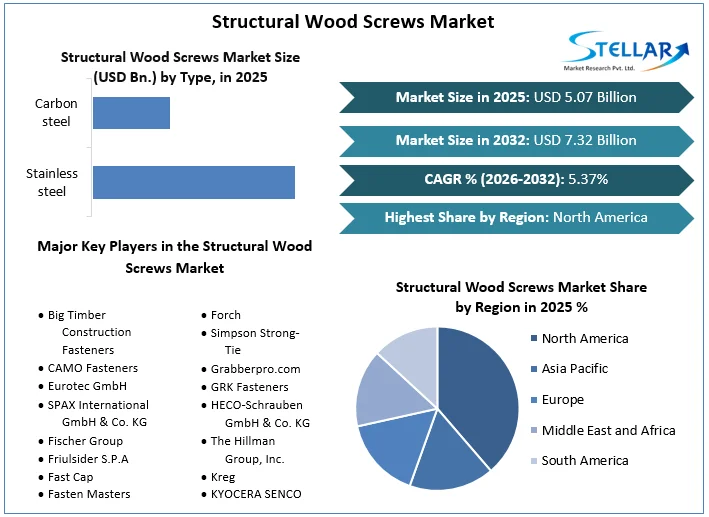
According to Stellar Market Research, the Global Structural Wood Screws Market was valued at USD 5.07 billion in 2025 and is projected to reach USD 7.32 billion by 2032, growing at a CAGR of 5.37% during the forecast period.
What are Structural Wood Screws?
Structural wood screws are heavy-duty fasteners specifically designed to create strong, durable, and long-lasting connections between wood components. They are widely used in structural framing, decking, timber construction, furniture manufacturing, and engineered wood applications.
Common types include:
- Hex head screws
- Flat head screws
- Countersunk screws
- Self-tapping wood screws
- Corrosion-resistant coated screws
Compared to conventional fasteners, structural wood screws offer greater holding power, easier installation, reduced splitting of wood, and excellent structural integrity.
𝐃𝐨𝐰𝐧𝐥𝐨𝐚𝐝 𝐅𝐫𝐞𝐞 𝐏𝐃𝐅 𝐁𝐫𝐨𝐜𝐡𝐮𝐫𝐞: https://www.stellarmr.com/report/req_sample/Structural-Wood-Screws-Market/2181
Market Growth Drivers
Expansion of the Construction Industry
Rapid urbanization, population growth, and increasing investments in residential and commercial infrastructure are significantly boosting demand for structural wood screws. Modern timber construction requires reliable fastening systems capable of supporting heavy structural loads while improving installation efficiency.
Growing Adoption of Engineered Wood
The increasing use of engineered wood products such as laminated veneer lumber (LVL), cross-laminated timber (CLT), and glued laminated timber (Glulam) has created strong demand for specialized structural wood screws that provide secure and durable connections.
Sustainable Building Practices
As governments and builders promote environmentally friendly construction, wood continues to gain popularity as a renewable building material. Structural wood screws support sustainable construction by enabling efficient timber assembly while reducing material waste.
Technological Advancements
Manufacturers continue introducing advanced screw designs featuring:
- Self-drilling tips
- Improved thread geometry
- Corrosion-resistant coatings
- High-strength steel alloys
- Enhanced torque performance
These innovations improve installation speed while increasing structural reliability.
Emerging Market Trends
Several innovations are shaping the Structural Wood Screws Market:
- High-performance stainless steel screws
- Eco-friendly corrosion-resistant coatings
- Fast-installation self-tapping screws
- Fasteners for mass timber construction
- Precision manufacturing technologies
- Smart fastening solutions for modular construction
Growing adoption of prefabricated and modular buildings is also increasing demand for advanced structural fastening systems.
Market Segmentation
By Type
The market includes:
- Stainless Steel
- Carbon Steel
Stainless steel screws held the largest market share in 2025 due to their superior corrosion resistance, durability, and suitability for outdoor, marine, and humid environments. Carbon steel screws continue to experience strong demand because of their affordability and widespread use in indoor construction projects.
By Application
Major application segments include:
- Construction
- Furniture and Crafts
- Other Applications
Construction remains the dominant segment as structural wood screws are extensively used in framing, decking, roofing, flooring, and timber building projects.
Regional Insights
North America Leads the Market
North America dominates the global Structural Wood Screws Market due to:
- Strong residential construction activity
- Increasing timber-frame housing
- Advanced construction technologies
- High adoption of engineered wood products
- Presence of leading fastener manufacturers
The United States and Canada continue to invest heavily in sustainable building practices and modern construction methods, supporting steady market growth.
Asia-Pacific Shows Significant Growth
Asia-Pacific is expected to register strong growth driven by:
- Rapid urbanization
- Expanding infrastructure development
- Rising disposable incomes
- Growth in residential construction
- Increasing adoption of engineered wood products
China and India are emerging as major markets due to ongoing investments in housing and commercial infrastructure.
Market Challenges
Despite positive growth prospects, several challenges remain.
Competition from Alternative Fastening Systems
Traditional nails, bolts, and adhesive bonding technologies continue to compete with structural wood screws in certain applications, particularly where lower initial costs are a priority.
Raw Material Price Volatility
Fluctuating prices of steel, aluminum, coatings, and other raw materials can impact manufacturing costs and overall profitability.
Regulatory Compliance
Manufacturers must comply with evolving building codes, structural performance standards, and environmental regulations while continuously investing in product innovation and quality assurance.
𝐃𝐨𝐰𝐧𝐥𝐨𝐚𝐝 𝐅𝐫𝐞𝐞 𝐏𝐃𝐅 𝐁𝐫𝐨𝐜𝐡𝐮𝐫𝐞: https://www.stellarmr.com/report/req_sample/Structural-Wood-Screws-Market/2181
Competitive Landscape
Leading companies are strengthening their market positions through:
- Development of high-strength fastening systems
- Investment in advanced manufacturing technologies
- Expansion of corrosion-resistant product portfolios
- Strategic partnerships with construction companies
- Research and development for engineered wood applications
- Sustainable manufacturing initiatives
Product quality, durability, pricing, and technical performance remain key competitive factors within the market.
Future Outlook
The Structural Wood Screws Market is expected to maintain steady growth as timber construction and sustainable building practices continue to expand worldwide.
Future opportunities include:
- Fasteners for mass timber construction
- AI-enabled manufacturing systems
- Smart construction hardware
- Advanced corrosion-resistant coatings
- High-strength lightweight fasteners
- Expansion of modular and prefabricated construction
Increasing investments in green buildings and modern infrastructure are expected to create long-term growth opportunities for manufacturers.
Conclusion
The global Structural Wood Screws Market is becoming increasingly important as the construction industry shifts toward stronger, more efficient, and environmentally sustainable building solutions. Rising demand for engineered wood, continuous innovation in fastening technologies, and expanding construction activities are supporting long-term market growth.
Manufacturers that invest in advanced materials, corrosion-resistant coatings, precision engineering, and sustainable production processes will be well positioned to capitalize on the growing demand for high-performance structural fastening solutions.
