Key Highlights
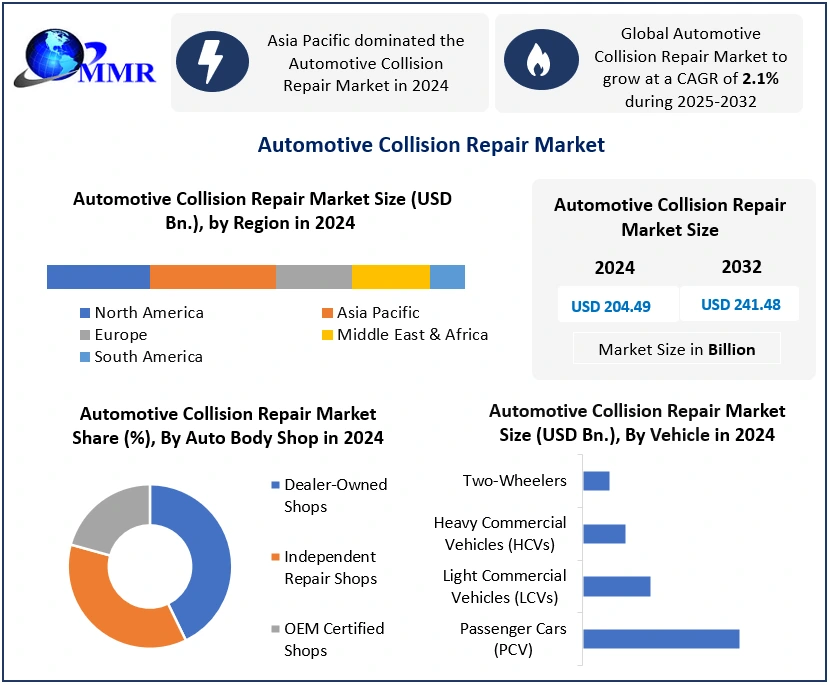
- Automotive Collision Repair Market valued at USD 204.49 billion in 2024
- Market projected to reach USD 241.48 billion by 2032
- Expected CAGR of 2.1% during 2025–2032
- Rising accident rates continue to generate consistent repair demand
- Dealer-operated repair facilities remain an important growth driver
- Advanced vehicle technologies are increasing repair complexity
- OEM-certified repair capabilities are becoming increasingly important
Why This Matters Now
Collision repair has shifted from replacing damaged components to restoring sophisticated electronic systems. Vehicles equipped with cameras, radar sensors, connectivity modules, and lightweight structural materials require highly specialized repair procedures that directly affect safety and vehicle performance.
For OEMs, certified repair networks help preserve vehicle quality and customer loyalty. For insurers, higher repair complexity influences claim costs and settlement strategies. Fleet operators increasingly prioritize repair quality and turnaround time to minimize downtime, while investors view the aftermarket as a stable revenue stream supported by an expanding global vehicle parc.
Market Overview
The Automotive Collision Repair Market Size encompasses services that restore vehicles damaged in accidents, including body repair, painting, structural restoration, replacement of damaged components, and electronic system calibration.
Despite moderate overall market growth, the industry continues to benefit from a consistent demand base generated by vehicle ownership and road traffic incidents. Dealer repair shops have strengthened their position by offering manufacturer-approved repair processes, access to genuine components, and technicians trained on increasingly sophisticated vehicle platforms.
Vehicle technology has fundamentally changed repair workflows. Modern automobiles incorporate numerous sensors supporting driver assistance functions, making post-repair calibration an essential part of collision restoration. This transition increases repair value per vehicle while raising entry barriers for independent workshops lacking advanced diagnostic capabilities.
The industry’s revenue growth therefore comes not only from repair volumes but also from the increasing technical sophistication required for each repair.
Key Trends Driving Growth
The expansion of dealer-operated repair centers remains one of the most important structural changes in the market. OEMs increasingly view collision repair as an extension of customer ownership experience, strengthening brand loyalty while generating recurring aftermarket revenue.
The growing adoption of ADAS-equipped vehicles is creating new service opportunities. Even relatively minor collisions may require recalibration of cameras, radar sensors, and safety systems before vehicles return to the road. This expands demand for diagnostic equipment, specialized technician training, and certified repair facilities.
Electrification introduces additional repair considerations. Electric vehicles require technicians trained to safely handle high-voltage systems and battery-integrated vehicle architectures. Repair facilities investing in specialized equipment are positioning themselves for future demand as EV adoption expands across major automotive markets.
Digitalization also continues to improve repair operations. Repair planning software, digital damage assessments, workflow management platforms, and connected diagnostics help reduce repair cycle times while improving communication between insurers, repair facilities, and vehicle owners.
Insurance companies increasingly collaborate with certified repair networks to improve quality consistency and reduce claim disputes. These partnerships influence repair volumes while encouraging higher operational standards throughout the aftermarket ecosystem.
Segment Insights
- Dominant Segment: The report identifies the leading market segment based on its comprehensive segmentation analysis. The dominant segment benefits from established repair demand, broad customer adoption, and strong aftermarket support as presented in the MMR report.
- Fastest-Growing Segment: The report identifies the fastest-growing segment based on forecast growth. Expansion is supported by changing vehicle technologies, increasing repair complexity, and evolving customer requirements.
Regional Growth Story
North America continues to represent a mature collision repair ecosystem supported by high vehicle ownership, established insurance coverage, and extensive dealer service networks. OEM-certified repair programs continue expanding as manufacturers seek greater control over repair quality and customer retention.
Europe’s market is influenced by stringent vehicle safety requirements and widespread adoption of advanced automotive technologies. Dealer repair centers and specialized workshops increasingly invest in diagnostic equipment capable of servicing sophisticated vehicle platforms.
Asia-Pacific remains an important automotive manufacturing and vehicle ownership region. Growing vehicle populations, expanding dealer infrastructure, and increasing consumer expectations for professional repair services support long-term aftermarket opportunities across several major economies.
China continues to strengthen its automotive ecosystem through technological advancement and growing production capabilities, while Japan and South Korea maintain strong positions in vehicle manufacturing and advanced automotive engineering. India’s expanding vehicle ownership and improving service infrastructure also contribute to long-term market development.
Across global automotive hubs, the collision repair industry is becoming increasingly technology-driven rather than labor-intensive, creating opportunities for businesses capable of investing in advanced repair capabilities.
Competitive Landscape
Competition is increasingly defined by technical capability rather than workshop size alone. Dealer networks leverage OEM certifications, proprietary repair procedures, and direct access to genuine components to differentiate their service offerings.
Independent repair facilities remain important market participants but face growing pressure to invest in diagnostic platforms, calibration systems, technician certification, and digital repair management. Those capable of delivering manufacturer-approved repairs strengthen relationships with insurers and fleet operators while improving customer confidence.
Technology providers supplying repair software, diagnostic equipment, and calibration solutions are becoming strategic partners within the collision repair ecosystem. Their innovations improve workflow efficiency while helping repair facilities meet increasingly demanding repair standards.
As vehicle complexity increases, businesses with advanced technical expertise, scalable repair networks, and strong manufacturer relationships are likely to strengthen their competitive positions.
Recent Developments
- Dealer-operated collision repair facilities continue expanding their service capabilities.
- Advanced diagnostic technologies are becoming standard across modern repair operations.
- OEM-certified repair programs are strengthening manufacturer presence in the aftermarket.
- Growing adoption of ADAS-equipped vehicles is increasing demand for calibration services.
- Investments in technician training continue to address the complexity of modern vehicle repairs.
Strategic Implications
The industry’s competitive advantage increasingly depends on technological capability rather than repair capacity alone. Investments in diagnostic systems, calibration equipment, technician certification, and digital workflow management create differentiation that directly influences repair quality and operational efficiency.
OEMs strengthen customer retention through certified repair ecosystems, while insurers benefit from standardized repair procedures that improve consistency and safety outcomes. Fleet operators increasingly select repair partners capable of minimizing downtime without compromising vehicle performance.
Technology suppliers supporting digital diagnostics, repair management software, and electronic calibration equipment are positioned to capture additional value as repair processes become increasingly data-driven.
Businesses delaying modernization risk losing competitiveness as advanced vehicle technologies continue raising industry standards.
Future Outlook
The Automotive Collision Repair Market will continue expanding steadily as advanced vehicle technologies increase repair sophistication, dealer networks strengthen aftermarket capabilities, and certified repair ecosystems become central to long-term competitive advantage. The future leaders will be organizations investing today in technology, skilled technicians, and manufacturer-certified repair capabilities, while those relying solely on traditional repair models risk falling behind.
Analyst Perspective
“The Automotive Collision Repair Market is transitioning toward technology-intensive service models where diagnostics, certification, and advanced repair expertise become primary competitive differentiators. Businesses that align with evolving vehicle technologies will be better positioned to capture long-term aftermarket value.” — Dharati Raut, Analyst
About Maximize Market Research
Maximize Market Research Pvt. Ltd. (MMR) is a global market research and consulting company that provides reliable, data-focused, and practical business insights. The firm serves a wide range of industries, including healthcare, pharmaceuticals, technology, automotive, electronics, chemicals, personal care, and consumer goods. Through market forecasts, competitive analysis, strategic consulting, and industry impact assessments, MMR helps organizations understand changing market conditions, identify growth opportunities, and make informed business decisions for long-term success.
2nd Floor, Navale IT Park Phase 3
Pune Banglore Highway, Narhe
Pune, Maharashtra 411041, India
+91 9607365656
sales@maximizemarketresearch.com
