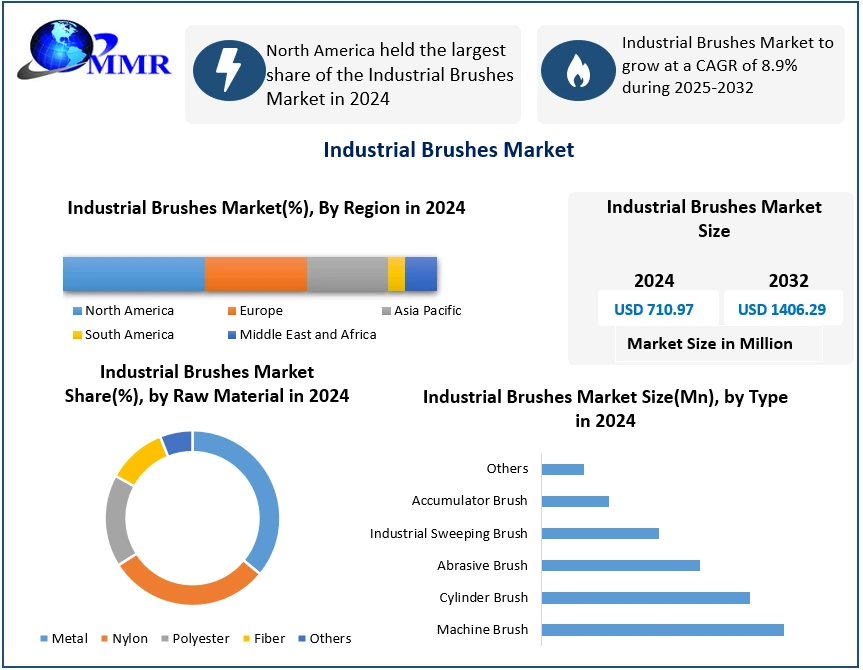
Key Highlights
Market Valuation: USD 710.97 Mn in 2024; projected USD 1406.29 Mn by 2032.
Growth Rate: 8.9% CAGR from 2025 to 2032.
Dominant Application: Industrial Manufacturing.
Dominant Material: Metal.
Core Driver: Integration of industrial brushes with robotic and CNC production lines.
Regional Leader: North America.
Why This Matters Now
The transition from internal combustion engine (ICE) vehicles to electric vehicles (EVs) is rewriting the playbook for automotive production. New component geometries—specifically within battery housings and precision drivetrain assemblies—demand levels of surface finishing that traditional manual methods cannot sustain. OEMs are pivoting toward automated, high-speed brushing systems to eliminate microscopic burrs that threaten performance and reliability. The data is clear: those who fail to integrate high-performance, robot-compatible brushing technology will face higher scrap rates, inconsistent quality, and escalating production costs in an increasingly tight-margin environment.
Market Overview
The global Industrial Brushes Market Size is experiencing a fundamental transformation. What was once a category defined by simple, manual cleaning tools has shifted into an engineering discipline. Brushes are now critical components of fully automated, high-speed production environments. With a market size of USD 710.97 Mn in 2024 and an anticipated CAGR of 8.9% through 2032, the sector is capitalizing on the broader industrial push for Industry 4.0, where precision surface preparation is a prerequisite for subsequent manufacturing stages like plating, painting, or assembly.
Key Trends Driving Growth
Robotic Integration: Brushes are increasingly designed for compatibility with robotic arms, enabling 24/7 autonomous deburring and polishing. This shift directly addresses the need for repeatable, high-precision results in high-volume automotive production.
Sustainability and Material Science: There is a surge in demand for silica-free abrasive compounds and eco-friendly filaments. Regulations on hazardous work environments are pushing suppliers to innovate, forcing a shift away from traditional, less-sustainable materials.
Precision Demands: Modern automotive components, particularly for EV drivetrains, require strict surface integrity. Manufacturers are investing in specialized, high-performance brushes to meet these exacting specifications without damaging delicate parts.
Segment Insights
Dominant Segment: Industrial Manufacturing (Application) holds the lead. It remains the backbone of the market, driven by the massive volume of surface preparation required in automotive, aerospace, and general metalworking.
Fastest-Growing Segment: Industrial Manufacturing (Application) continues to set the pace. Driven by the constant need for cleaning, finishing, and deburring across various production lines, this segment is expected to maintain its top-tier status throughout the forecast period.
Raw Material Dynamics: The Metal segment dominated the market in 2024, largely sustained by the heavy-duty requirements of global vehicle manufacturing. However, Nylon and Abrasive brushes are gaining traction as manufacturers look for specialized cleaning solutions that handle modern materials without material degradation.
Regional Growth Story
North America currently commands the largest share of the industrial brushes market, supported by a sophisticated automotive manufacturing base and high aerospace production activity. Europe follows closely, driven by a regional focus on industrial automation and high-quality production standards in countries like Germany. The Asia-Pacific region represents the most significant growth opportunity, with China, India, Japan, and South Korea aggressively expanding their automotive manufacturing footprints and embracing automated production lines to compete globally.
Competitive Landscape
The market is characterized by high competitive intensity, with major players such as 3M, Osborn, Tanis Brush, Gordon Brush Manufacturing, Bosch Power Tools, Makita, and Saint-Gobain vying for dominance. Strategy is centered on two pillars: R&D investment and automation compatibility. 3M, for instance, is leveraging its vast abrasives portfolio to launch hundreds of new products annually, while Osborn is focusing on advanced robotic deburring systems.
Recent Developments
May 2025: Osborn (Germany) launched a high-performance, silica-free abrasive compound series, targeting safer, more sustainable surface treatment workflows.
March 2025: 3M (USA) announced a USD 3.5 billion R&D investment, signaling a long-term strategy to dominate high-growth industrial segments through rapid product innovation.
May–June 2025: Makita Corporation (Japan) expanded its industrial footprint with a new series of 40V MAX and 18V LXT cordless surface preparation tools, aiming at the intersection of portability and industrial-grade finishing.
Strategic Implications
The market is moving away from generic consumables toward engineered system solutions. OEMs must view industrial brushes not as indirect costs, but as performance-critical tools that directly influence the reliability of their final product. Suppliers who align with the robotic transition—offering high-wear, consistent, and silica-free solutions—will capture the largest margins. The era of the general-purpose brush is ending; the era of application-specific, automated surface finishing is here.
Future Outlook
The winners in this landscape will be those who bridge the gap between material science and robotics; those who lag will find themselves incompatible with the highly automated, high-precision assembly lines of the next decade.
Analyst Perspective
“The industrial brushes market is rapidly evolving from manual upkeep to an integral part of high-speed, automated manufacturing sequences. Manufacturers that prioritize precision and safety—specifically by adopting advanced, robotic-ready, and sustainable abrasive technologies—will secure a definitive advantage in meeting the demanding quality standards of modern EV and aerospace production cycles,” says Dharati Raut, Analyst at Maximize Market Research.
About Maximize Market Research
Maximize Market Research Pvt. Ltd. (MMR) is a global market research and consulting company that provides reliable, data-focused, and practical business insights. The firm serves a wide range of industries, including healthcare, pharmaceuticals, technology, automotive, electronics, chemicals, personal care, and consumer goods. Through market forecasts, competitive analysis, strategic consulting, and industry impact assessments, MMR helps organizations understand changing market conditions, identify growth opportunities, and make informed business decisions for long-term success.
2nd Floor, Navale IT Park Phase 3
Pune Banglore Highway, Narhe
Pune, Maharashtra 411041, India
+91 9607365656
sales@maximizemarketresearch.com
