Key Highlights
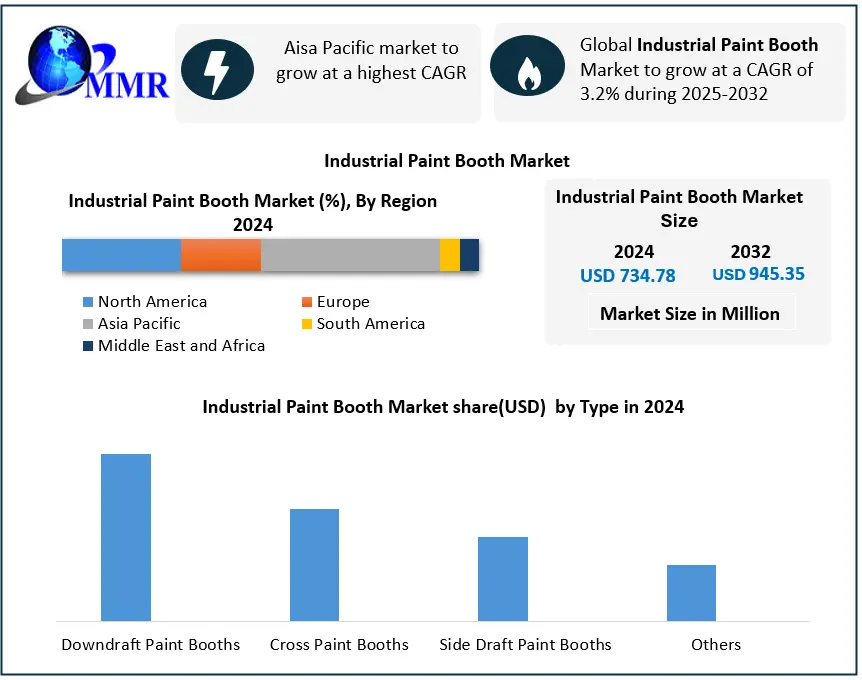
- Global Industrial Paint Booth Market was valued at USD 734.78 million in 2024.
- The market is projected to reach USD 945.35 million by 2032, expanding at a 3.2% CAGR during 2025–2032.
- Automotive manufacturing remains one of the largest demand generators for industrial paint booth systems.
- Stricter environmental regulations are accelerating investments in energy-efficient and low-emission coating facilities.
- Automation and digital manufacturing continue to reshape paint shop operations across global production hubs.
- Asia-Pacific remains the leading regional manufacturing center supported by expanding automotive production and industrial investments.
Why This Matters Now
Automotive manufacturers are facing simultaneous pressure to improve production efficiency, reduce emissions, and maintain finish quality while controlling costs. Paint shops remain among the most energy-intensive stages in vehicle manufacturing, making every investment decision strategically significant.
Industrial paint booth suppliers are no longer competing only on equipment quality. They are increasingly competing on automation capability, energy efficiency, environmental compliance, and lifecycle operating costs. As manufacturers modernize production facilities, paint booth technology is becoming an essential investment rather than a supporting manufacturing asset.
Market Overview
The Global Industrial Paint Booth Market Size was valued at USD 734.78 million in 2024 and is expected to reach USD 945.35 million by 2032, growing at a CAGR of 3.2% during the forecast period.
Industrial paint booths provide controlled environments for coating components across automotive, aerospace, heavy equipment, industrial machinery, and manufacturing sectors. These systems improve coating consistency, worker safety, production efficiency, and environmental compliance while minimizing material waste.
Growth remains closely linked with manufacturing activity. Rising vehicle production, factory modernization, and stricter environmental standards are encouraging companies to replace conventional coating systems with advanced paint booth technologies that consume less energy while delivering higher-quality finishes.
The market’s moderate growth rate also signals maturity. Instead of rapid volume expansion, demand is increasingly driven by technology upgrades, replacement cycles, and investments in automated manufacturing facilities.
Key Trends Driving Growth
Automation continues to reshape industrial coating operations. Manufacturers are integrating robotic painting systems with intelligent paint booths to improve productivity, reduce defects, and lower labor dependence. The combination enables higher production consistency while supporting increasingly complex vehicle designs.
Environmental compliance has become another major investment driver. Governments continue tightening regulations governing volatile organic compound (VOC) emissions and workplace safety. Industrial facilities are therefore investing in advanced filtration systems, airflow management technologies, and energy-efficient booth designs that satisfy regulatory requirements while lowering operating expenses.
The transition toward electric vehicle manufacturing is also influencing paint shop investments. Although EVs require similar finishing processes as internal combustion vehicles, new production facilities emphasize automation, digital monitoring, and sustainable manufacturing from the outset. This creates opportunities for paint booth suppliers capable of delivering integrated production solutions.
Manufacturing digitalization further strengthens market demand. Connected equipment, predictive maintenance, and real-time production monitoring allow manufacturers to optimize paint consumption, minimize downtime, and improve throughput. These operational gains directly influence profitability for high-volume automotive plants.
Supply chain resilience has also become a purchasing consideration. Manufacturers increasingly prioritize equipment suppliers capable of providing long-term service support, replacement components, and stable delivery schedules amid continuing global manufacturing disruptions.
Segment Insights
- Dominant Segment: Automotive applications continue to represent the largest demand segment, supported by continuous vehicle production and high-quality finishing requirements.
- Fastest-Growing Segment: The report identifies expanding industrial automation and advanced manufacturing applications as key areas supporting future growth where manufacturers seek greater efficiency, precision, and environmental compliance.
- Automated paint booths improve coating consistency while reducing paint consumption and production losses.
- Energy-efficient booth systems help manufacturers reduce operating expenses alongside carbon reduction initiatives.
- Advanced filtration technologies support compliance with increasingly stringent environmental standards.
Regional Growth Story
Asia-Pacific continues to lead the Industrial Paint Booth Market, supported by its position as the world’s largest automotive manufacturing region. China, India, Japan, and South Korea continue investing in production capacity while expanding advanced manufacturing capabilities. These investments sustain demand for modern coating infrastructure across passenger vehicles, commercial vehicles, and industrial manufacturing.
China remains central to regional growth through its extensive automotive manufacturing ecosystem and expanding electric vehicle production. Continuous factory upgrades create opportunities for suppliers offering automated and environmentally compliant paint booth systems.
India is strengthening its manufacturing base through increasing domestic vehicle production and industrial expansion. Investments in manufacturing modernization are supporting demand for efficient industrial finishing technologies.
Japan and South Korea continue emphasizing manufacturing precision, automation, and production efficiency. Their mature automotive industries increasingly focus on upgrading existing facilities with intelligent manufacturing systems rather than solely expanding capacity.
North America maintains steady demand driven by factory modernization, aftermarket manufacturing, and industrial equipment production. Manufacturers continue replacing aging paint infrastructure with automated systems that improve productivity while reducing energy consumption.
Europe remains influenced by stringent environmental regulations and sustainability targets. Germany, as a major automotive manufacturing hub, continues emphasizing energy-efficient production technologies and advanced coating solutions capable of supporting premium vehicle manufacturing.
Competitive Landscape
Competition increasingly extends beyond equipment manufacturing into complete production solutions. Suppliers are differentiating themselves through automation integration, energy-efficient technologies, digital monitoring capabilities, and lifecycle service offerings.
Manufacturers investing in research and development are strengthening their competitive positioning by introducing systems capable of reducing operating costs while improving environmental performance. This strategy enhances customer retention as industrial buyers increasingly evaluate long-term operating efficiency rather than initial equipment cost alone.
Capacity expansions and technology investments also signal confidence in continued manufacturing modernization. Companies capable of integrating robotics, smart controls, advanced airflow systems, and sustainable coating technologies are better positioned to capture replacement demand from automotive OEMs and industrial manufacturers.
Competitive positioning increasingly depends on global service capabilities. Customers require reliable maintenance support, spare parts availability, and technical expertise throughout equipment lifecycles, making aftermarket services an increasingly important competitive differentiator.
Recent Developments
- Manufacturers continue investing in automated paint booth technologies to improve production efficiency and coating consistency.
- Growing adoption of energy-efficient paint booth systems supports corporate sustainability and carbon reduction objectives.
- Environmental compliance investments continue accelerating development of advanced filtration and emission control technologies.
- Digital manufacturing integration is improving operational monitoring, predictive maintenance, and production optimization across industrial coating facilities.
Strategic Implications
Industrial paint booths are becoming strategic production assets rather than isolated manufacturing equipment. Their impact now extends across productivity, sustainability, product quality, regulatory compliance, and operational resilience.
For automotive OEMs, investment decisions increasingly balance production speed with environmental performance and lifecycle costs. Tier-1 suppliers benefit from offering integrated automation capabilities that align with manufacturers’ digital transformation strategies.
Fleet manufacturers, industrial equipment producers, and contract manufacturers also gain competitive advantages through consistent product quality and lower operating expenses achieved with advanced coating technologies.
Investors should view steady market expansion as an indicator of ongoing industrial modernization rather than cyclical equipment demand. The replacement of aging infrastructure with intelligent manufacturing systems creates recurring opportunities across developed and emerging manufacturing economies.
Future Outlook
The Industrial Paint Booth Market is expected to maintain stable expansion through 2032 as manufacturers prioritize automation, sustainable production, and regulatory compliance. Companies capable of combining intelligent automation, energy efficiency, and comprehensive lifecycle services will define the next phase of competitive leadership, while manufacturers delaying modernization risk losing productivity, compliance advantages, and long-term cost competitiveness.
Analyst Perspective
Dharati Raut, Analyst at Maximize Market Research, said: “Industrial paint booth investments are increasingly driven by manufacturing efficiency and environmental compliance rather than production expansion alone. Companies adopting automated, energy-efficient, and digitally connected coating systems will be better positioned to meet future manufacturing requirements while improving operational performance and sustainability.”
About Maximize Market Research
Maximize Market Research Pvt. Ltd. (MMR) is a global market research and consulting company that provides reliable, data-focused, and practical business insights. The firm serves a wide range of industries, including healthcare, pharmaceuticals, technology, automotive, electronics, chemicals, personal care, and consumer goods. Through market forecasts, competitive analysis, strategic consulting, and industry impact assessments, MMR helps organizations understand changing market conditions, identify growth opportunities, and make informed business decisions for long-term success.
2nd Floor, Navale IT Park Phase 3
Pune Banglore Highway, Narhe
Pune, Maharashtra 411041, India
+91 9607365656
sales@maximizemarketresearch.com
