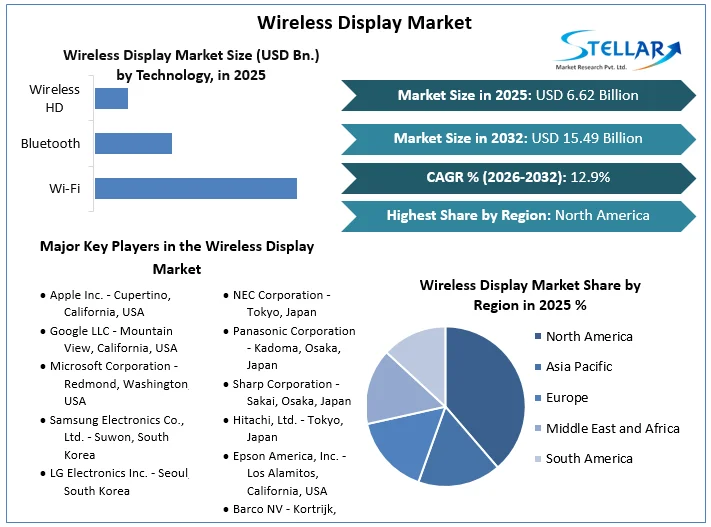
Wireless display technology is transforming the way users share content across devices, creating a more flexible and collaborative digital environment. As businesses adopt hybrid work models and consumers increasingly rely on smart devices for entertainment, wireless display solutions have become an essential component of modern connectivity. According to Stellar Market Research, the Wireless Display Market was valued at USD 6.62 billion in 2025 and is projected to reach USD 15.49 billion by 2032, expanding at a CAGR of 12.9% during the forecast period. This rapid growth reflects rising investments in wireless communication technologies, cloud-enabled collaboration, and next-generation display solutions.
Growing demand for cable-free connectivity
Wireless display solutions eliminate the need for physical cables by allowing content to be streamed from smartphones, laptops, tablets, and other connected devices directly to televisions, projectors, monitors, and digital signage displays. This capability has gained widespread popularity in corporate offices, educational institutions, healthcare facilities, and residential settings.
The growing adoption of hybrid workplaces has significantly increased demand for wireless presentation systems. Employees expect seamless collaboration regardless of their physical location, while organizations seek technologies that simplify conference room management and improve productivity. Wireless display systems reduce setup time, minimize cable clutter, and support real-time collaboration across multiple devices.
Consumers are also contributing to market growth through increasing use of smart televisions, streaming platforms, gaming consoles, and connected home entertainment systems.
Download Free PDF Brochure: https://www.stellarmr.com/report/req_sample/Wireless-Display-Market/2189
Smart devices continue to fuel market expansion
The rapid penetration of smartphones, tablets, ultrabooks, and smart TVs has created a favorable environment for wireless display technologies. Modern consumers frequently switch between devices and expect uninterrupted content sharing.
Improved Wi-Fi standards, lower latency, higher bandwidth, and enhanced screen mirroring capabilities have significantly improved user experiences. Technologies such as Miracast, AirPlay, Google Cast, and Wireless HDMI continue to evolve, enabling faster and more reliable wireless transmission.
The rollout of Wi-Fi 6, Wi-Fi 6E, and emerging Wi-Fi 7 infrastructure is expected to further strengthen wireless display performance by supporting higher-resolution content with minimal lag.
Enterprise collaboration creates new opportunities
Businesses are increasingly investing in intelligent meeting rooms equipped with wireless presentation platforms. These solutions allow employees to instantly share presentations, spreadsheets, videos, and applications from personal devices without requiring complex hardware installations.
Educational institutions are also replacing traditional classroom equipment with wireless interactive displays that support collaborative learning. Teachers can easily project educational content while students participate through tablets or laptops.
Healthcare providers use wireless displays for medical imaging, telemedicine consultations, and collaborative diagnostics, improving workflow efficiency while maintaining secure communication.
Retailers, hospitality businesses, and public venues continue expanding digital signage networks using wireless technologies that simplify installation and reduce maintenance costs.
Consumer entertainment remains a major growth driver
Home entertainment applications remain one of the strongest contributors to market expansion. Streaming services, online gaming, video conferencing, and smart home ecosystems have increased the need for high-performance wireless display solutions.
Consumers increasingly expect instant screen mirroring from mobile devices to televisions for watching movies, sharing photos, participating in virtual meetings, and gaming on larger displays.
Manufacturers continue integrating wireless display capabilities directly into televisions and monitors, reducing dependence on external adapters while improving user convenience.
Technology innovations reshape the industry
Continuous innovation is driving the wireless display market toward higher performance and broader adoption. Artificial intelligence is beginning to optimize wireless signal management and improve streaming quality under varying network conditions.
Cloud-based collaboration platforms are integrating seamlessly with wireless presentation systems, allowing remote participants to share content without physical limitations.
Support for 4K and even 8K resolution streaming continues to improve as compression technologies become more efficient. Lower latency and stronger encryption protocols are also making wireless display systems suitable for enterprise-grade applications.
Manufacturers are focusing on improving interoperability across different operating systems to simplify deployment in mixed-device environments.
Regional outlook
North America currently represents the largest share of the wireless display market, supported by widespread adoption of smart devices, advanced communication infrastructure, and strong enterprise investment in collaboration technologies. The United States remains the primary contributor due to rapid implementation of digital workplace solutions and high consumer spending on connected electronics.
Europe continues experiencing steady market growth as organizations accelerate digital transformation initiatives across education, healthcare, and manufacturing sectors. Government investments in digital infrastructure also support broader adoption.
Asia-Pacific is expected to witness the fastest growth during the forecast period. Countries including China, India, Japan, and South Korea continue investing heavily in smart city projects, advanced telecommunications infrastructure, consumer electronics manufacturing, and digital education initiatives. Rising disposable incomes and expanding internet connectivity further strengthen regional demand.
Latin America and the Middle East & Africa are gradually emerging as promising markets due to improving broadband infrastructure and increasing digital transformation across commercial sectors.
Competitive landscape
Competition within the wireless display market remains highly dynamic as global technology companies continue expanding their product portfolios through innovation and strategic partnerships.
Major participants include Apple, Google, Microsoft, LG Electronics, Samsung Electronics, Roku, Intel, Qualcomm, Netgear, Barco, Epson, Dell Technologies, BenQ, Airtame, Crestron Electronics, and other technology providers. These companies focus on improving wireless transmission quality, expanding compatibility across operating systems, strengthening cybersecurity, and integrating artificial intelligence into collaboration platforms.
Manufacturers are also investing in software ecosystems that combine wireless presentation, conferencing, cloud collaboration, and device management into unified enterprise solutions.
Download Free PDF Brochure: https://www.stellarmr.com/report/req_sample/Wireless-Display-Market/2189
Recent industry developments
Several notable developments continue shaping the wireless display market.
LG introduced its Signature OLED T transparent wireless television equipped with the Zero Connect Box, demonstrating advanced wireless transmission of high-resolution video and audio.
Technology companies continue enhancing wireless collaboration platforms with improved compatibility across Windows, Android, macOS, and iOS ecosystems.
Growing integration of AI-powered meeting assistants is improving presentation quality, device recognition, and collaboration efficiency in enterprise environments.
Expansion of Wi-Fi 6E and preparation for Wi-Fi 7 deployments are enabling faster wireless display performance while supporting ultra-high-definition streaming.
Increasing enterprise demand for secure wireless communication has encouraged vendors to strengthen encryption protocols and enterprise-grade authentication capabilities.
Future outlook
The wireless display market is expected to experience sustained growth through 2032 as organizations continue embracing digital workplaces and consumers increasingly adopt connected smart devices. Improvements in wireless communication standards, artificial intelligence, cloud computing, and collaboration software will continue expanding application opportunities across industries.
As remote work, digital education, smart healthcare, and intelligent entertainment ecosystems become more widespread, wireless display technologies will play an increasingly important role in enabling seamless communication and content sharing. Continued innovation, broader interoperability, stronger cybersecurity, and faster wireless connectivity are expected to position the wireless display market as one of the most dynamic segments within the global consumer electronics and enterprise collaboration industry.
Media Contact
Stellar Market Research
Website: Stellar Market Research – Global Research Reports & Consulting
Email: sales@stellarmr.com
