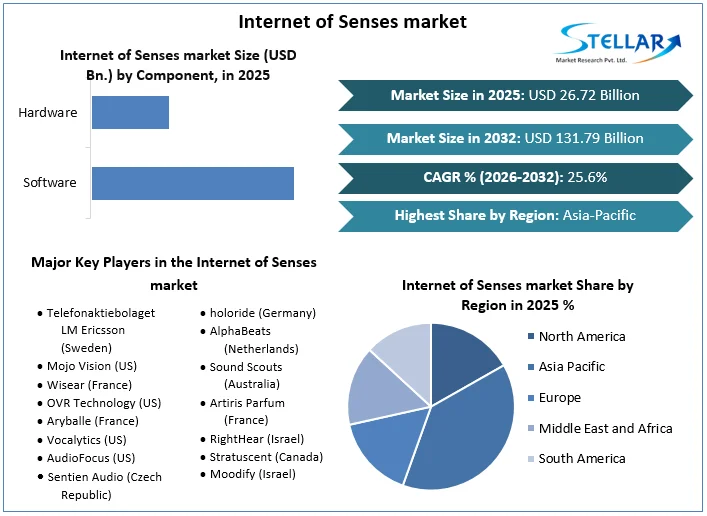
PUNE, India, July 14, 2026 – The Internet of Senses Market is entering a transformative growth phase as artificial intelligence, 5G/6G connectivity, extended reality (XR), and advanced sensor technologies redefine how people interact with digital environments. According to the latest study by Stellar Market Research, the global Internet of Senses Market is projected to grow from USD 26.72 billion in 2025 to USD 131.79 Bn. by 2032, expanding at a remarkable CAGR of 25.6% during the forecast period.
The convergence of AI, augmented reality (AR), virtual reality (VR), haptic technologies, and ultra-low-latency communication networks is enabling immersive digital experiences that extend beyond visual and audio interactions. The Internet of Senses is poised to transform industries including healthcare, education, entertainment, retail, manufacturing, and automotive by introducing realistic touch, smell, taste, and sensory feedback into virtual environments.
Download Free PDF Brochure: https://www.stellarmr.com/report/req_sample/Internet-of-Senses-Market/1179
Digital transformation is redefining human-machine interaction
The Internet of Senses represents the next evolution of digital connectivity. Unlike traditional internet services that primarily engage sight and hearing, this emerging ecosystem integrates multiple human senses through intelligent devices, wearable technologies, cloud computing, and advanced communication infrastructure.
Businesses are increasingly investing in immersive customer experiences to improve engagement, remote collaboration, and digital commerce. Retailers are exploring virtual shopping experiences with tactile feedback, healthcare providers are adopting immersive training environments, while manufacturers are leveraging digital twins supported by sensory feedback for improved operational efficiency.
As organizations accelerate digital transformation initiatives, demand for multi-sensory computing platforms continues to rise across both consumer and enterprise applications.
Artificial intelligence and extended reality drive market expansion
Artificial intelligence remains the backbone of the Internet of Senses ecosystem by enabling intelligent interpretation of sensory data in real time. Machine learning algorithms process environmental information while personalizing user experiences based on behavioral patterns.
Extended Reality technologies combining AR, VR, and Mixed Reality are creating immersive digital environments where users can interact naturally through multiple senses. These innovations are increasingly supported by edge computing, reducing latency and enabling seamless sensory communication.
Growing deployment of 5G infrastructure and research surrounding 6G networks are further strengthening the market by providing the ultra-fast connectivity required for real-time sensory transmission.
Healthcare emerges as a major application area
Healthcare is becoming one of the most promising application sectors for Internet of Senses technologies. Medical institutions are adopting immersive simulation platforms for surgical training, rehabilitation, and remote consultation.
Haptic feedback systems allow physicians to practice complex procedures within virtual environments, while AI-powered digital platforms enhance medical education and patient engagement. Future applications may include remote diagnostics supported by advanced sensory communication.
Educational institutions are similarly exploring immersive learning environments that enhance knowledge retention through interactive sensory experiences.
Consumer demand fuels innovation
Consumers increasingly expect richer digital experiences across gaming, entertainment, e-commerce, and social networking platforms. Smart wearables, advanced headsets, and connected devices are enabling realistic virtual interactions that closely resemble physical experiences.
Gaming companies continue investing heavily in immersive technologies incorporating tactile feedback and environmental simulation. Retailers are exploring virtual fitting rooms and interactive shopping experiences capable of replicating physical product interactions.
These developments are expected to significantly increase adoption of Internet of Senses solutions during the forecast period.
Market segmentation highlights
The Internet of Senses Market is segmented by component, technology, application, end user, and region. According to Stellar Market Research:
The software segment dominates the component category due to rising demand for immersive digital platforms and AI-enabled applications.
Virtual Reality (VR) represents the leading technology segment because of wider commercial adoption and declining hardware costs.
Applications span hearing, sight, smell, taste, touch, and cognitive interaction, with touch and immersive sensory experiences attracting increasing investment.
The consumer segment accounts for the largest market share owing to growing adoption of wearable devices, gaming platforms, and connected entertainment ecosystems.
Asia-Pacific leads global growth
Asia-Pacific is expected to remain the leading regional market throughout the forecast period. Countries including China, India, Japan, and South Korea continue investing heavily in 5G deployment, AI research, semiconductor manufacturing, and digital infrastructure.
Rapid urbanization, expanding internet penetration, and a young technology-oriented population are creating favorable conditions for widespread adoption of Internet of Senses technologies.
North America remains another important market supported by strong innovation ecosystems, advanced research institutions, and significant investments from leading technology companies.
Europe also demonstrates promising growth as governments promote digital transformation, industrial automation, and advanced communication technologies.
Challenges remain despite strong momentum
Although the market outlook remains highly optimistic, several challenges continue to influence commercialization.
Developing highly immersive sensory experiences requires substantial investments in network infrastructure, AI computing capabilities, and sophisticated hardware. Privacy and cybersecurity concerns also become increasingly significant as future platforms collect and process sensitive sensory data.
Standardization across communication protocols and interoperability between multiple hardware platforms will remain essential for broader adoption.
Despite these barriers, continued investment from technology companies and telecommunications providers is expected to accelerate commercialization over the coming decade.
Competitive landscape encourages continuous innovation
- holoride (Germany)
- AlphaBeats (Netherlands)
- Sound Scouts (Australia)
- Artiris Parfum (France)
- RightHear (Israel)
- Stratuscent (Canada)
- Moodify (Israel)
Download Free PDF Brochure: https://www.stellarmr.com/report/req_sample/Internet-of-Senses-Market/1179
Future outlook
The future of the Internet of Senses Market will be shaped by continued advances in artificial intelligence, edge computing, digital twins, extended reality, and ultra-fast wireless communication. As 6G research progresses and immersive technologies become more affordable, sensory-enabled digital experiences are expected to become increasingly mainstream.
Organizations across healthcare, education, manufacturing, automotive, retail, and entertainment are anticipated to integrate Internet of Senses technologies into their digital transformation strategies, creating significant long-term growth opportunities.
According to Stellar Market Research, the combination of AI, immersive computing, and next-generation connectivity positions the Internet of Senses Market as one of the fastest-growing technology sectors globally, with strong investment potential through 2032.
Media Contact
Stellar Market Research
Website: Stellar Market Research – Global Research Reports & Consulting
Email: sales@stellarmr.com
