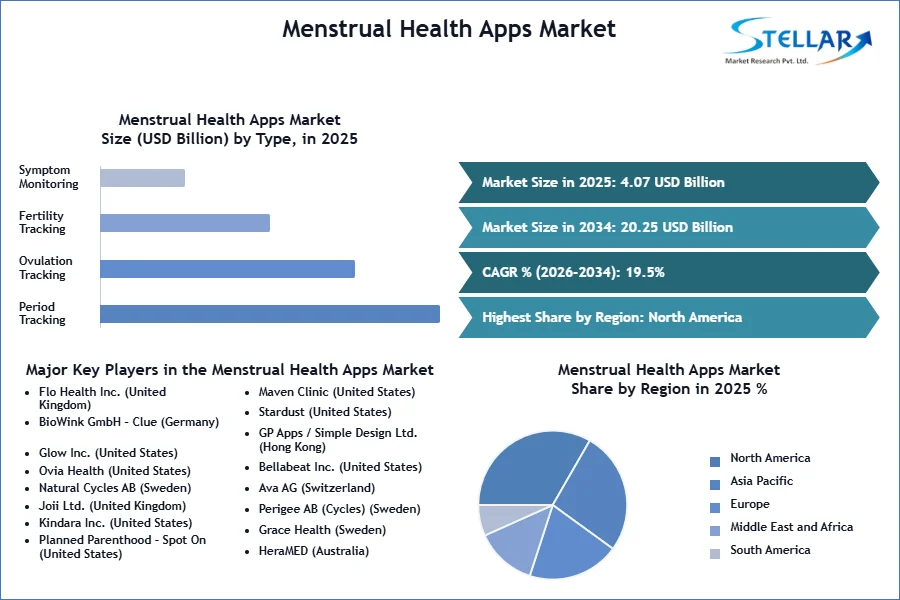
The Menstrual Health Apps Market has become a vital segment of the rapidly expanding femtech industry by offering women convenient tools to monitor menstrual cycles, predict ovulation, track fertility, record symptoms, manage reproductive health, and gain personalized wellness insights. These applications combine mobile technology, artificial intelligence (AI), cloud computing, and data analytics to help users better understand their reproductive health while supporting informed healthcare decisions.
Growing awareness of menstrual wellness, increasing demand for preventive healthcare, expanding digital health ecosystems, and rising acceptance of telehealth services are accelerating market growth. Integration with wearable devices, smart health platforms, and personalized health recommendations is further enhancing the functionality of menstrual health applications.
Growing Awareness of Women’s Health Drives Market Growth
One of the primary drivers of the Menstrual Health Apps Market is the increasing focus on women’s reproductive health and preventive healthcare. Consumers are seeking digital tools that provide accurate cycle predictions, symptom tracking, and personalized health insights.
Menstrual health apps are widely used for:
Menstrual cycle tracking
Ovulation prediction
Fertility monitoring
Pregnancy planning
Symptom logging
Hormonal health tracking
Medication reminders
Health education
These features help users better understand their menstrual patterns while supporting proactive health management.
𝐃𝐨𝐰𝐧𝐥𝐨𝐚𝐝 𝐅𝐫𝐞𝐞 𝐏𝐃𝐅 𝐁𝐫𝐨𝐜𝐡𝐮𝐫𝐞: https://www.stellarmr.com/report/req_sample/Global-Menstrual-Health-Apps-Market/1431
AI and Predictive Analytics Enhance Personalization
Artificial intelligence and machine learning are transforming menstrual health apps by providing more accurate predictions and individualized recommendations.
Key technological advancements include:
AI-powered cycle prediction
Personalized health insights
Predictive fertility analytics
Symptom pattern recognition
Hormonal trend analysis
Intelligent reminders
Behavioral health recommendations
Automated wellness reporting
These capabilities improve user engagement while supporting more personalized healthcare experiences.
Wearable Device Integration Expands Digital Health Ecosystems
The growing adoption of wearable health devices is enhancing the functionality of menstrual health applications through continuous health monitoring.
Popular integrations include:
Smartwatches
Fitness trackers
Body temperature sensors
Heart rate monitoring
Sleep tracking
Physical activity monitoring
Stress management tools
Health data synchronization
These connected ecosystems provide a more comprehensive view of overall health and wellness.
Telehealth and Remote Care Create New Opportunities
Digital healthcare platforms are increasingly integrating menstrual health applications with virtual care services.
Emerging healthcare capabilities include:
Online gynecology consultations
Reproductive health education
Fertility counseling
Digital prescriptions
Pregnancy support programs
Mental wellness resources
Lifestyle coaching
Preventive healthcare guidance
These services improve healthcare accessibility while encouraging continuous health monitoring.
Data Privacy and Security Become Strategic Priorities
As menstrual health apps collect sensitive personal health information, developers are strengthening privacy protections and cybersecurity measures.
Key security features include:
End-to-end encryption
Secure cloud storage
User consent management
Multi-factor authentication
Privacy-focused data controls
Compliance with health data regulations
Anonymous data analytics
Secure account management
Strong data governance practices help build user trust while supporting regulatory compliance.
𝐃𝐨𝐰𝐧𝐥𝐨𝐚𝐝 𝐅𝐫𝐞𝐞 𝐏𝐃𝐅 𝐁𝐫𝐨𝐜𝐡𝐮𝐫𝐞: https://www.stellarmr.com/report/req_sample/Global-Menstrual-Health-Apps-Market/1431
Regional Market Insights
North America
North America leads the Menstrual Health Apps Market, supported by high smartphone adoption, advanced digital healthcare infrastructure, growing femtech investments, and increasing consumer awareness of reproductive health.
Europe
Europe continues to experience strong market growth due to expanding digital health initiatives, increasing focus on preventive healthcare, supportive healthcare policies, and rising adoption of personalized wellness applications.
Asia Pacific
Asia Pacific is projected to witness the fastest growth, driven by increasing smartphone penetration, improving healthcare access, rising awareness of women’s health, expanding digital health ecosystems, and growing femtech innovation across China, India, Japan, South Korea, and Southeast Asia.
Latin America, Middle East, and Africa
These regions are gradually strengthening market adoption through expanding internet connectivity, digital healthcare initiatives, and increasing public awareness of menstrual health and reproductive wellness.
Competitive Landscape
The Menstrual Health Apps Market is highly competitive, with femtech startups, digital health companies, healthcare technology providers, and wellness application developers investing heavily in innovation.
Major competitive strategies include:
AI-powered health analytics
Wearable device integration
Personalized wellness recommendations
Cloud-based health platforms
Telehealth partnerships
User experience enhancements
Data security improvements
Global market expansion
Companies continue focusing on improving prediction accuracy, user engagement, privacy, and healthcare integration.
Emerging Opportunities
Several trends are expected to shape future market growth:
AI-powered reproductive health insights
Digital fertility management
Remote women’s healthcare
Personalized hormone monitoring
Mental wellness integration
Connected femtech ecosystems
Preventive women’s health platforms
Population health analytics
These innovations are expected to improve reproductive healthcare while supporting personalized and data-driven wellness management.
Future Outlook
The future of the Menstrual Health Apps Market remains highly promising as consumers increasingly embrace digital healthcare solutions to manage reproductive health, fertility, and overall wellness. Continued advancements in AI, wearable technology, cloud computing, and telehealth integration will further enhance the capabilities of menstrual health applications.
Companies that prioritize innovation, privacy, scientific accuracy, accessibility, and personalized healthcare experiences will be well positioned to capitalize on the expanding opportunities within the global femtech industry.
Conclusion
The Menstrual Health Apps Market is transforming women’s healthcare by enabling personalized menstrual tracking, fertility monitoring, reproductive health management, and preventive wellness through intelligent digital platforms. Rising awareness of women’s health, increasing smartphone adoption, AI-powered personalization, and expanding digital healthcare services are creating significant growth opportunities across the industry.
As digital health technologies continue to evolve and personalized healthcare becomes increasingly important, the Menstrual Health Apps Market is expected to witness sustained long-term growth, benefiting app developers, healthcare providers, femtech companies, researchers, and millions of users worldwide.
