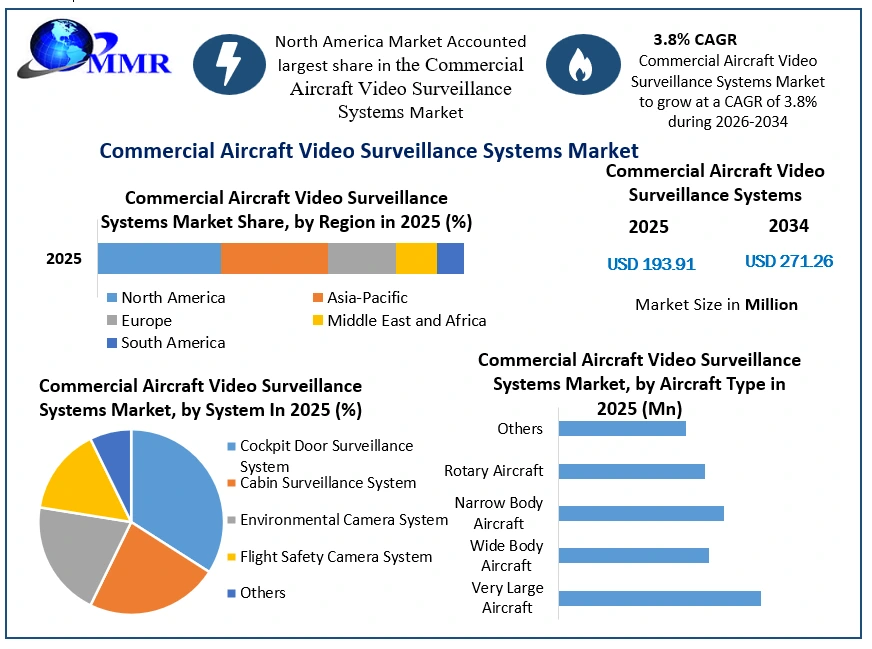
Key Highlights
Sector Evolution: Surveillance is shifting from ancillary monitoring to integrated operational intelligence.
Driver: Heightened security regulations and the mandate for real-time situational awareness during flight.
Technological Shift: Adoption of AI-powered analytics and high-definition sensors in line-fit configurations.
Regional Leadership: North America maintains the largest market share; Asia-Pacific demonstrates the most rapid adoption rate.
Why This Matters Now
The aviation industry is recalibrating its security posture to address both physical threats and modern operational requirements. As aircraft fleet modernization accelerates, the integration of digital surveillance systems has moved from a secondary consideration to a baseline requirement for regulatory compliance and insurer confidence. For aviation OEMs, MRO operators, and airlines, the transition represents a departure from reactive security to proactive, automated situational awareness.
Market Overview
The Commercial Aircraft Video Surveillance Systems Market —covering cockpit door, cabin, and environmental monitoring—are undergoing a fundamental redesign. Modern systems are increasingly architected as modular platforms that separate certifiable hardware from rapidly evolving software analytics. This shift minimizes obsolescence risks and allows operators to deploy new threat-detection capabilities through software iterations rather than costly, full-hardware replacements. Airlines are prioritizing these upgrades to reduce risk exposure, streamline ground-to-air coordination, and provide actionable data for incident investigations.
Key Trends Driving Growth
Efficiency and data-driven operations are the primary catalysts for current investment. Beyond the fundamental necessity of cockpit door security, there is an urgent demand for “smart” cabin monitoring. AI-powered analytics now allow for the detection of unauthorized movement, equipment tampering, and passenger behavioral patterns, providing flight crews with earlier alerts. Furthermore, the push for weight reduction and power efficiency is driving the adoption of lightweight, low-latency sensor suites that integrate seamlessly into existing onboard data buses.
Segment Insights
Dominant Segment: Cabin Surveillance Systems. The requirement for enhanced passenger safety and the ability to monitor high-density cabin environments keep this segment at the forefront of procurement.
Fastest-Growing Segment: Line-Fit Installations. As newer aircraft roll out of production lines, original equipment manufacturers are increasingly integrating advanced surveillance as a standard feature, outpacing the traditional retrofit market.
Regional Growth Story
North America remains the largest theater for surveillance deployment, sustained by its massive commercial fleet and the presence of top-tier aircraft manufacturers. Europe follows, with a strong focus on regulatory-compliant security upgrades for aging fleets. The Asia-Pacific region is the most dynamic, characterized by rapid fleet expansion and the commencement of new national airline services, both of which necessitate the procurement of state-of-the-art surveillance infrastructure from day one.
Competitive Landscape
The market is consolidating around firms capable of providing end-to-end integration services—from sensor hardware to cloud-connected management platforms. Industry leaders are focusing on cybersecurity-hardened architectures, responding to the growing threat of data tampering and unauthorized system access. Competitive positioning now relies on the ability to demonstrate a clear path to certification while offering modularity that protects airline capital investments for the life of the airframe.
Recent Developments
Modular Architectures: Manufacturers are decoupling hardware from software to accelerate the deployment of analytics-driven features.
Cyber-Hardened Designs: New platforms are implementing tamper-evidence and traceability to meet stringent global aviation security requirements.
Fleet-Wide Connectivity: Implementation of cloud-connected monitoring systems for centralized fleet surveillance management is rising among major international carriers.
Regulatory Compliance: Tightened international standards for cockpit door monitoring have spurred a renewed cycle of upgrades in both established and emerging aviation markets.
Strategic Implications
For stakeholders, the era of “install-and-forget” hardware is over. Procurement strategies must now prioritize interoperability and lifecycle maintenance. Airlines and operators that select platforms with open-bus architectures are positioned to integrate future AI innovations without the burden of complete sensor overhauls. Investors should track firms that provide comprehensive lifecycle support, as maintenance and software upgrade paths are increasingly becoming the most stable revenue streams in this sector.
Future Outlook
As security becomes synonymous with digital situational awareness, the market will separate companies that treat surveillance as a static utility from those that offer integrated, scalable intelligence, with the latter poised to dominate the future of the aviation ecosystem.
Analyst Perspective
“The commercial aircraft surveillance market is in the midst of a transition from basic monitoring to advanced situational awareness,” notes Rucha Deshpande, Analyst at Maximize Market Research. “Airlines and OEMs that successfully integrate AI-driven analytics into their modular flight deck and cabin systems will not only meet the next wave of security regulations but will fundamentally improve the efficiency and safety of their global operations.”
About Maximize Market Research
Maximize Market Research Pvt. Ltd. (MMR) is a global market research and consulting company that provides reliable, data-focused, and practical business insights. The firm serves a wide range of industries, including healthcare, pharmaceuticals, technology, automotive, electronics, chemicals, personal care, and consumer goods. Through market forecasts, competitive analysis, strategic consulting, and industry impact assessments, MMR helps organizations understand changing market conditions, identify growth opportunities, and make informed business decisions for long-term success.
2nd Floor, Navale IT Park Phase 3
Pune Banglore Highway, Narhe
Pune, Maharashtra 411041, India
+91 9607365656
sales@maximizemarketresearch.com
