Key Highlights
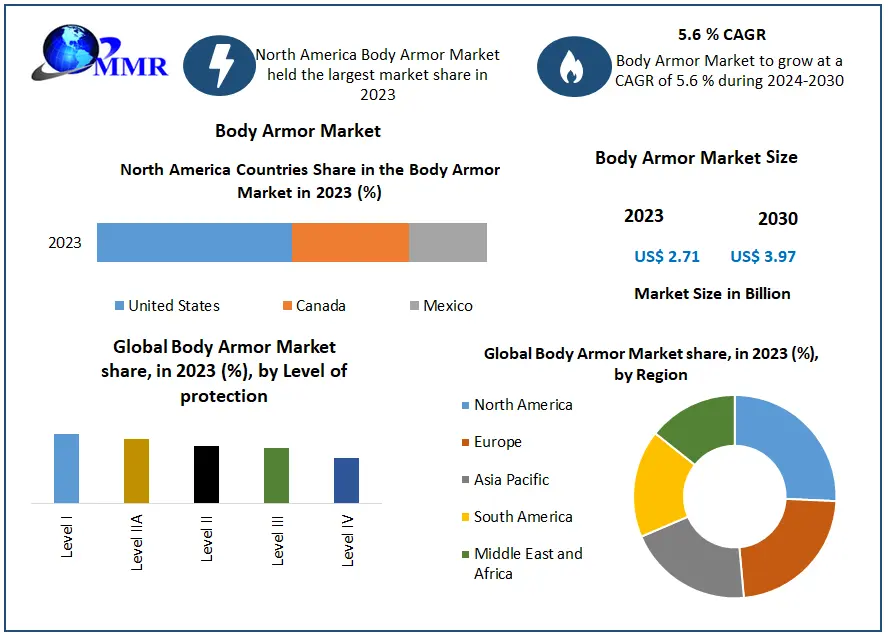
Market Growth: $2.71 billion in 2023, reaching $3.97 billion by 2030 at a 5.6% CAGR.
System Shift: Move from bulky legacy protection to Modular Scalable Vests (MSVs) and user-centric designs.
Innovation: Integration of smart features including vital-sign sensors, AR interfaces, and secure communication.
Material Science: Advancements in ceramic hard plates and UHMWPE-based soft armor for better weight-to-protection ratios.
Why This Matters Now
Modern conflict environments demand that soldiers operate with extreme mobility while remaining shielded from diverse, evolving ballistic threats. For defense contractors and government procurement agencies, the “one-size-fits-all” era of protective gear has ended, replaced by a mandate for modular, ergonomic, and data-linked systems. Suppliers failing to transition from legacy hardware to integrated, smart-enabled protective ecosystems risk losing relevance in the high-stakes defense procurement cycle.
Market Overview
The global Body Armor Market is a high-velocity sector where material science meets operational necessity. In 2023, the market size stood at $2.71 billion, with a trajectory pointing toward $3.97 billion by 2030. The industry is defined by the integration of two core types: soft armor (flexible, energy-dissipating polymers like UHMWPE) and hard armor (reinforced ceramics or composite plates). The evolution of these systems is no longer just about stopping rounds; it is about reducing the physiological burden on the wearer while increasing the capability for sustained combat.
Key Trends Driving Growth
The most aggressive driver of growth is the transition to “Smart Armor.” This is not merely a defensive layer but an active participant in the combat theater. These systems integrate sensors for real-time health monitoring—tracking heart rate and vital signs—alongside communication nodes and AR overlays. By providing soldiers with a continuous stream of environmental and tactical data, smart armor transforms the individual soldier into a networked combat asset.
Parallel to this is the push for modularity. The Modular Scalable Vest (MSV) represents the modern standard, allowing field commanders to swap protection levels and configurations based on mission-specific threats. This modularity also addresses the physiological diversity of modern armed forces, including improved fitment for female soldiers and various anthropometric profiles, which directly translates to better weapon accuracy and injury mitigation.
Segment Insights
Dominant Segment: Soft Armor. Continues to see high demand due to its fundamental utility in providing lightweight, flexible protection for everyday law enforcement and secondary military roles.
Fastest-Growing Segment: Hard Armor Plates. Driven by the increasing prevalence of high-velocity rifle threats in modern battlefields, necessitating ceramic and high-strength composite upgrades.
Regional Growth Story
North America acts as the primary theater for innovation, with heavy legislative and budgetary support driving the development of the next-generation Soldier Protective System. This region sets the global benchmark for ballistic and spike-test certifications (NIJ/HOSDB). European and Asian-Pacific markets are similarly prioritizing large-scale military modernization, importing or co-developing these high-end protection standards to counter regional security instability.
Competitive Landscape
Competition is fierce, rewarding firms that move beyond traditional manufacturing into advanced materials research. Companies are currently racing to commercialize “future-proof” materials like composite metal foams (CMFs) and shear-thickening liquid fluids that solidify upon impact. Success in this landscape is defined by the ability to win large-scale government contracts that require both rapid production capacity and long-term R&D investment in next-generation material science.
Recent Developments
Modular Scalable Vests (MSVs): Wide-scale adoption of systems that allow for custom fitment and adjustable protection zones, significantly reducing weight while enhancing ergonomics.
Smart Integration: Pilots of vital-sign sensors and AR interfaces within plate carriers to enhance situational awareness.
Material Innovations: Ongoing testing of foam-based armor and liquid-state protective fluids designed to disintegrate or deflect armor-piercing threats.
Inclusion Mandates: Legislative focus on anthropometric research to produce protective gear designed for the full spectrum of soldier body types, ensuring optimal coverage and comfort.
Strategic Implications
Defense suppliers must treat body armor as an interconnected system. The inclusion of communication ports, sensor arrays, and battery management systems within the plate carrier design is now a competitive necessity. For procurement agencies, the strategic imperative is to lower the “load carriage” penalty—every gram of weight saved increases operational reach. Future contracts will gravitate toward suppliers who can prove a direct correlation between gear ergonomics and the reduction of field injuries and long-term medical costs.
Future Outlook
The divide between market leaders and laggards will be determined by how quickly manufacturers can integrate “active” intelligence—sensors, data processing, and energy storage—into the “passive” ballistic armor of yesterday. Those who successfully bridge this gap will define the safety standards of the modern soldier.
Analyst Perspective
“The body armor market has moved from a material-science focus to a systems-engineering challenge,” says Rucha Deshpande, Analyst at Maximize Market Research. “As we approach 2030, the real winners will be those who successfully fuse life-saving ballistic integrity with the data-rich, intelligent requirements of the networked modern soldier.”
About Maximize Market Research
Maximize Market Research Pvt. Ltd. (MMR) is a global market research and consulting company that provides reliable, data-focused, and practical business insights. The firm serves a wide range of industries, including healthcare, pharmaceuticals, technology, automotive, electronics, chemicals, personal care, and consumer goods. Through market forecasts, competitive analysis, strategic consulting, and industry impact assessments, MMR helps organizations understand changing market conditions, identify growth opportunities, and make informed business decisions for long-term success.
2nd Floor, Navale IT Park Phase 3
Pune Banglore Highway, Narhe
Pune, Maharashtra 411041, India
+91 9607365656
sales@maximizemarketresearch.com
