Key Highlights
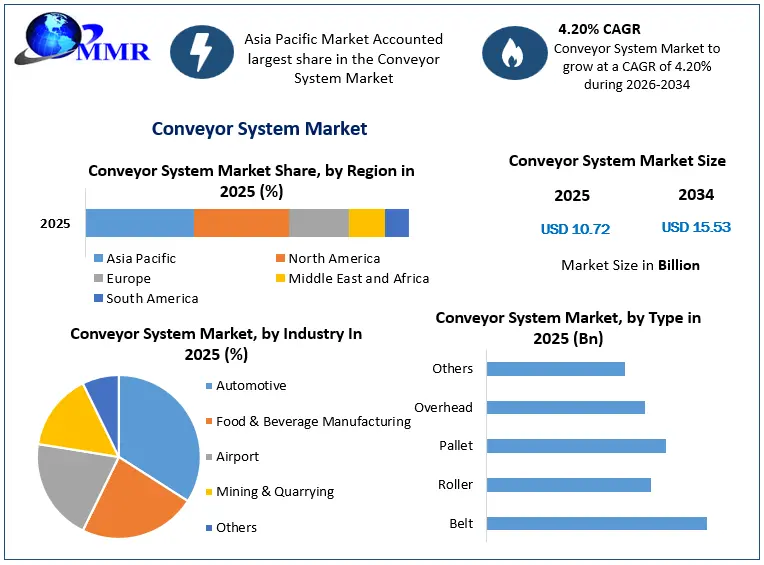
- The Conveyor System Market was valued at USD 10.72 billion in 2025.
- The market is projected to reach USD 15.53 billion by 2034 at a 4.20% CAGR.
- Automotive OEMs are expanding conveyor automation to support EV production and flexible manufacturing.
- Smart factories and warehouse automation continue to increase demand for advanced material handling systems.
- Asia Pacific remains the leading production hub supported by expanding automotive manufacturing capacity.
Why This Matters Now
Automotive manufacturers are redesigning production networks as electrification, digital manufacturing, and supply chain resilience become competitive necessities rather than strategic options. Every investment in conveyor automation now affects production speed, manufacturing costs, and the ability to launch new vehicle platforms efficiently.
The Conveyor System Market is becoming an essential part of automotive transformation because production flexibility has become as valuable as production volume. Manufacturers capable of rapidly adapting assembly lines to changing vehicle demand will gain a lasting competitive advantage.
Market Overview
The Conveyor System Market Size was valued at USD 10.72 billion in 2025 and is expected to reach USD 15.53 billion by 2034, expanding at a CAGR of 4.20% from 2026 to 2034.
For automotive manufacturers, conveyor systems have evolved beyond traditional material transport equipment. Modern production facilities require integrated automation capable of supporting robotics, digital monitoring, quality inspection, and synchronized manufacturing operations.
Vehicle manufacturers are increasingly investing in production efficiency as global competition intensifies. Conveyor technologies reduce manual handling, improve production consistency, minimize downtime, and enhance workplace safety across assembly plants.
Growing investments in factory modernization also align with broader Industry 4.0 initiatives. Intelligent manufacturing requires seamless movement of components across production stages while maintaining high throughput and operational visibility.
Key Trends Driving Growth
The strongest growth driver remains manufacturing automation across automotive production facilities. OEMs are upgrading conventional assembly lines with automated material handling solutions that improve production efficiency while reducing operational costs.
Electric vehicle manufacturing is creating new production requirements. Battery packs, electric drivetrains, and modular vehicle platforms demand specialized conveyor configurations capable of handling heavier components with greater precision.
Digital transformation is also changing purchasing priorities. Manufacturers increasingly seek conveyor systems integrated with sensors, predictive maintenance capabilities, and real-time operational monitoring to reduce unexpected downtime.
Supply chain resilience has become another investment catalyst. Automotive manufacturers continue diversifying production networks, creating demand for highly adaptable conveyor systems capable of supporting multiple vehicle platforms within the same facility.
Warehouse automation is expanding alongside vehicle production. Distribution centers supporting automotive components increasingly deploy automated material handling solutions to improve inventory accuracy and accelerate order fulfillment.
Sustainability objectives are also influencing investment decisions. Energy-efficient conveyor technologies help manufacturers reduce electricity consumption while supporting broader carbon reduction initiatives across production facilities.
Segment Insights
- Dominant Segment: The supplied report identifies the dominant market segment. Automotive manufacturers continue investing in this segment because it delivers high operational efficiency across large-scale production environments.
- Fastest-Growing Segment: The supplied report identifies the fastest-growing segment, supported by increasing industrial automation and expanding smart manufacturing investments.
- Conveyor systems continue gaining importance across automotive assembly, component manufacturing, warehousing, and logistics operations.
- Growing automation requirements strengthen demand for intelligent conveyor technologies capable of supporting flexible production lines.
Regional Growth Story
Asia Pacific continues to lead the Conveyor System Market as automotive production capacity expands across major manufacturing economies. Rising investments in vehicle production, industrial automation, and manufacturing modernization support sustained equipment demand.
China remains central to global automotive manufacturing through extensive investments in electric vehicle production and factory automation. Expanding manufacturing facilities continue increasing demand for advanced conveyor technologies that improve production efficiency.
India is strengthening its position as a major automotive manufacturing destination. Government support for industrial development and expanding vehicle production encourage greater adoption of automated material handling systems.
Japan and South Korea continue investing in high-precision manufacturing technologies to maintain global competitiveness. Advanced automation supports both conventional vehicle production and next-generation mobility manufacturing.
Germany remains Europe’s manufacturing leader, where premium automotive producers continue modernizing factories through digital manufacturing technologies and automation investments.
The United States continues expanding automation across automotive manufacturing and logistics operations. Investments in domestic production capacity and supply chain resilience create additional opportunities for conveyor system providers.
Competitive Landscape
Competition increasingly focuses on automation capabilities rather than conventional equipment supply. Manufacturers capable of delivering integrated conveyor solutions with digital monitoring, predictive maintenance, and flexible production configurations are strengthening their competitive positions.
Technology partnerships have become strategically significant because automotive customers increasingly demand complete automation ecosystems instead of standalone equipment. Suppliers able to integrate conveyors with robotics, warehouse automation, and manufacturing software gain stronger customer relationships and higher switching costs.
Capacity expansion signals long-term confidence in industrial automation demand. Companies investing in manufacturing capabilities position themselves to benefit from sustained factory modernization across automotive production networks.
Investment in intelligent conveyor technologies also strengthens pricing power. Suppliers offering energy-efficient, digitally connected, and highly reliable systems can compete on long-term operational value rather than initial equipment cost alone.
Recent Developments
- Automotive manufacturers continue expanding factory automation investments to improve production efficiency.
- Smart manufacturing initiatives are increasing demand for digitally connected conveyor systems.
- Warehouse automation projects continue supporting broader adoption of advanced material handling technologies.
- Industrial modernization programs across key manufacturing economies are accelerating conveyor system deployment.
- Increasing investment in flexible manufacturing supports adoption of intelligent conveyor solutions capable of handling multiple production requirements.
Strategic Implications
OEMs increasingly evaluate conveyor investments as long-term production infrastructure rather than standalone equipment purchases. Flexible manufacturing has become essential as vehicle portfolios diversify across internal combustion, hybrid, and electric platforms.
Tier-1 suppliers also benefit from greater automation adoption because synchronized production improves delivery reliability while reducing operational costs throughout automotive supply chains.
Investors should monitor automation providers with strong digital capabilities. Competitive differentiation increasingly depends on software integration, predictive maintenance, operational analytics, and lifecycle services rather than hardware alone.
Fleet electrification indirectly supports market expansion by increasing demand for new production facilities, battery manufacturing plants, and logistics infrastructure requiring advanced material handling systems.
Manufacturers delaying automation investments risk higher operating costs, lower production flexibility, and reduced competitiveness as digital manufacturing standards continue advancing.
Future Outlook
The Conveyor System Market is expected to maintain steady expansion as industrial automation, smart manufacturing, and automotive production modernization continue driving investment worldwide. Digital connectivity, operational efficiency, and manufacturing flexibility will increasingly define purchasing decisions across automotive production facilities.
As OEMs accelerate factory transformation, conveyor technologies will become a strategic productivity asset supporting both conventional and electric vehicle manufacturing. Companies combining automation expertise with intelligent digital solutions will be best positioned for long-term growth.
Future industry leaders will be those that transform conveyor systems into intelligent production platforms, while laggards will remain constrained by inflexible manufacturing infrastructure.
Analyst Perspective
“Automotive manufacturers are increasingly viewing conveyor systems as strategic production infrastructure rather than conventional material handling equipment. As factory automation expands, investment decisions will increasingly prioritize flexibility, digital integration, and operational efficiency to support future mobility manufacturing.” — Dharati Raut, Analyst
About Maximize Market Research
Maximize Market Research Pvt. Ltd. (MMR) is a global market research and consulting company that provides reliable, data-focused, and practical business insights. The firm serves a wide range of industries, including healthcare, pharmaceuticals, technology, automotive, electronics, chemicals, personal care, and consumer goods. Through market forecasts, competitive analysis, strategic consulting, and industry impact assessments, MMR helps organizations understand changing market conditions, identify growth opportunities, and make informed business decisions for long-term success.
2nd Floor, Navale IT Park Phase 3
Pune Banglore Highway, Narhe
Pune, Maharashtra 411041, India
+91 9607365656
sales@maximizemarketresearch.com
