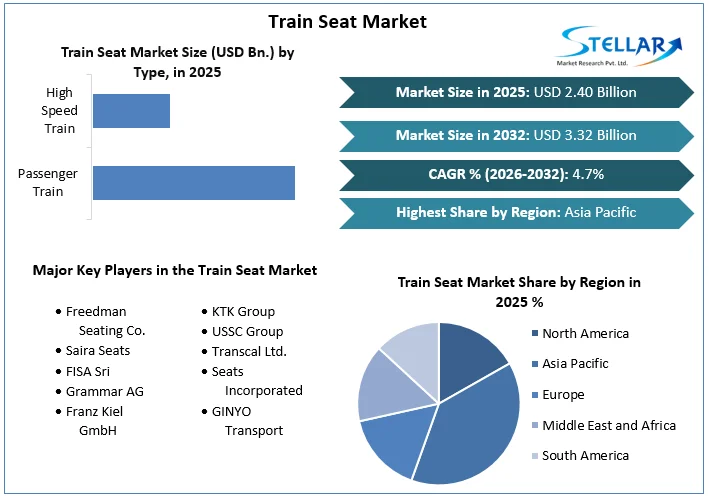
The Train Seat Market was valued at USD 2.40 billion in 2025 and is projected to reach USD 3.32 billion by 2032, growing at a 4.70% CAGR, as investments in high-speed rail, passenger comfort, and sustainable transportation accelerate demand for next-generation railway seating solutions.
PUNE, India, July 14, 2026 – The Train Seat Market, according to the latest study by Stellar Market Research, is entering a period of sustained growth as governments and railway operators worldwide prioritize passenger comfort, railway modernization, and sustainable public transportation. The report highlights that increasing investments in metro systems, high-speed rail corridors, and smart mobility infrastructure are creating significant opportunities for manufacturers developing lightweight, ergonomic, and technologically advanced seating solutions.
Market opportunity overview
Global railway transportation is undergoing a major transformation driven by urbanization, decarbonization targets, and rising passenger expectations. Governments are investing billions in rail infrastructure to reduce road congestion and carbon emissions, making passenger experience a key differentiator for rail operators.
Modern train seats have evolved beyond basic functionality to include ergonomic designs, lightweight composite materials, USB charging ports, integrated infotainment systems, improved accessibility, and enhanced safety features. Manufacturers are increasingly collaborating with rolling stock producers to deliver modular seating systems that improve passenger comfort while reducing vehicle weight and maintenance costs.
Growing deployment of high-speed rail networks, metro projects, and regional transit systems across Asia-Pacific, Europe, and the Middle East is expected to generate substantial demand for innovative seating technologies throughout the forecast period.
Download Free PDF Brochure: https://www.stellarmr.com/report/req_sample/Global-Train-Seat-Market/1379
Key findings from the report
The global Train Seat Market was valued at USD 2.40 billion in 2025 and is expected to reach USD 3.32 billion by 2032, registering a 4.70% CAGR.
The report segments the market by Train Type into Passenger Train and High-Speed Train, and by Seat Type into Dining Seat and Regular Seat.
Asia-Pacific is projected to maintain the largest market share throughout the forecast period due to expanding railway infrastructure and rising train production.
Europe continues to witness strong investment in high-speed rail and urban transit modernization, supporting long-term demand.
Smart seating technologies featuring multimedia connectivity, lightweight construction, and enhanced ergonomics are becoming major purchasing priorities for railway operators.
Public investments in sustainable transportation infrastructure continue to strengthen long-term market opportunities.
Market drivers and restraints
The rapid expansion of metro rail systems, intercity railways, and high-speed train networks remains the primary driver for market growth. Governments across developed and emerging economies are investing heavily in rail transportation to improve urban mobility and reduce greenhouse gas emissions.
Passenger expectations are also evolving. Travelers increasingly demand greater comfort, digital connectivity, accessibility, and premium seating experiences, encouraging operators to modernize rail interiors.
Technological advances in lightweight materials, modular seat designs, and smart cabin integration are improving operational efficiency while reducing maintenance costs.
However, the market faces challenges including high procurement and installation costs associated with premium seating systems. In addition, lengthy railway procurement cycles and strict certification requirements can delay product commercialization and infrastructure deployment.
Technology, regulation, and sustainability trends
Railway manufacturers are integrating advanced materials such as aluminum alloys and composite polymers to reduce train weight and improve energy efficiency. Digital features including USB charging ports, wireless connectivity, occupancy sensors, and passenger information systems are becoming standard in premium rail services.
Governments continue strengthening railway accessibility, passenger safety, and fire-resistance regulations, encouraging manufacturers to develop certified seating solutions that comply with international standards.
Sustainability remains a central industry priority. Manufacturers are increasing the use of recyclable materials, low-emission production processes, and modular seat designs that extend product life while reducing environmental impact.
Regional insights
Asia-Pacific is expected to dominate the Train Seat Market throughout the forecast period, supported by rapid railway expansion across China, India, Japan, South Korea, and Southeast Asia. Large-scale metro projects, high-speed rail investments, and increasing passenger traffic continue to stimulate demand for advanced seating systems.
Europe represents another significant growth region owing to continuous modernization of railway fleets, expansion of cross-border rail connectivity, and growing investments in sustainable public transportation. Countries including Germany, France, Italy, Spain, and the United Kingdom continue upgrading passenger rail infrastructure to improve comfort and operational efficiency.
North America is also expected to experience steady growth as passenger rail modernization projects and commuter rail investments gain momentum.
Recent industry developments
Alstom (2026): Expanded production and modernization programs supporting next-generation passenger rail interiors, including lightweight seating solutions for improved passenger comfort and operational efficiency.
Siemens Mobility (2025): Continued investments in digital rail technologies and modern rolling stock supporting enhanced passenger experience and sustainable transportation initiatives.
Freedman Seating (2025): Expanded product development focused on ergonomic, lightweight, and durable seating solutions for public transportation applications.
Hitachi Rail (2025): Advanced rail fleet modernization programs incorporating passenger-centric interior innovations and accessibility improvements.
European railway investment initiatives (2025–2026): Continued public funding for high-speed rail and sustainable mobility projects is accelerating procurement of modern passenger seating systems across regional rail networks.
Competitive landscape
The Train Seat Market remains moderately competitive with manufacturers emphasizing product innovation, lightweight engineering, passenger comfort, customization, and strategic partnerships with rolling stock manufacturers. Key participants include Freedman Seating Co., Saira Seats, FISA SRL, Grammer AG, Franz Kiel GmbH, KTK Group, USSC Group, Transcal Ltd., Seats Incorporated, and GINYO Transport. Companies continue investing in ergonomic design, sustainable materials, modular manufacturing, and smart seating technologies to strengthen their global market position.
Download Free PDF Brochure: https://www.stellarmr.com/report/req_sample/Global-Train-Seat-Market/1379
Analyst commentary
“Passenger experience is becoming one of the most important competitive differentiators in modern railway transportation. Future growth will increasingly be driven by intelligent seating solutions that combine lightweight engineering, digital connectivity, accessibility, and sustainability while helping operators improve operational efficiency and customer satisfaction,” said a Senior Research Analyst at Stellar Market Research.
Future outlook
The Train Seat Market is expected to experience steady expansion through 2032 as governments continue prioritizing sustainable transportation, railway electrification, and urban mobility. Growing investments in high-speed rail corridors, metro expansion, and smart transportation systems will create new opportunities for seating manufacturers capable of delivering innovative, lightweight, and digitally connected passenger solutions.
Manufacturers investing in recyclable materials, modular seating platforms, advanced ergonomics, and integrated passenger technologies are expected to gain competitive advantages as rail operators increasingly focus on improving passenger experience while achieving sustainability objectives.
About Stellar Market Research
Stellar Market Research is a global market research and business consulting firm providing actionable market intelligence across manufacturing, transportation, healthcare, chemicals, information technology, automotive, consumer goods, and industrial sectors. Through comprehensive primary and secondary research, the company delivers strategic insights into market dynamics, competitive benchmarking, emerging technologies, investment opportunities, and regulatory developments. Its research enables organizations to identify growth opportunities, optimize business strategies, and make informed investment decisions across global markets.
Media contact
Stellar Market Research
Website: https://www.stellarmr.com/
Email: sales@stellarmr.com
