Orthopedic Trauma Fixation Devices Market: Advancing Fracture Care with Innovative Surgical Solutions
Orthopedic trauma injuries caused by road accidents, sports activities, workplace incidents, and age-related falls continue to rise worldwide. As healthcare providers increasingly adopt advanced surgical techniques and implant technologies, the demand for reliable trauma fixation devices is growing steadily. These devices play a crucial role in stabilizing fractured bones, restoring mobility, and improving patient outcomes.
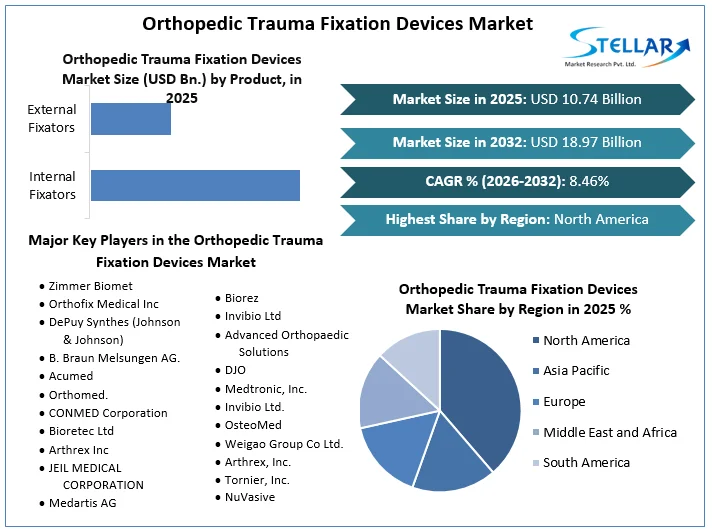
According to Stellar Market Research, the Global Orthopedic Trauma Fixation Devices Market was valued at USD 10.74 billion in 2025 and is expected to reach USD 18.97 billion by 2032, expanding at a CAGR of 8.46% during the forecast period.
What Are Orthopedic Trauma Fixation Devices?
Orthopedic trauma fixation devices are specialized medical implants and instruments used to stabilize broken or damaged bones until they heal naturally. These devices maintain proper bone alignment, reduce pain, and allow patients to regain movement more quickly.
Common fixation devices include:
- Bone plates
- Screws
- Intramedullary nails
- External fixators
- Pins and wires
- Bone cement
Depending on the severity and location of the fracture, surgeons select either internal or external fixation methods to achieve optimal healing.
𝐃𝐨𝐰𝐧𝐥𝐨𝐚𝐝 𝐅𝐫𝐞𝐞 𝐏𝐃𝐅 𝐁𝐫𝐨𝐜𝐡𝐮𝐫𝐞: https://www.stellarmr.com/report/req_sample/Orthopedic-Trauma-Fixation-Devices-Market/1792
Market Growth Drivers
Increasing Incidence of Traumatic Injuries
The growing number of road traffic accidents, sports injuries, industrial accidents, and falls among the elderly has significantly increased the demand for orthopedic trauma surgeries. Rising trauma cases worldwide continue to fuel the need for advanced fixation devices.
Aging Population
An expanding elderly population is more susceptible to osteoporosis and fragile bone fractures. Hip fractures, wrist fractures, and spinal injuries are becoming increasingly common, driving the adoption of orthopedic fixation implants.
Growth of Minimally Invasive Surgery
Healthcare providers are increasingly performing minimally invasive orthopedic procedures that reduce surgical trauma, minimize blood loss, shorten hospital stays, and accelerate patient recovery. Advanced trauma fixation devices are designed to support these modern surgical approaches.
Continuous Technological Innovation
Manufacturers are introducing next-generation implants featuring:
- Biocompatible materials
- Titanium and stainless-steel alloys
- Locking plate technology
- Patient-specific implants
- Bioabsorbable fixation devices
- Improved implant durability
These innovations improve surgical precision and long-term clinical outcomes.
Key Market Trends
The orthopedic trauma fixation industry is rapidly evolving with the integration of advanced technologies.
Emerging trends include:
- Personalized orthopedic implants
- 3D-printed fixation devices
- Smart surgical planning software
- Computer-assisted orthopedic surgery
- Robotic-assisted trauma procedures
- Advanced imaging technologies
These developments are helping surgeons perform more accurate procedures while improving recovery times.
Market Segmentation
By Product
The market includes:
- Internal Fixators
- External Fixators
Internal fixation devices—including plates, screws, intramedullary nails, and bone cement—held the largest market share in 2025 due to their ability to provide superior fracture stabilization, faster healing, and improved patient mobility.
By End User
Major healthcare facilities utilizing orthopedic trauma fixation devices include:
- Hospitals
- Orthopedic Specialty Clinics
- Ambulatory Surgical Centers (ASCs)
- Trauma Centers
Hospitals continue to dominate the market because they perform the majority of emergency trauma surgeries.
Regional Insights
North America Leads the Market
North America accounted for the largest market share in 2025, supported by:
- High incidence of traumatic injuries
- Advanced healthcare infrastructure
- Strong reimbursement systems
- Early adoption of innovative orthopedic technologies
- Presence of leading medical device manufacturers
Growing demand for minimally invasive orthopedic procedures and continuous technological innovation further strengthen the region’s market position.
Asia-Pacific Shows Strong Growth Potential
Countries such as China, India, Japan, and South Korea are expected to witness rapid market expansion due to:
- Improving healthcare infrastructure
- Rising healthcare expenditure
- Growing orthopedic surgical volume
- Increasing awareness of advanced trauma care
- Expanding elderly population
Market Challenges
Despite positive growth, several challenges remain.
High Cost of Advanced Implants
Premium orthopedic fixation systems can be expensive, limiting adoption in developing economies with constrained healthcare budgets.
Regulatory Requirements
Medical device manufacturers must comply with rigorous regulatory standards and clinical approval processes, which can increase product development costs and time to market.
Surgical Complexity
Successful trauma fixation procedures require experienced orthopedic surgeons and specialized healthcare facilities, creating challenges in regions with limited medical resources.
𝐃𝐨𝐰𝐧𝐥𝐨𝐚𝐝 𝐅𝐫𝐞𝐞 𝐏𝐃𝐅 𝐁𝐫𝐨𝐜𝐡𝐮𝐫𝐞: https://www.stellarmr.com/report/req_sample/Orthopedic-Trauma-Fixation-Devices-Market/1792
Competitive Landscape
Leading companies continue investing in research and development to introduce innovative trauma fixation solutions with enhanced strength, durability, and surgical precision.
Key competitive strategies include:
- Product innovation
- Strategic partnerships
- Geographic expansion
- Research collaborations
- Development of minimally invasive fixation systems
- Patient-specific implant technologies
These efforts are expected to improve treatment outcomes while expanding global market reach.
Future Outlook
The Orthopedic Trauma Fixation Devices Market is expected to experience sustained growth as healthcare systems focus on improving trauma care and patient recovery.
Future opportunities include:
- AI-assisted surgical planning
- Robot-assisted orthopedic procedures
- Smart implants with monitoring capabilities
- 3D-printed customized fixation devices
- Bioabsorbable implant technologies
- Expansion into emerging healthcare markets
As technological innovation continues to reshape orthopedic surgery, trauma fixation devices will become increasingly effective, personalized, and accessible.
Conclusion
Orthopedic trauma fixation devices have become indispensable in modern fracture management, enabling surgeons to stabilize complex injuries while promoting faster recovery and improved patient outcomes. Rising trauma cases, an aging global population, advancements in implant technology, and increasing adoption of minimally invasive surgical techniques are driving strong market growth.
With continuous innovation and expanding healthcare investments worldwide, the Orthopedic Trauma Fixation Devices Market is poised to remain a vital segment of the global orthopedic medical device industry in the years ahead.
