Key Highlights
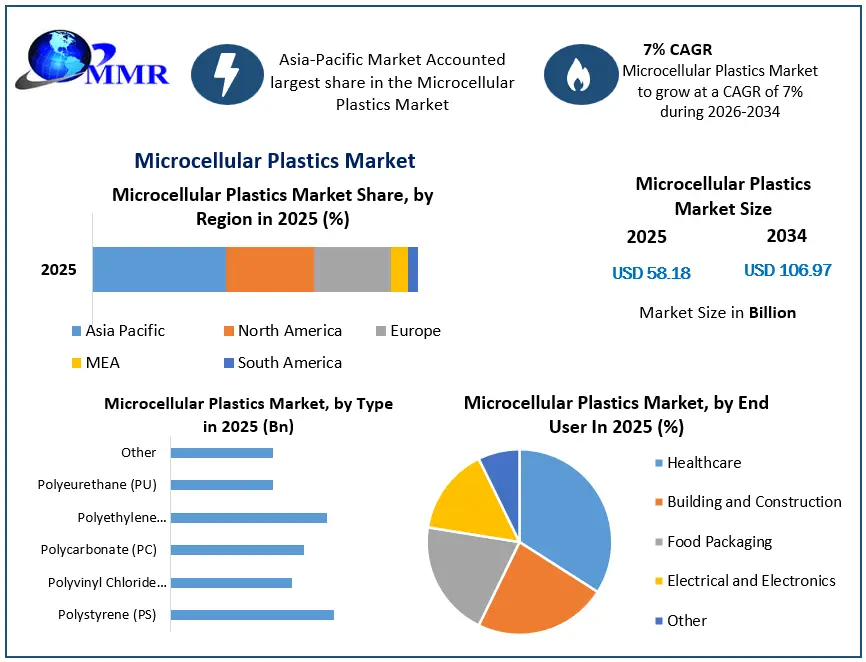
The global microcellular plastics market size reached USD 58.18 Billion in 2025 and is projected to expand to USD 106.97 Billion by 2034.
Market revenues will expand at a Compound Annual Growth Rate (CAGR) of 7% from 2026 to 2034, driven by high-density cell structures that reduce material usage.
Downstream automotive and transportation applications command a dominant share of consumption due to strict vehicle emissions standards.
The electronics and packaging sectors represent the fastest-growing segments, seeking improved thermal insulation and impact resistance.
Regulatory frameworks targeting carbon reduction accelerate the shift from solid commodity plastics to microcellular alternatives.
Advanced injection molding and extrusion processes utilizing supercritical fluids dictate modern production capacity investments.
Why This Matters Now
Volatile petrochemical raw material pricing and stringent carbon reduction mandates force immediate structural adjustments across the global plastics supply chain. Chemical manufacturers face intensifying pressure to lower the carbon footprint of their polymer portfolios while industrial buyers demand immediate weight reduction in component design. This market shift alters procurement strategies, shifting focus from raw volume purchasing to advanced structural efficiency.
Traditional solid plastics consume high volumes of polymer resins, exposing margins to feedstock price shocks. Microcellular processing introduces microscopic cells into the plastic matrix, allowing manufacturers to reduce raw material consumption by up to 20 percent without sacrificing structural integrity. Industrial buyers who fail to integrate these lightweight materials risk falling behind under modern corporate sustainability goals and regional regulatory frameworks. Consequently, capital investment is pivoting rapidly toward specialized foaming technologies and compatible resin formulations.
Market Overview
The microcellular plastics market is entering an intensive growth phase, expanding from USD 58.18 Billion in 2025 to USD 106.97 Billion by 2034. This expansion represents a steady 7% CAGR over the forecast period, signaling sustained industrial deployment across multiple manufacturing sectors. The fundamental driver is the ongoing transformation of traditional polymer processing into low-density, high-performance manufacturing.
This transition alters the supply-demand balance for commodity resins. As microcellular technology gains traction, the demand for traditional, unfoamed resins faces displacement, forcing material suppliers to adjust their production mix. Compounding facilities are responding by engineering specialized grades of polymers optimized for gas absorption and cell nucleation. The resulting market structure prioritizes technical collaboration between chemical suppliers, machinery manufacturers, and downstream tier-one industrial suppliers.
Key Trends Driving Growth
Process technology advancements serve as the primary catalyst for microcellular plastics adoption. The shift from chemical blowing agents to physical blowing agents, specifically supercritical carbon dioxide and nitrogen, improves environmental performance and process control. This evolution enables the production of uniform cell structures with diameters below 100 micrometers, maximizing mechanical strength while minimizing density.
Furthermore, circular economy initiatives alter the feedstock dynamics of the industry. Recycled polymers pose processing challenges due to inconsistent molecular weight distribution and impurities. Microcellular foaming mitigates these mechanical deficits by halting micro-crack propagation within the cellular matrix. This allows industrial molders to increase the percentage of post-consumer recycled content in their products without compromising component performance.
Segment Insights
Dominant Segment: Automotive and transportation components constitute the largest market share, driven by global fuel efficiency regulations and vehicle electrification. Automakers utilize microcellular injection molding to reduce vehicle weight, directly extending the battery range of electric vehicles and decreasing emissions for internal combustion engines.
Fastest-Growing Segment: Healthcare and medical packaging represent the fastest-growing application area, as companies seek sterile, high-insulation materials that minimize shipping weight. The inherent purity of physical foaming processes, which eliminate hazardous chemical residues, accelerates adoption in biocompatible medical devices.
Regional Growth Story
North America maintains a commanding position in the microcellular plastics market, supported by advanced manufacturing infrastructure in the United States. Stringent corporate average fuel economy standards drive rapid adoption across domestic automotive supply chains. Simultaneously, significant investments in aerospace and defense manufacturing sustain high demand for high-performance microcellular fluoropolymers and engineering plastics.
In the Asia-Pacific region, rapid industrialization across China and India accelerates production capacity additions. China continues to expand its domestic petrochemical infrastructure, positioning itself as a low-cost supplier of base resins optimized for foaming applications. Meanwhile, India’s expanding electronics manufacturing sector fuels demand for microcellular packaging materials to protect sensitive components during domestic transport and export flows. Europe displays strong regulatory-driven growth, where circular economy mandates in Germany push manufacturers toward recyclable microcellular structures.
Competitive Landscape
The global market features a blend of diversified chemical conglomerates and specialized polymer processing technology providers. Companies focus heavily on expanding production capacities and establishing strategic technology partnerships to secure proprietary foaming mechanisms. The control over intellectual property regarding gas delivery systems and specialized mold designs determines long-term pricing power.
Strategic investments concentrate on updating older extrusion and injection molding assets to handle supercritical fluids. This capital deployment signals a shift away from low-margin commodity plastic production toward high-value specialty materials. Furthermore, major chemical suppliers are acquiring niche compounding firms to integrate proprietary nucleating agents directly into their commercial resin portfolios. This vertical integration tightens the competitive environment, raising entry barriers for smaller regional compounders.
Recent Developments
Machinery manufacturers introduced retrofittable gas injection systems, allowing conventional injection molding machines to transition to microcellular production with minimal capital expenditure.
Resin producers launched certified bio-based polymers specifically tailored for microcellular extrusion, targeting zero-carbon consumer electronics packaging.
Collaborative partnerships between tier-one automotive suppliers and polymer specialists expanded to validate microcellular structural components for commercial electric vehicle platforms.
Strategic Implications
For procurement leaders, the expansion of the microcellular plastics market requires a thorough reevaluation of long-term sourcing contracts. Relying strictly on per-kilogram resin pricing becomes obsolete when evaluating materials that offer significant volumetric savings. Organizations must evaluate total cost of ownership models that factor in reduced material weight, lower shipping costs, and faster cycle times during the molding process.
For chemical manufacturers, asset flexibility determines future profitability. Facilities must adapt to sudden shifts in downstream volume demands as industrial buyers convert lines to microcellular processing. Companies that fail to offer compatible resins or technical support for gas-assisted molding risk losing volume share to agile competitors. Additionally, supply chain resilience hinges on securing stable sources of high-purity industrial gases alongside polymer feedstocks.
Future Outlook
The market will witness deep integration of microcellular processing across consumer goods, building materials, and advanced packaging networks by 2034. The technology will transition from a premium lightweighting option to a baseline manufacturing standard as carbon taxes penalize heavy, material-inefficient product designs. Winners will be industrial manufacturing operations that successfully combine post-consumer recycled resins with advanced physical foaming technologies to achieve true closed-loop circularity.
Analyst Perspective
“The transition to a USD 106.97 Billion microcellular plastics market represents a fundamental structural disruption in polymer economics rather than a simple substitution of materials. Chemical companies must stop selling volume and start selling volumetric efficiency, as downstream buyers increasingly prioritize lightweight structural integrity over raw resin mass.” — Ankita Kagwade, Lead Analyst, Maximize Market Research
About Maximize Market Research
Maximize Market Research Pvt. Ltd. (MMR) is a global market research and consulting company that provides reliable, data-focused, and practical business insights. The firm serves a wide range of industries, including healthcare, pharmaceuticals, technology, automotive, electronics, chemicals, personal care, and consumer goods. Through market forecasts, competitive analysis, strategic consulting, and industry impact assessments, MMR helps organizations understand changing market conditions, identify growth opportunities, and make informed business decisions for long-term success.
2nd Floor, Navale IT Park Phase 3
Pune Banglore Highway, Narhe
Pune, Maharashtra 411041, India
+91 9607365656
sales@maximizemarketresearch.com
