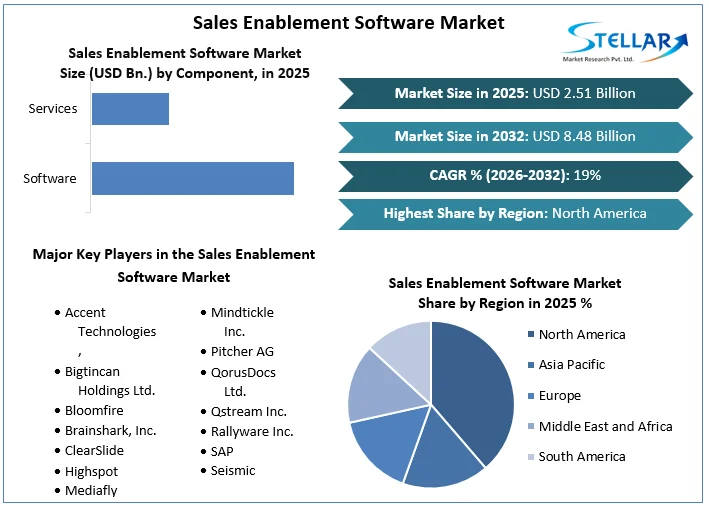
Sales Enablement Software Market: size was valued at USD 2.51 Billion in 2025 and the total Market revenue is expected to grow at 19% through 2026 to 2032, reaching nearly USD 8.48 Billion.
The Sales Enablement Software Market is witnessing remarkable growth as organizations increasingly prioritize digital transformation to improve sales productivity, customer engagement, and revenue generation. Sales enablement software has become an essential business tool by providing sales teams with the right content, training, analytics, and customer insights throughout the sales cycle. As businesses operate in increasingly competitive markets, organizations are investing in intelligent platforms that help sales representatives deliver personalized customer experiences while shortening sales cycles and improving conversion rates.
The rapid adoption of artificial intelligence (AI), machine learning, predictive analytics, and cloud computing is transforming the way organizations approach sales operations. Companies across industries are leveraging advanced sales enablement solutions to improve collaboration between marketing and sales teams, automate repetitive tasks, and provide real-time insights that support informed decision-making. As remote and hybrid work environments continue to evolve, cloud-based sales enablement platforms have become indispensable for maintaining workforce productivity and ensuring consistent customer engagement.
Download Free PDF Brochure: https://www.stellarmr.com/report/req_sample/Sales-Enablement-Software-Market/1380
Market estimation and definition
Sales enablement software refers to digital platforms designed to equip sales professionals with the resources, tools, training, and customer intelligence required to engage prospects effectively and close deals efficiently. These platforms integrate content management, customer relationship management (CRM), sales coaching, performance analytics, communication tools, and AI-driven recommendations into a unified ecosystem.
The market is expanding steadily due to increasing digitalization across enterprises and the growing demand for data-driven sales strategies. Organizations are focusing on enhancing sales effectiveness through automation, personalized customer interactions, and real-time performance tracking. As businesses seek higher operational efficiency, sales enablement platforms are becoming strategic investments that contribute directly to revenue growth and customer retention.
Growing demand for AI-powered sales enablement
Artificial intelligence has emerged as one of the most influential technologies transforming the sales enablement software market. AI-powered platforms analyze customer behavior, purchase history, engagement patterns, and sales performance to provide intelligent recommendations that improve sales outcomes.
Modern sales enablement solutions use AI to automate lead scoring, recommend personalized content, predict buying intent, and identify the most promising sales opportunities. Sales representatives benefit from automated coaching, conversation intelligence, and real-time guidance during customer interactions. These capabilities reduce manual workloads while enabling sales teams to focus on building stronger customer relationships.
The increasing integration of generative AI into sales platforms is further accelerating innovation by helping sales professionals create personalized emails, proposals, presentations, and customer communication in significantly less time.
Cloud deployment continues to dominate
Cloud-based deployment has become the preferred choice for organizations implementing sales enablement software. Cloud platforms offer scalability, flexibility, lower implementation costs, and easy integration with existing CRM systems and enterprise applications.
Remote work trends have strengthened demand for cloud-based solutions that enable sales teams to collaborate seamlessly regardless of geographical location. Organizations benefit from centralized content management, secure data access, automatic software updates, and improved system reliability.
Small and medium-sized enterprises are increasingly adopting cloud-based sales enablement platforms because they eliminate the need for expensive IT infrastructure while providing enterprise-grade capabilities at affordable subscription costs.
Digital transformation driving market expansion
Organizations worldwide are accelerating digital transformation initiatives to remain competitive in rapidly evolving markets. Sales enablement software plays a central role by improving coordination between sales, marketing, and customer success teams.
Businesses are increasingly relying on digital content libraries, virtual training modules, automated workflow management, and customer engagement analytics to streamline sales operations. The ability to deliver personalized content at every stage of the buyer journey has become a major competitive advantage.
Industries including information technology, healthcare, financial services, manufacturing, telecommunications, and retail are expanding investments in digital sales infrastructure to improve customer acquisition and retention.
Integration with CRM and business intelligence platforms
One of the strongest growth drivers for the sales enablement software market is seamless integration with Customer Relationship Management (CRM) systems and business intelligence platforms.
Integrated solutions allow organizations to access customer information, sales history, engagement metrics, and predictive insights from a single interface. This unified approach enhances collaboration between departments while improving forecasting accuracy and sales planning.
Advanced analytics dashboards help management monitor key performance indicators, identify skill gaps, optimize sales strategies, and improve overall organizational performance.
Market opportunities across emerging economies
Emerging economies are creating significant growth opportunities for sales enablement software providers. Increasing internet penetration, expanding digital infrastructure, and rising cloud adoption are encouraging businesses to modernize their sales operations.
Countries across Asia-Pacific, Latin America, and the Middle East are witnessing rapid digital adoption among enterprises of all sizes. Growing startup ecosystems, expanding e-commerce activities, and government initiatives supporting digital transformation are further strengthening market demand.
As businesses in developing regions increasingly compete in global markets, investment in intelligent sales technologies is expected to accelerate substantially over the coming years.
Challenges affecting market growth
Despite strong market momentum, several challenges continue to influence adoption rates. High implementation costs associated with enterprise-wide deployments may discourage smaller organizations with limited technology budgets.
Data privacy concerns, cybersecurity risks, and compliance requirements also require organizations to invest in secure software environments and governance frameworks. Companies handling sensitive customer information must ensure compliance with regional regulations governing data protection and privacy.
Integration complexity with legacy systems can create operational challenges during implementation. Successful deployment often requires employee training, organizational change management, and continuous technical support.
Regional market outlook
North America remains the leading regional market due to widespread adoption of advanced enterprise software, strong cloud infrastructure, and the presence of major technology providers. Organizations across the United States and Canada continue investing heavily in AI-powered sales technologies to enhance customer engagement and improve operational efficiency.
Europe is experiencing steady growth supported by increasing enterprise digitalization, regulatory compliance initiatives, and growing investments in customer experience management. Businesses across Germany, the United Kingdom, France, and other European economies are expanding adoption of intelligent sales solutions.
Asia-Pacific represents the fastest-growing regional market as businesses rapidly embrace cloud technologies, digital commerce, and artificial intelligence. China, India, Japan, South Korea, and Southeast Asian countries are witnessing increasing investments in digital sales platforms across multiple industries.
Latin America and the Middle East & Africa are also emerging as promising markets, supported by expanding internet connectivity, cloud adoption, and digital business transformation initiatives.
Competitive landscape
- Bloomfire
- Brainshark, Inc.
- ClearSlide
- Highspot
- Mediafly
- Mindtickle Inc.
- Pitcher AG
- QorusDocs Ltd.
Download Free PDF Brochure: https://www.stellarmr.com/report/req_sample/Sales-Enablement-Software-Market/1380
Future outlook
The future of the Sales Enablement Software Market appears highly promising as organizations increasingly recognize the importance of technology-enabled sales excellence. Artificial intelligence, machine learning, predictive analytics, and generative AI will continue transforming sales processes by delivering personalized customer experiences and improving decision-making.
Growing investments in cloud infrastructure, digital transformation, and customer-centric business strategies are expected to sustain long-term market expansion. Organizations that successfully integrate AI-powered sales enablement solutions with CRM, marketing automation, and customer analytics platforms will be better positioned to improve productivity, accelerate revenue growth, and strengthen competitive advantage.
As enterprises continue modernizing their commercial operations, sales enablement software will remain a critical component of digital business strategy, supporting smarter selling, stronger customer relationships, and sustainable business growth across industries worldwide.
Media Contact
Stellar Market Research
Website: Stellar Market Research – Global Research Reports & Consulting
Email: sales@stellarmr.com
