Key Highlights
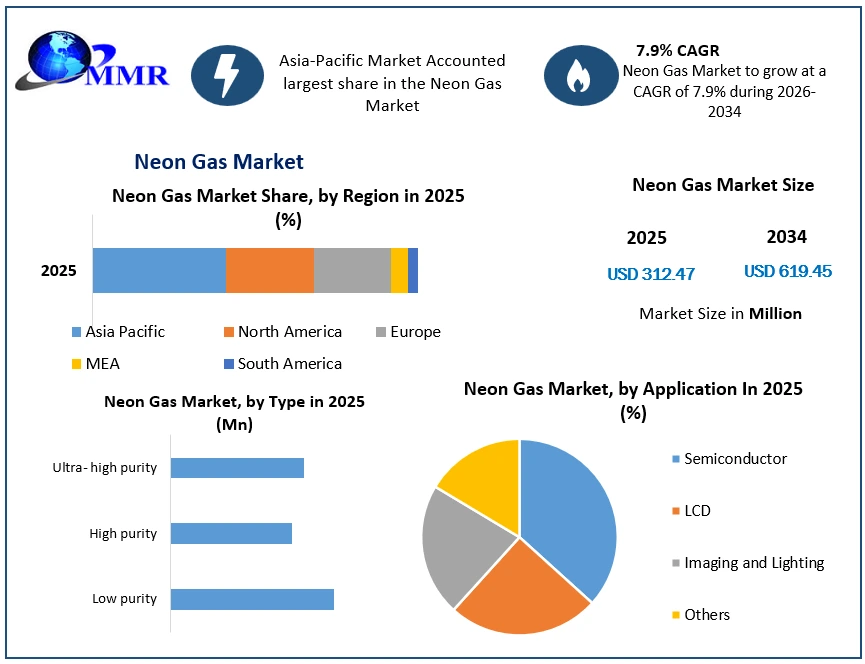
- Global Neon Gas Market valued at USD 312.47 million in 2025
- Market projected to reach USD 619.45 million by 2034
- Forecast CAGR stands at 7.9% (2026–2034)
- Dominant Segment: Semiconductor applications
- Fastest-Growing Segment: Semiconductor applications
- Asia Pacific leads global demand through electronics manufacturing
- Semiconductor investments continue to reshape supply security priorities
- High-purity neon production remains a strategic focus for industrial gas suppliers
Why This Matters Now
Semiconductor manufacturers cannot expand production without secure access to specialty gases. Neon sits at the center of excimer laser lithography, making supply continuity as critical as wafer capacity itself.
The Global Neon Gas Market, valued at USD 312.47 million in 2025, is expected to reach USD 619.45 million by 2034, growing at a 7.9% CAGR. That growth signals more than rising gas consumption. It points to increasing investment in localized supply chains, higher purification capacity, and long-term procurement agreements across the semiconductor ecosystem.
Market Overview
The Neon Gas Market remains one of the world’s rarest industrial gases. Produced primarily through cryogenic air separation, it serves industries requiring exceptional purity and process stability. Semiconductor manufacturing accounts for the largest share of consumption because excimer lasers used in advanced lithography depend on high-purity neon.
The industry’s supply dynamics changed dramatically after geopolitical disruptions exposed the concentration of global purification capacity. Manufacturers responded by diversifying sourcing strategies, expanding purification facilities, and signing multi-year supply contracts. These shifts have transformed neon from a specialty industrial input into a strategically managed raw material.
Demand growth increasingly follows semiconductor capital expenditure rather than traditional lighting applications. As fabrication plants move toward smaller process nodes, reliable access to ultra-high-purity gases becomes an operational requirement rather than a procurement preference.
Key Trends Driving Growth
Semiconductor investment remains the strongest growth engine. New fabrication facilities across Asia, North America, and Europe require consistent supplies of electronic-grade neon for lithography equipment. Every new production line increases long-term industrial gas consumption, creating stable demand for producers.
Supply resilience has become a competitive advantage. Industrial gas companies are investing in diversified purification networks and additional production capabilities to reduce dependence on geographically concentrated sources. These investments strengthen pricing stability while improving customer confidence during periods of supply disruption.
Technology is also changing the competitive landscape. Advances in gas purification, recovery systems, and process monitoring allow manufacturers to improve product quality while reducing operational losses. Higher recovery rates support both cost efficiency and sustainability objectives.
Environmental considerations are influencing production decisions as well. Although neon itself is inert, manufacturers are improving energy efficiency within cryogenic separation operations and expanding gas recycling technologies inside semiconductor facilities. Circular resource management helps reduce operating costs while supporting broader sustainability commitments.
Pricing continues to reflect supply-demand balance rather than commodity cycles alone. Semiconductor production schedules, geopolitical developments, and purification capacity all influence contract negotiations between industrial gas suppliers and electronics manufacturers.
Segment Insights
- Dominant Segment: Semiconductor applications remain the largest consumer of neon gas, driven by advanced lithography requirements in integrated circuit manufacturing. This leadership demonstrates the market’s close connection with global chip production and electronics investment.
- Fastest-Growing Segment: Semiconductor applications are also expected to record the strongest growth during the forecast period as governments and private investors expand domestic semiconductor manufacturing capacity. Higher wafer production translates directly into greater consumption of high-purity neon.
Regional Growth Story
Asia Pacific continues to dominate the Neon Gas Market because it houses the world’s largest semiconductor manufacturing ecosystem. China, Japan, South Korea, and Taiwan maintain extensive electronics production capacity, creating sustained demand for specialty gases used in advanced manufacturing processes. Continued fab investments reinforce the region’s leadership.
The United States is strengthening domestic semiconductor manufacturing through significant investment in fabrication facilities. This creates opportunities for industrial gas suppliers capable of delivering reliable local production and purification capabilities. Procurement strategies increasingly prioritize supply security alongside price competitiveness.
Germany remains Europe’s industrial anchor for advanced manufacturing and specialty chemicals. Semiconductor investments across Europe are encouraging greater regional sourcing of industrial gases while reducing dependence on imported supply chains.
India is emerging as a strategic manufacturing destination through electronics production initiatives and semiconductor investments. Although domestic demand remains smaller than East Asia’s, expanding manufacturing capacity presents new opportunities for industrial gas suppliers.
Japan and South Korea continue investing in next-generation semiconductor technologies, supporting long-term consumption of electronic-grade gases. These markets reward suppliers capable of delivering consistently high purity and uninterrupted supply.
Competitive Landscape
Competition extends beyond production volume. Industrial gas companies increasingly compete through purification technology, logistics capabilities, long-term contracts, and supply reliability.
Capacity expansion signals confidence in sustained semiconductor demand rather than short-term market fluctuations. Producers investing in purification infrastructure position themselves to capture premium customers requiring electronic-grade specifications.
Strategic partnerships with semiconductor manufacturers also reshape competitive positioning. Long-term agreements improve capacity utilization while providing buyers with predictable supply and pricing. These relationships raise barriers for smaller suppliers lacking production scale or distribution networks.
Investment decisions increasingly focus on regional production footprints. Companies establishing facilities closer to semiconductor clusters reduce transportation risk and improve delivery responsiveness. That shift strengthens customer relationships while increasing operational resilience.
Recent Developments
- Expansion of semiconductor manufacturing continues to increase demand for high-purity neon gas.
- Industrial gas suppliers are strengthening purification capacity to improve supply resilience.
- Manufacturers are adopting advanced gas recovery and recycling technologies to improve operational efficiency.
- Regional diversification strategies are reducing dependence on concentrated supply sources while supporting long-term procurement stability.
Strategic Implications
For chemical manufacturers, neon represents a specialty product with increasing strategic value rather than a conventional industrial gas. Companies capable of supplying semiconductor-grade purity stand to benefit from premium pricing and long-term customer relationships.
Procurement leaders should prioritize supplier diversification alongside contractual flexibility. Supply interruptions can halt semiconductor production, making resilience more valuable than short-term cost savings.
Investors should monitor semiconductor capital expenditure as the primary demand indicator. Fab construction, lithography technology upgrades, and regional manufacturing incentives provide stronger signals than traditional industrial production metrics.
Technology providers have opportunities in purification systems, gas recycling solutions, and digital monitoring platforms that improve efficiency throughout the specialty gas value chain.
Future Outlook
The Neon Gas Market is becoming increasingly aligned with the strategic priorities of the semiconductor industry rather than the broader industrial gas sector. Supply security, purification capability, and regional manufacturing investment will determine competitive leadership as electronic-grade demand continues to expand. Companies that combine reliable production with resilient supply networks will capture the highest-value opportunities while those dependent on concentrated sourcing face greater competitive risk.
Analyst Perspective
“Neon is no longer viewed as simply an industrial gas. Semiconductor manufacturing has elevated it into a strategically managed resource, making supply resilience and purification capability decisive competitive factors across the global value chain.” — Ankita Kagwade, Analyst
About Maximize Market Research
Maximize Market Research Pvt. Ltd. (MMR) is a global market research and consulting company that provides reliable, data-focused, and practical business insights. The firm serves a wide range of industries, including healthcare, pharmaceuticals, technology, automotive, electronics, chemicals, personal care, and consumer goods. Through market forecasts, competitive analysis, strategic consulting, and industry impact assessments, MMR helps organizations understand changing market conditions, identify growth opportunities, and make informed business decisions for long-term success.
2nd Floor, Navale IT Park Phase 3
Pune Banglore Highway, Narhe
Pune, Maharashtra 411041, India
+91 9607365656
sales@maximizemarketresearch.com
