Key Highlights
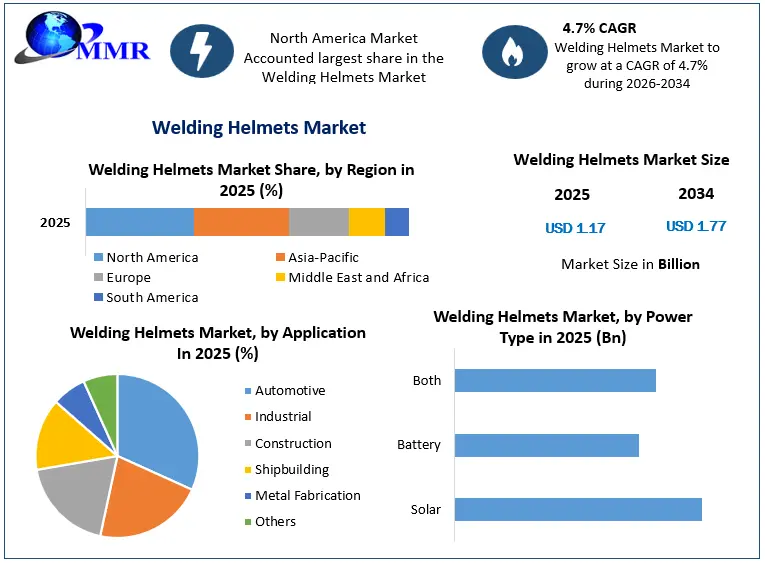
- The Global Welding Helmets Market was valued at USD 1.17 billion in 2025.
- The market is projected to reach USD 1.77 billion by 2034.
- Revenue is expected to grow at a CAGR of 4.7% from 2026 to 2034.
- Rising demand from automotive manufacturing, construction, and industrial fabrication supports long-term growth.
- Workplace safety regulations continue encouraging adoption of advanced personal protective equipment (PPE).
- Manufacturers are investing in auto-darkening technology, lightweight materials, and ergonomic helmet designs.
Why This Matters Now
Automotive manufacturers and industrial fabricators are expanding production while facing increasingly stringent workplace safety requirements. OEMs, Tier-1 suppliers, and fabrication companies must balance productivity with worker protection as automated welding and advanced manufacturing become standard across global production facilities.
The Welding Helmets Market is benefiting directly from this shift. A market valued at USD 1.17 billion in 2025 and projected to reach USD 1.77 billion by 2034 demonstrates that safety equipment is becoming a strategic investment rather than a compliance expense. Companies adopting advanced protective technologies improve operational continuity, workforce safety, and regulatory compliance while strengthening manufacturing performance.
Market Overview
The Global Welding Helmets Market Size was valued at USD 1.17 billion in 2025 and is expected to reach USD 1.77 billion by 2034, expanding at a CAGR of 4.7% during the forecast period.
Welding helmets remain essential protective equipment across automotive manufacturing, heavy engineering, construction, shipbuilding, aerospace, metal fabrication, energy infrastructure, and industrial maintenance. Modern helmets protect workers from ultraviolet radiation, infrared exposure, sparks, molten metal, and flying debris while improving visibility during precision welding operations.
Growing manufacturing activity and infrastructure development continue supporting equipment demand. Expansion of automotive production, industrial fabrication, and construction projects increases the number of skilled welders operating across production facilities and job sites, creating sustained demand for high-quality personal protective equipment.
Technology is also reshaping purchasing decisions. Industrial buyers increasingly prioritize auto-darkening filters, improved optical clarity, lightweight materials, ergonomic comfort, and longer service life. These features improve productivity while reducing operator fatigue during extended welding operations.
Key Trends Driving Growth
Automotive manufacturing continues generating substantial demand for advanced welding helmets. Vehicle assembly plants increasingly rely on automated and manual welding processes across body structures, chassis, battery enclosures, and structural components. Every increase in vehicle production creates recurring demand for reliable protective equipment.
The transition toward electric vehicle manufacturing further expands welding requirements. Battery pack production, lightweight aluminum structures, and specialized vehicle components require precision welding processes supported by advanced operator protection.
Industrial automation is another major growth driver. While robotic welding systems continue expanding, manual welding remains critical across maintenance, custom fabrication, repair operations, and complex manufacturing applications. Advanced welding helmets improve worker productivity by reducing interruptions while maintaining consistent visibility.
Construction and infrastructure investment also contribute to market expansion. Steel fabrication, bridge construction, commercial buildings, transportation infrastructure, and industrial facilities require skilled welding operations supported by certified protective equipment.
Regulatory enforcement continues strengthening market demand. Employers increasingly invest in higher-quality PPE to improve workplace safety, reduce occupational injuries, and comply with industrial safety standards.
Segment Insights
- Dominant Segment: The report identifies the leading segment based on product type and end-user analysis.
- Fastest-Growing Segment: The report highlights the fastest-growing segment benefiting from industrial automation and manufacturing expansion.
- Automotive and industrial manufacturing remain major application areas due to continuous welding operations.
- Construction and infrastructure projects support stable replacement demand for protective equipment.
- Advanced auto-darkening helmets continue attracting greater adoption through productivity and worker comfort improvements.
Regional Growth Story
Asia-Pacific continues leading the Welding Helmets Market through expanding manufacturing capacity, automotive production, industrialization, and infrastructure investment. China remains a major manufacturing hub with strong demand from automotive assembly, heavy engineering, and metal fabrication industries.
India continues strengthening regional demand through increasing vehicle production, industrial development, railway expansion, commercial construction, and government infrastructure initiatives. Expanding manufacturing activity creates sustained opportunities for industrial safety equipment suppliers.
Japan and South Korea maintain demand through advanced automotive manufacturing, electronics production, shipbuilding, and precision engineering industries. Manufacturers in these markets increasingly adopt premium protective equipment that improves both worker safety and operational efficiency.
North America benefits from stable automotive production, energy infrastructure projects, aerospace manufacturing, and industrial modernization. Companies continue upgrading safety equipment while integrating advanced protective technologies into manufacturing operations.
Europe remains supported by strict occupational safety regulations and advanced industrial manufacturing. Germany continues to serve as a major automotive and engineering center where manufacturers emphasize worker protection alongside production efficiency.
Emerging manufacturing economies also present new opportunities as industrialization accelerates and workplace safety standards improve.
Competitive Landscape
Competition increasingly depends on technology, product quality, and worker comfort rather than basic protective functionality. Manufacturers investing in auto-darkening filters, improved optical performance, lightweight materials, and ergonomic designs strengthen competitive positioning while supporting premium pricing.
Product innovation remains central to market differentiation. Companies introducing helmets with wider viewing areas, faster lens response, adjustable sensitivity, and enhanced durability improve productivity for professional welders while strengthening long-term customer relationships.
Manufacturing expansion also signals confidence in sustained industrial growth. Companies increasing production capacity position themselves to meet rising global demand while improving supply chain responsiveness.
Strategic partnerships with industrial distributors, safety equipment providers, and manufacturing companies strengthen market access. Businesses capable of combining innovative products with strong distribution networks improve customer retention and aftermarket sales.
Recent Developments
- Manufacturers continue investing in advanced auto-darkening welding helmet technologies.
- Product development emphasizes lightweight construction and improved operator comfort.
- Industrial automation increases demand for premium protective equipment.
- Workplace safety regulations continue supporting adoption of certified welding helmets.
- Manufacturing expansion strengthens global production and distribution capabilities.
Strategic Implications
Manufacturers should continue investing in product innovation that improves both worker safety and operational productivity. Industrial customers increasingly evaluate protective equipment based on comfort, durability, optical clarity, and total lifecycle value rather than acquisition cost alone.
Automotive OEMs and Tier-1 suppliers benefit from advanced protective equipment that supports workforce efficiency while reducing workplace incidents. Improved safety contributes directly to manufacturing continuity and operational performance.
Investors should monitor companies combining technology development with manufacturing expansion. Businesses capable of delivering premium products supported by efficient production systems are better positioned to capture long-term market growth.
Industrial procurement teams should also prioritize certified, high-performance protective equipment capable of meeting evolving workplace safety requirements while supporting operator productivity.
Future Outlook
The Welding Helmets Market will continue expanding as automotive manufacturing, industrial fabrication, construction, and infrastructure investment sustain global welding activity. Product innovation, worker safety, and manufacturing efficiency will increasingly determine competitive leadership across the industry.
Manufacturers that invest in advanced protective technologies, ergonomic product design, and global production capacity will outperform competitors focused primarily on price-driven product offerings.
Analyst Perspective
“The Welding Helmets Market continues to benefit from expanding manufacturing activity, infrastructure investment, and increasingly stringent workplace safety standards. Manufacturers that combine advanced protective technologies with ergonomic design and product innovation will be best positioned to capitalize on long-term opportunities across global industrial markets,” says Dharati Raut, Analyst, Maximize Market Research.
About Maximize Market Research
Maximize Market Research Pvt. Ltd. (MMR) is a global market research and consulting company that provides reliable, data-focused, and practical business insights. The firm serves a wide range of industries, including healthcare, pharmaceuticals, technology, automotive, electronics, chemicals, personal care, and consumer goods. Through market forecasts, competitive analysis, strategic consulting, and industry impact assessments, MMR helps organizations understand changing market conditions, identify growth opportunities, and make informed business decisions for long-term success.
2nd Floor, Navale IT Park Phase 3
Pune Banglore Highway, Narhe
Pune, Maharashtra 411041, India
+91 9607365656
sales@maximizemarketresearch.com
