Key Highlights
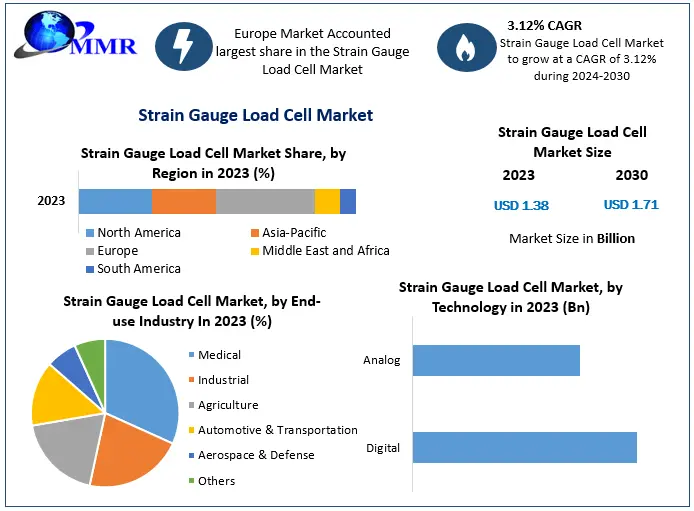
- The global Strain Gauge Load Cell Market was valued at USD 1.38 billion in 2023.
- The market is forecast to reach USD 1.71 billion by 2030.
- The industry is expected to expand at a 3.12% CAGR during 2024–2030.
- Europe accounted for the largest market share in 2023.
- Analog technology continues to maintain significant industry adoption due to affordability and reliability.
- Automotive, industrial, aerospace, and medical industries remain major demand generators.
- Precision testing requirements continue supporting sensor technology adoption.
- Asia Pacific is emerging as the fastest-growing regional manufacturing hub.
Why This Matters Now
Manufacturers are under increasing pressure to improve production accuracy, product quality, and operational efficiency. Strain gauge load cells provide the precision required for automated manufacturing, industrial weighing, structural testing, and vehicle development. As automotive manufacturers transition toward electric and autonomous vehicles, the need for advanced testing equipment continues to grow. At the same time, industrial automation and smart manufacturing are expanding the role of precision sensing technologies across global production facilities, creating long-term demand for high-performance load cell solutions.
Market Overview
The Strain Gauge Load Cell Market includes force and weight measurement sensors used across industrial automation, automotive testing, aerospace engineering, agriculture, medical equipment, and manufacturing operations. These sensors convert mechanical force into electrical signals, enabling accurate measurement for quality control, testing, and production monitoring.
Demand continues to rise as manufacturers prioritize precision, repeatability, and process automation. Original equipment manufacturers increasingly integrate strain gauge sensing technology into production systems because of its proven accuracy, responsiveness, and long-term reliability.
Automotive manufacturers remain among the largest users of strain gauge load cells. Vehicle testing, structural validation, crash simulations, and component qualification require highly accurate force measurement systems capable of meeting strict engineering standards.
Supply remains supported by established sensor manufacturers investing in product innovation, digital integration, and improved measurement accuracy. However, increasing competition and pricing pressure require suppliers to differentiate through technology performance, product durability, and application expertise.
Macroeconomic trends including Industry 4.0 adoption, industrial automation, electric vehicle development, and advanced manufacturing continue shaping purchasing decisions worldwide.
Key Trends Driving Growth
Industrial automation expansion
Factories continue deploying automated production systems that require accurate force measurement for process control, quality assurance, and equipment monitoring.
Automotive technology evolution
The transition toward electric and autonomous vehicles increases testing complexity. Manufacturers require advanced load cell technologies to validate vehicle safety, structural integrity, and performance.
Demand for precision engineering
Industries including aerospace, defense, and medical devices continue adopting high-accuracy measurement solutions to meet increasingly stringent quality standards.
Digital transformation
Although analog load cells remain widely used, digital sensing technologies are gradually expanding through integration with smart manufacturing systems and real-time production monitoring.
Global manufacturing investments
Manufacturing expansion across Asia Pacific continues increasing demand for industrial weighing and force measurement equipment, strengthening regional equipment sales.
Explore detailed analysis, insights, and growth opportunities
Segment Insights
Dominant Segment – Analog Technology
Analog strain gauge load cells continue holding a significant market share because they combine affordability, mechanical robustness, and reliable performance.
Many industrial users continue selecting analog solutions due to their compatibility with existing manufacturing infrastructure and lower implementation costs. Their proven durability also makes them suitable for demanding industrial environments.
The business impact is significant because analog technology allows manufacturers to improve production accuracy without substantial capital investment, making it attractive for both established and emerging industries.
Fastest-Growing Segment – Digital Technology
Digital strain gauge load cells are expected to experience stronger growth as manufacturers modernize production facilities.
Digital systems enable higher measurement precision, improved diagnostics, simplified calibration, and seamless integration into Industry 4.0 environments. These capabilities support predictive maintenance and real-time operational monitoring.
For suppliers, digital load cells create opportunities for premium product positioning and higher-value industrial automation projects.
Additional Key Sub-segments
By Type
Single-point load cells remain widely used in commercial weighing systems due to their compact design and versatility.
Shear-beam and bending-beam load cells continue serving industrial weighing applications requiring stable performance under heavy loads.
Compression load cells maintain strong demand across heavy industrial sectors where high-capacity force measurement is essential.
S-type load cells continue supporting tensile and compression testing across laboratories, industrial equipment, and material testing facilities.
By End-use Industry
Industrial manufacturing remains the largest application sector because production automation increasingly depends on accurate force measurement.
Automotive and transportation continue expanding demand through vehicle development, crash testing, and component validation.
Medical applications continue growing as precision weighing systems become essential for diagnostic and laboratory equipment.
Aerospace and defense industries rely on high-performance load cells for structural testing and aircraft component qualification.
Regional Growth Story
Europe
Europe remains the leading regional market due to its strong automotive manufacturing ecosystem and concentration of global sensor manufacturers.
Vehicle manufacturers continue investing in advanced testing technologies to support electric vehicle development and autonomous mobility solutions.
Asia Pacific
Asia Pacific is expected to record the fastest market expansion, supported by rapid industrialization and growing automotive production.
China and Japan continue strengthening regional manufacturing capabilities, while India expands industrial automation investments across multiple sectors.
North America
North America maintains steady demand through advanced manufacturing, aerospace innovation, industrial automation, and precision engineering applications.
Technology-driven industries continue investing in next-generation testing equipment to improve production quality and operational efficiency.
Middle East & Africa and South America
Emerging industrial development and manufacturing investments gradually increase adoption of force measurement technologies across infrastructure, industrial production, and logistics sectors.
Competitive Landscape
The Strain Gauge Load Cell Market remains highly competitive, with established sensor manufacturers competing through technology innovation, measurement accuracy, and industry-specific application expertise.
Flintec Group AB, Vishay Precision Group, Hottinger Baldwin Messtechnik GmbH (HBM), OMEGA Engineering, and Futek Advanced Sensor Technologies maintain strong market positions through broad product portfolios serving industrial, aerospace, automotive, and laboratory applications.
Companies including Dytran Instruments, Anyload Weigh & Measure Inc., UTILCELL, Thames Side Sensors Ltd., Siemens AG, NMB Technologies Corporation, Spectris, Indutrade, A&D Company Limited, ADOS, AEP Transducers, and Omega continue strengthening their presence through application-focused sensor technologies and global distribution networks.
Competitive differentiation increasingly depends on sensor precision, digital connectivity, long-term reliability, and integration with automated manufacturing systems rather than price competition alone.
Recent Developments
- Kistler Group acquired Corrsys-Datron Sensorsysteme GmbH to strengthen its vehicle dynamics testing portfolio.
- The acquisition expanded Kistler’s automotive measurement solutions across Europe.
- Manufacturers continue investing in advanced force measurement technologies for vehicle testing applications.
- Automotive electrification continues increasing demand for precision testing equipment.
- Digital sensing technologies are gaining wider adoption alongside industrial automation initiatives.
Future Outlook
Companies that combine precision sensing, digital connectivity, and Industry 4.0 integration will secure the strongest competitive position as global manufacturing shifts toward intelligent automation.
About Maximize Market Research
Maximize Market Research Pvt. Ltd. (MMR) is a global market research and consulting company that provides reliable, data-focused, and practical business insights. The firm serves a wide range of industries, including healthcare, pharmaceuticals, technology, automotive, electronics, chemicals, personal care, and consumer goods. Through market forecasts, competitive analysis, strategic consulting, and industry impact assessments, MMR helps organizations understand changing market conditions, identify growth opportunities, and make informed business decisions for long-term success.
Contact Us :
2nd Floor, Navale IT Park Phase 3
Pune Banglore Highway, Narhe
Pune, Maharashtra 411041, India
+91 9607365656
sales@maximizemarketresearch.com
