Key Highlights
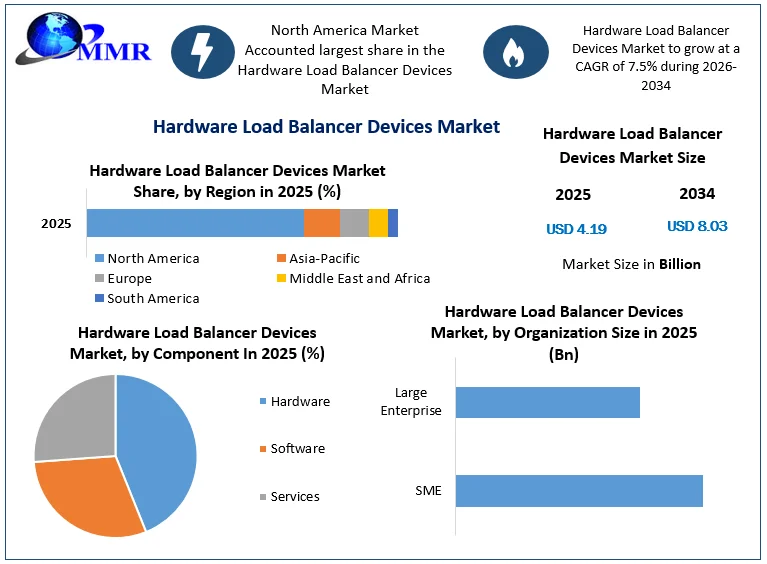
- The Hardware Load Balancer Devices Market was valued at USD 4.19 billion in 2025.
- Market revenue is projected to reach USD 8.03 billion by 2034, expanding at a CAGR of 7.5% from 2026 to 2034.
- Growing AI deployments and cloud migration are increasing demand for high-performance traffic management infrastructure.
- Enterprises continue to prioritize resilient application delivery and cybersecurity as digital services become business-critical.
- Data center modernization and network transformation remain central investment priorities across technology-intensive industries.
Why This Matters Now
Artificial intelligence is reshaping enterprise infrastructure faster than traditional networking architectures were designed to handle. Organizations are redesigning digital environments to accommodate larger workloads, real-time analytics, and always-on customer experiences, making network availability a strategic business requirement rather than a technical objective.
The Hardware Load Balancer Devices Market Size reflects this transition. The market was valued at USD 4.19 billion in 2025 and is projected to reach USD 8.03 billion by 2034, growing at a 7.5% CAGR from 2026 to 2034. This expansion signals sustained enterprise investment in infrastructure capable of supporting application performance, operational resilience, and secure digital transformation. Every dollar directed toward hardware load balancing strengthens business continuity while enabling organizations to scale increasingly complex digital operations.
Market Overview
Modern enterprises depend on uninterrupted application availability. Whether supporting cloud-native services, digital banking, e-commerce platforms, manufacturing systems, or telecommunications networks, application performance increasingly determines customer satisfaction and operational efficiency.
Hardware load balancer devices occupy a central role in this architecture by distributing network traffic efficiently across multiple servers while improving availability and reducing bottlenecks. As organizations modernize infrastructure to support AI workloads, hybrid cloud environments, and increasingly distributed applications, dedicated hardware continues to provide performance advantages where predictable latency, security, and reliability remain essential.
Digital transformation has also changed purchasing priorities. Technology leaders are no longer evaluating networking equipment solely on throughput. They increasingly assess how networking infrastructure supports automation, cybersecurity, scalability, and long-term operational resilience.
Key Trends Driving Growth
Artificial intelligence is significantly increasing infrastructure demands across enterprise environments. AI-driven applications require consistent availability, lower latency, and efficient traffic distribution, placing hardware load balancing at the center of enterprise networking strategies.
Cloud migration continues to reshape deployment models. Organizations increasingly operate hybrid environments that combine private infrastructure with public cloud resources. This shift increases the complexity of managing application traffic while creating greater demand for intelligent load distribution across multiple environments.
Cybersecurity has become equally important. As applications become primary business interfaces, organizations seek networking infrastructure capable of improving resilience against outages while supporting secure application delivery. Hardware load balancers contribute by improving traffic control, redundancy, and availability across mission-critical systems.
Data center modernization remains another major catalyst. Enterprises continue investing in infrastructure upgrades to improve computing efficiency, application responsiveness, and digital service reliability. Hardware-based traffic management supports these objectives by optimizing resource utilization and reducing service interruptions.
Automation also continues to influence purchasing decisions. Infrastructure teams increasingly favor platforms that integrate with modern orchestration environments while reducing manual network management. As enterprises automate IT operations, networking infrastructure evolves from static equipment into programmable digital assets supporting broader business transformation.
Segment Insights
- Dominant Segment: The supplied report identifies a dominant market segment. Organizations in this segment benefit from strong demand driven by enterprise application delivery, infrastructure modernization, and digital transformation initiatives.
- Fastest-Growing Segment: The supplied report identifies the fastest-growing segment, reflecting increasing enterprise investment in next-generation networking environments and advanced workload management.
- Hardware load balancing continues to gain importance as enterprises expand AI-enabled services, digital platforms, and business-critical applications requiring uninterrupted availability.
- Increasing demand for high-performance networking solutions supports broader enterprise modernization strategies across cloud, cybersecurity, and digital infrastructure initiatives.
Regional Growth Story
Technology investment continues to reshape competitive positioning across major global economies.
The United States remains a major center for enterprise software deployment, cloud infrastructure investment, AI adoption, and hyperscale data center expansion. Organizations continue modernizing networking infrastructure to support increasingly complex digital ecosystems.
China continues investing in digital infrastructure, cloud computing, industrial automation, and advanced connectivity. Growing enterprise digitalization creates sustained demand for high-performance networking equipment capable of supporting large-scale workloads.
India’s expanding digital economy, rapid enterprise cloud adoption, and accelerating digital transformation initiatives create significant opportunities for networking infrastructure deployment across both public and private sectors.
Germany, the United Kingdom, Japan, and South Korea continue emphasizing industrial digitalization, advanced manufacturing, telecommunications modernization, and cybersecurity resilience. These priorities support ongoing investments in resilient networking architectures that improve operational continuity and application performance.
Across regions, digital competitiveness increasingly depends on infrastructure readiness rather than application development alone. Enterprises capable of scaling network performance gain measurable operational advantages as digital workloads continue expanding.
Competitive Landscape
Competition increasingly centers on platform capability rather than hardware specifications alone. Technology vendors are positioning load balancing solutions as strategic components within broader networking, security, cloud, and application delivery ecosystems.
As enterprise architectures become more distributed, vendors compete by delivering integrated solutions supporting automation, hybrid cloud operations, application visibility, and security. This evolution strengthens long-term customer relationships while increasing switching costs through platform integration.
The market also reflects growing convergence between networking and cybersecurity. Organizations increasingly evaluate infrastructure investments based on their ability to support zero-trust architectures, application resilience, operational automation, and AI-enabled network management.
Platform ecosystems continue becoming a competitive differentiator. Vendors capable of integrating hardware load balancing with enterprise software, cloud environments, analytics platforms, and infrastructure automation tools strengthen their positioning as strategic technology partners rather than equipment suppliers.
For investors, these competitive dynamics suggest increasing emphasis on recurring enterprise relationships, infrastructure modernization cycles, and technology ecosystems rather than isolated hardware purchases.
Recent Developments
- Rising enterprise investment in AI-ready infrastructure continues increasing demand for advanced traffic management technologies.
- Hybrid cloud adoption is accelerating infrastructure modernization across enterprise IT environments.
- Organizations continue strengthening cybersecurity strategies by improving application availability and network resilience.
- Data center expansion supports increased deployment of dedicated networking infrastructure designed for high-performance digital services.
- Enterprise automation initiatives continue driving adoption of intelligent networking technologies supporting operational efficiency.
Strategic Implications
For CIOs, networking infrastructure has become an executive priority rather than a back-office technology decision. Application performance increasingly influences revenue generation, customer experience, regulatory compliance, and operational continuity.
Telecommunications operators benefit from networking investments supporting expanding digital traffic, enterprise connectivity, and next-generation communications services. Reliable traffic distribution enables more efficient utilization of network resources while improving service quality.
Cloud providers also gain from infrastructure capable of supporting increasingly distributed workloads across hybrid environments. As organizations continue balancing on-premises and cloud deployments, efficient traffic management becomes fundamental to delivering consistent digital experiences.
Investors should recognize that networking infrastructure increasingly supports broader digital transformation initiatives rather than isolated hardware refresh cycles. Organizations investing in AI, automation, cybersecurity, and cloud modernization create sustained demand for resilient application delivery technologies.
Future Outlook
The Hardware Load Balancer Devices Market is entering a period where infrastructure decisions increasingly shape enterprise competitiveness. AI adoption, cloud expansion, cybersecurity priorities, and digital service expectations continue raising performance requirements across every industry.
As organizations modernize networks, hardware load balancing becomes an essential layer supporting resilient digital operations, scalable enterprise applications, and high-performance computing environments. Technology leaders will increasingly prioritize infrastructure capable of adapting to rapidly changing workloads while maintaining operational continuity.
The next competitive divide will not be determined by who deploys more applications—it will be determined by who builds networking infrastructure capable of sustaining AI-driven digital economies while competitors struggle with performance limitations and operational complexity.
Analyst Perspective
“The Hardware Load Balancer Devices Market demonstrates how enterprise networking is evolving into a strategic business capability. Organizations investing in resilient traffic management infrastructure today are positioning themselves to support AI adoption, cloud transformation, and increasingly complex digital ecosystems over the coming decade.” — Yash Ghosalkar, Analyst
About Maximize Market Research
Maximize Market Research Pvt. Ltd. (MMR) is a global market research and consulting company that provides reliable, data-focused, and practical business insights. The firm serves a wide range of industries, including healthcare, pharmaceuticals, technology, automotive, electronics, chemicals, personal care, and consumer goods. Through market forecasts, competitive analysis, strategic consulting, and industry impact assessments, MMR helps organizations understand changing market conditions, identify growth opportunities, and make informed business decisions for long-term success.
2nd Floor, Navale IT Park Phase 3
Pune Banglore Highway, Narhe
Pune, Maharashtra 411041, India
+91 9607365656
sales@maximizemarketresearch.com
