Fish Feed Market: Supporting Sustainable Aquaculture Through Advanced Nutrition Solutions
The global aquaculture industry continues to expand as seafood demand rises and wild fish stocks face increasing pressure. Fish feed plays a vital role in ensuring healthy fish growth, improving feed efficiency, and enhancing the productivity of aquaculture operations. As producers adopt sustainable farming practices and advanced feed technologies, the global Fish Feed Market is experiencing steady growth.
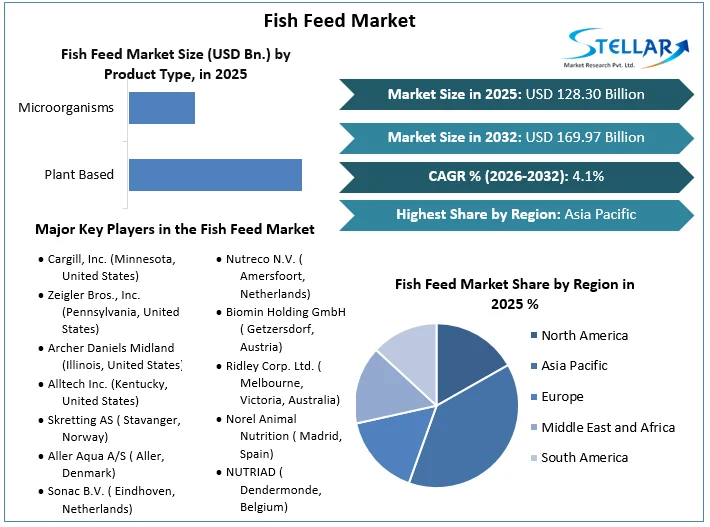
According to Stellar Market Research, the Global Fish Feed Market was valued at USD 128.30 billion in 2025 and is projected to reach USD 169.97 billion by 2032, growing at a CAGR of 4.1% during the forecast period.
What is Fish Feed?
Fish feed is a specially formulated nutritional product designed to provide farmed fish with balanced proteins, lipids, vitamins, minerals, and other essential nutrients. It is commonly manufactured in the form of pellets, granules, flakes, sticks, and powders to meet the dietary needs of different fish species and farming systems.
Modern fish feed formulations increasingly incorporate plant-based proteins, algae, and other sustainable ingredients to reduce dependence on traditional fishmeal and fish oil while maintaining optimal fish health and growth.
𝐃𝐨𝐰𝐧𝐥𝐨𝐚𝐝 𝐅𝐫𝐞𝐞 𝐏𝐃𝐅 𝐁𝐫𝐨𝐜𝐡𝐮𝐫𝐞: https://www.stellarmr.com/report/req_sample/Fish-Feed-Market/1875
Market Growth Drivers
Rising Global Demand for Aquaculture
Growing seafood consumption, increasing populations, and declining wild fish catches have accelerated aquaculture production worldwide. As fish farming expands, demand for high-quality feed continues to rise, making fish feed one of the most critical inputs in modern aquaculture.
Shift Toward Sustainable Feed Ingredients
Environmental concerns and the limited availability of fishmeal have encouraged manufacturers to develop feeds using soybean, corn, peas, algae, and other plant-based proteins. These alternatives help reduce pressure on marine ecosystems while supporting sustainable aquaculture practices.
Technological Advancements in Feed Formulation
Innovations in feed technology are improving nutritional value, digestibility, and feed conversion efficiency. Precision nutrition, alternative proteins, and specialized formulations for different fish species are helping farmers achieve higher productivity with lower environmental impact.
Government Support for Aquaculture
Many governments are investing in aquaculture infrastructure, research, and sustainable farming initiatives to strengthen food security and increase seafood production. These supportive policies continue to drive demand for advanced fish feed products.
Emerging Market Trends
Several trends are transforming the Fish Feed Market:
- Increased use of plant-based proteins
- Algae-based feed ingredients
- Functional feeds for improved fish health
- Precision nutrition and species-specific formulations
- Sustainable feed production technologies
- Reduced reliance on fishmeal and fish oil
These innovations help improve fish growth while minimizing environmental impacts and production costs.
Market Segmentation
By Product Type
The market includes:
- Plant-Based Feed
- Fish and Fish Products
- Microorganism-Based Feed
- Others
Plant-based feed is gaining significant traction due to sustainability benefits and improved ingredient availability.
By Form
Fish feed is available in:
- Pellets
- Granules
- Flakes
- Sticks
- Powder
- Others
Pellets dominate the market because they offer consistent nutrition, easy handling, excellent water stability, and minimal feed wastage.
By Application
Major applications include:
- Aquaculture
- Household
- Others
Aquaculture remains the largest application segment as commercial fish farming continues to expand globally to meet rising seafood demand.
By Distribution Channel
Distribution channels include:
- Direct Sales (B2B)
- Retail Stores
- Others
Business-to-business (B2B) distribution dominates the market, enabling efficient bulk supply to commercial aquaculture operations.
Regional Insights
Asia-Pacific Leads the Market
Asia-Pacific holds the largest share of the global Fish Feed Market, supported by:
- Large-scale aquaculture production
- Strong seafood consumption
- Favorable climatic conditions
- Government investments in aquaculture
- Rapid technological adoption
Countries such as China, India, Vietnam, Indonesia, and Thailand are major contributors to regional market growth due to their well-established aquaculture industries.
Other Regions
North America and Europe continue to invest in sustainable aquaculture technologies and premium fish feed formulations, while Latin America is witnessing increasing aquaculture production driven by export demand.
Market Challenges
Despite steady growth, the industry faces several challenges.
Rising Raw Material Costs
Fluctuations in the prices of fishmeal, fish oil, grains, and alternative protein sources can increase production costs and affect profitability.
Sustainability Concerns
Reducing dependence on marine-derived ingredients while maintaining nutritional performance remains a key challenge for feed manufacturers.
Regulatory Compliance
Manufacturers must meet stringent quality, safety, and environmental standards, requiring continuous investment in research, product development, and sustainable production practices.
Competitive Landscape
Leading companies are strengthening their market positions through:
- Development of sustainable feed ingredients
- Investment in research and development
- Expansion of production capacity
- Strategic partnerships
- Advanced feed formulation technologies
- Innovation in plant-based and alternative protein feeds
Many manufacturers are also focusing on improving feed conversion ratios and reducing the environmental footprint of aquaculture operations.
𝐃𝐨𝐰𝐧𝐥𝐨𝐚𝐝 𝐅𝐫𝐞𝐞 𝐏𝐃𝐅 𝐁𝐫𝐨𝐜𝐡𝐮𝐫𝐞: https://www.stellarmr.com/report/req_sample/Fish-Feed-Market/1875
Future Outlook
The Fish Feed Market is expected to witness stable growth as aquaculture becomes increasingly important in meeting global protein demand.
Key future opportunities include:
- Alternative protein ingredients
- Insect-based and algae-based feeds
- AI-driven feed optimization
- Precision aquaculture nutrition
- Sustainable feed manufacturing
- Expansion of commercial aquaculture in emerging economies
Continued innovation in feed technology and sustainable ingredient sourcing will play a critical role in supporting efficient and environmentally responsible fish farming.
Conclusion
The global Fish Feed Market is a cornerstone of the rapidly growing aquaculture industry, enabling efficient seafood production while supporting sustainability goals. Rising demand for seafood, advancements in feed technology, increasing adoption of plant-based ingredients, and strong government support are driving long-term market growth.
As the industry continues to embrace innovative and environmentally responsible feed solutions, manufacturers that invest in sustainable formulations, advanced nutrition technologies, and efficient production processes will be well positioned to capitalize on future opportunities.
