Key Highlights
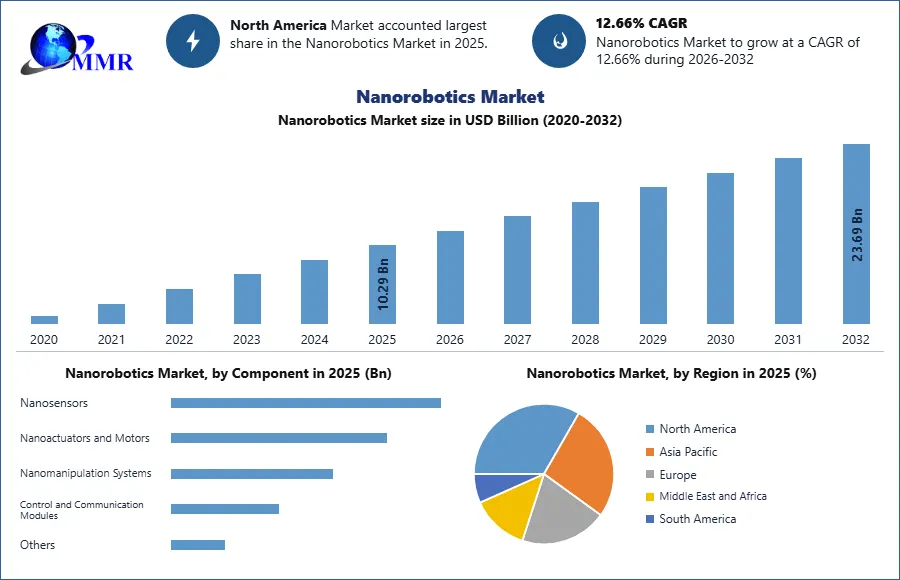
- The global Nanorobotics Market reached USD 10.29 billion in 2025.
- The market is projected to reach USD 23.69 billion by 2032.
- The industry is expected to grow at a 12.66% CAGR from 2025 to 2032.
- Healthcare remains the most promising application area for nanorobotic technologies.
- Nanomanipulators dominated the market in 2025 due to precision and research applications.
- North America held the largest market share due to strong R&D infrastructure.
- AI, machine learning, and swarm robotics are improving nanorobot capabilities.
- High development costs and regulatory challenges remain key barriers.
Why This Matters Now
Nanorobotics is moving from laboratory research toward commercial applications across healthcare, electronics, agriculture, and environmental technologies. The ability to operate at the molecular level creates opportunities for targeted therapies, advanced diagnostics, and highly precise manufacturing processes.
Healthcare is driving investment as pharmaceutical companies and research institutions explore nanorobots for cancer treatment, drug delivery, and minimally invasive procedures. At the same time, semiconductor manufacturers and material scientists are using nanoscale manipulation technologies to develop smaller and more efficient devices.
The market is attracting funding because nanorobotics combines multiple high-growth fields including artificial intelligence, biotechnology, robotics, and advanced materials.
Market Overview
The Nanorobotics Market focuses on robotic systems designed to operate between 1 and 100 nanometers, enabling manipulation, sensing, and movement at molecular and cellular levels.
Unlike traditional robotics, nanorobots provide capabilities beyond mechanical automation by interacting directly with biological systems, materials, and nanoscale structures.
Healthcare represents the largest opportunity area. Nanorobots are being researched for targeted drug delivery, cancer cell detection, tissue engineering, and precision surgery. These technologies aim to improve treatment effectiveness while reducing side effects associated with conventional therapies.
Beyond medicine, nanorobotics is expanding into semiconductor manufacturing, agriculture, environmental monitoring, and energy applications. Nanobots can support precision farming by analyzing soil conditions, improve electronics manufacturing through nanoscale assembly, and assist environmental cleanup through pollutant detection.
Market development is supported by government-funded nanotechnology programs, academic research, and private investment. Initiatives such as the National Nanotechnology Initiative (NNI) in the United States, Horizon Europe, Japan’s nanotechnology research programs, and China’s nanoscience initiatives continue supporting commercialization.
However, high research costs, manufacturing complexity, ethical concerns, and regulatory approval requirements remain significant challenges.
Key Trends Driving Growth
Precision Medicine and Targeted Drug Delivery
Healthcare remains the strongest growth driver for nanorobotics. Nanorobots can deliver drugs directly to targeted cells, improving treatment accuracy and reducing damage to healthy tissues.
Cancer treatment is a major focus area, where researchers are developing nanoscale systems capable of identifying and attacking tumor cells.
AI and Machine Learning Integration
Artificial intelligence is improving nanorobot navigation, decision-making, and autonomous operation.
AI-enabled nanorobots can analyze complex biological environments and optimize responses, creating opportunities for advanced diagnostics and personalized medicine.
Swarm Nanorobotics
Swarm robotics enables multiple nanorobots to work together for complex tasks such as medical procedures and environmental remediation.
This approach increases efficiency by allowing distributed operations at microscopic levels.
Advanced Materials Development
Nanomaterials including graphene, carbon nanotubes, and quantum dots are improving nanorobot performance through enhanced strength, conductivity, and energy efficiency.
These advancements support applications in electronics, aerospace, healthcare, and energy storage.
Government and Private Research Funding
Global research initiatives continue accelerating innovation. Increased funding supports clinical research, prototype development, and commercialization efforts.
Explore detailed analysis, insights, and growth opportunities
Segment Insights
Dominant Segment – Nanomanipulators
Nanomanipulators dominated the Nanorobotics Market in 2025.
These systems provide precise control over nanoscale objects and are widely used in semiconductor manufacturing, materials science research, and biomedical applications.
Their ability to position, assemble, and analyze nanoscale materials makes them essential tools for researchers developing advanced technologies.
The business impact is significant because nanomanipulators enable faster innovation cycles in industries requiring extreme precision, including electronics and healthcare.
Fastest-Growing Segment – Bio-Nanorobotics
Bio-nanorobotics is expected to experience strong growth during the forecast period.
These systems use biological components such as DNA structures, bacteria-based mechanisms, and molecular systems to perform targeted functions.
Their strongest potential lies in healthcare applications, including drug delivery, diagnostics, and regenerative medicine.
For companies investing in biotechnology-driven robotics, bio-nanorobotics represents a high-value opportunity with significant future commercial potential.
Additional Key Sub-segments
By Propulsion
Magnetic actuation remains a major propulsion method because external magnetic fields provide controlled movement inside biological environments.
Chemical and catalytic propulsion technologies continue advancing for autonomous nanoscale operations.
Bio-hybrid propulsion systems are gaining research attention due to their compatibility with biological applications.
By Component
Nanosensors play a critical role by enabling detection and monitoring at molecular levels.
Nanoactuators and motors provide movement capabilities required for precise manipulation.
Control and communication modules are becoming increasingly important as nanorobots become more autonomous.
By Application
Drug delivery remains the leading application area.
Medical imaging and diagnostics continue expanding due to demand for early disease detection.
Environmental remediation applications are emerging as industries explore nanoscale solutions for pollution control and water purification.
Regional Growth Story
North America
North America held the largest Nanorobotics Market share in 2025.
The region benefits from strong biotechnology research, advanced universities, government funding, and technology startups.
The presence of companies such as Thermo Fisher Scientific, Bruker Corporation, and Nanobot Therapeutics strengthens commercialization opportunities.
Healthcare innovation remains the primary driver, supported by investments in precision medicine and advanced diagnostics.
Europe
Europe maintains a strong position through advanced research institutions and nanotechnology companies.
Countries including Germany, the United Kingdom, and Switzerland are investing in nanoscale manufacturing and biomedical applications.
Asia Pacific
Asia Pacific is emerging as a major growth region due to semiconductor manufacturing strength, biotechnology investments, and government-supported nanotechnology programs.
Japan, China, and India are expanding research capabilities, creating opportunities for nanorobotics commercialization.
Middle East & Africa and South America
Adoption remains at an early stage, but investments in healthcare technology and scientific research infrastructure are expected to create future opportunities.
Competitive Landscape
The Nanorobotics Market features a combination of established scientific equipment companies, biotechnology startups, and research organizations.
Thermo Fisher Scientific, Oxford Instruments plc, Bruker Corporation, and Agilent Technologies maintain strong positions through advanced imaging, microscopy, and nanoscale analysis technologies supporting nanorobotics research.
Biotechnology companies such as Nanobot Therapeutics, Ginkgo Bioworks, and Nanovery focus on biological nanorobot applications, including medical treatments and molecular engineering.
Other important players including JEOL Ltd., Park Systems Corp., Imina Technologies SA, Klocke Nanotechnik GmbH, Kleindiek Nanotechnik GmbH, Nanosurf AG, WITec GmbH, EV Group, Smaract GmbH, and Theranautilus are advancing nanoscale instrumentation and manipulation technologies.
Competition is increasingly focused on clinical validation, AI integration, commercialization speed, and scalable manufacturing capabilities.
Recent Developments
- Thermo Fisher Scientific expanded its nanotechnology and electron microscopy portfolio to support nanorobotics research, biomedical applications, and semiconductor analysis.
- JEOL Ltd. enhanced electron microscopy and nanoscale instrumentation capabilities for nanorobotics, healthcare research, and advanced materials analysis.
- Companies continue integrating AI-powered imaging and automated nanoscale analysis systems.
- Research collaborations between universities and private companies are accelerating nanorobotics commercialization.
- Healthcare applications, particularly targeted drug delivery and diagnostics, continue attracting significant investment.
Future Outlook
Companies that successfully commercialize AI-enabled medical nanorobots and scalable nanoscale manufacturing solutions will define the next phase of the global nanorobotics industry.
Analyst Perspective – Dharti Raut
The Nanorobotics Market represents one of the most transformative intersections of biotechnology, artificial intelligence, and advanced engineering. While commercial adoption remains limited by regulatory and manufacturing challenges, rapid progress in precision medicine and nanoscale technologies is shifting nanorobotics from experimental research toward real-world applications.
About Maximize Market Research
Maximize Market Research Pvt. Ltd. (MMR) is a global market research and consulting company that provides reliable, data-focused, and practical business insights. The firm serves a wide range of industries, including healthcare, pharmaceuticals, technology, automotive, electronics, chemicals, personal care, and consumer goods. Through market forecasts, competitive analysis, strategic consulting, and industry impact assessments, MMR helps organizations understand changing market conditions, identify growth opportunities, and make informed business decisions for long-term success.
Contact Us :
2nd Floor, Navale IT Park Phase 3
Pune Banglore Highway, Narhe
Pune, Maharashtra 411041, India
+91 9607365656
sales@maximizemarketresearch.com
